The Engelbart Mural: A Memory for Our Development
It has been 2 months since we decided to start ROCK, Resources for Open Community Knowledge, as a way of sharing knowledge to produce human development. I have stated that the Dominican Republic is 20 years behind from the standpoint of ICTs (Information and Communication Technologies); that the Society of…
It has been 2 months since we decided to start ROCK, Resources for Open Community Knowledge, as a way of sharing knowledge to produce human development.
I have stated how the Dominican Republic is 20 years behind in terms of ICTs (Information and Communication Technologies); that the Information Society in the Dominican Republic establishes that we are in the «Information Age», while globally it is held that humanity is entering the «Conceptual Age».
Personally, I have noticed that the only person informed about this (whether out of advantage or fashion) is President Fernández, who recently used the «Concept» in his public speeches.
¿20 years behind, where does that figure come from?
40 years ago, on December 9, 1968, Douglas C. Engelbart and the group of 17 researchers working with him at the Augmentation Research Center of the Stanford Research Institute in Menlo Park, CA, gave a 90-minute live public demonstration of the online system, NLS, which they had been working on since 1962.

This demonstration is called «Mother of All Demos» (or «La Madre de todas las demostraciones», in Spanish) and where the «Mouse» is one of the elements presented. That demonstration is regarded as one of the modern catalysts in technology, which paved the way for the tools we enjoy today.
But the «mouse» was only one of the many innovations presented that day, including hypertext, object addressing and dynamic file linking, as well as the shared screen that allowed two people in different places to collaborate over a network with an audio and video interface.
Yes, this was in 1968. You can watch the video of the «Demo», courtesy of Stanford University. http://sloan.stanford.edu/mousesite/1968Demo.html
Where does the analysis come from?
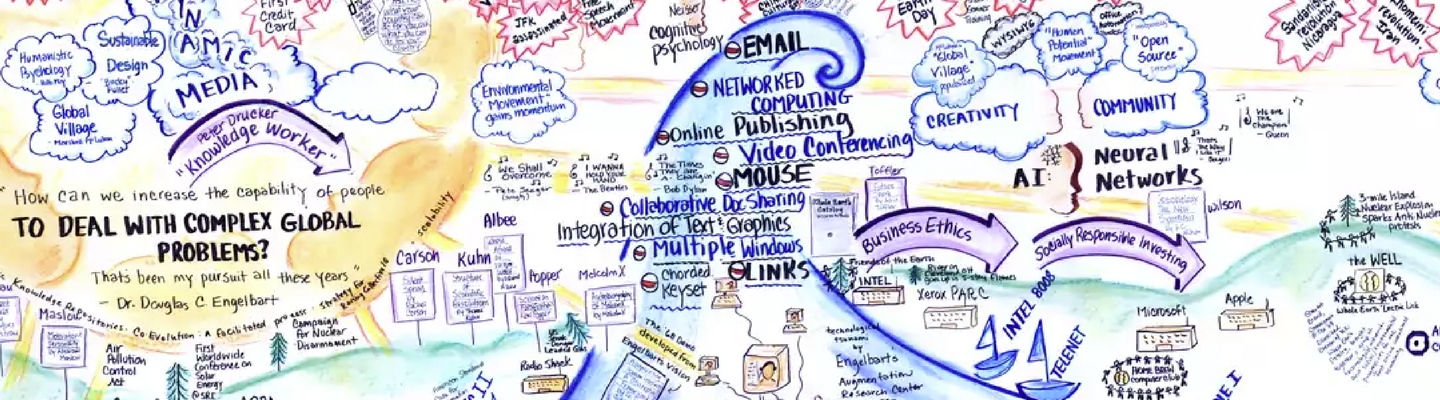
On the 40 anniversary of «La Madre de todas las demostraciones» and in honor of Douglas C. Engelbart, a mural (4 feet by 27 feet) was made that describes the evolution of culture and technology from 1925 to the present, from the perspective of the life of Doug Engelbart, inventor of the computer mouse and other technological advances that changed the world.

If you look closely, we can see in the mural a purple band that specifies the eras of Co-Evolution of «Human Systems» and Tools. There we can clearly see the following data:
- The «Industrial Age» begins in 1935 and ends in 1963.
- The «Information Age» begins in 1964 and ends in 1989.
- The «Knowledge Age» begins in 1990 and ends in 2008 (many do not agree on this date).
- The «Conceptual Age», according to the experts, begins with «the paradigm shift about paradigms».
This mural is very interesting; I had seen it online a few months after it was made. But it was during a visit to Frederick Emam-Sade -when he held the position of Director of FUNGLODE, where I found the Printed Mural in a proportional frame; in fact, our conversation changed the subject, to my astonishment at being able to see the Human Co-Evolution at a single glance.
Yes, it is 20 years behind.
Why do I say it is 20 years behind? It is simple. Although in public statements the President of Indotel, José Rafael Vargas, indicates that we are in the Knowledge Era -which is true, but on the other side, at the helm of the ship, we have the nation's ruler working to break paradigms.
How so? As President Fernández has been saying since last year, we are in a crisis of doctrines and concepts; that is entirely accurate. We are, because we are 5 or 10 years away from the next (social, technological, political… change. Pick whichever you prefer; I will stay with the technological one.) and as a country we are not prepared.
Our first challenge is to guarantee the elements that are fixed variables in the formula we call development. Fixed variables, which are an essential part of the «Industrial and Information Eras»: Electricity and Education.
While Vargas wants to bring society into the «Information Era», through telecenters and «purchases» of equipment, there is no electricity. He wants to reduce the digital divide, but the electricity gap is larger. Is it his fault? No.
It is evident that what our country lacks are concepts; our President has said as much. But the policy has been to teach us to eat like chickens -I mean from the standpoint of the concept. If I want to use a PC, the education system tells us: Uses Windows. But can I think what I can use? No. Our education is geared toward consumption and not toward generating ideas.
La tapa al pomo
From Indotel we see an infrastructure policy. At the conference held at the palace, Hamadoun Touré, Secretary-General of the International Telecommunication Union (ITU) said (something that did not make it into the press releases): that we have as much infrastructure as Korea. True? Honestly, yes. Our technological density is high, and we also like to have the latest equipment, whether out of advantage or out of commission.
We have said it in public: enough is enough of big infrastructure spending that we cannot sustain. Wi-Fi networks that cannot work without a backup generator are of no use. Our development drifts away from us when we have to invest twice as much to guarantee our own power supply.
Our mirror
Engelbart's mural is a mirror that speaks of progress without demagoguery. Some events were isolated and others consecutive, and together they produced exponential progress, but with only one factor in common: Collective intelligence.
There are many affordable ways to place PCs in telecenters, build portals that don't cost millions, and give schools email without spending a single cent: Setting standards, not brands. But those are equations that are not part of Dominican politics; even so, they will persist in the Engelbart mural.