The Dominican Republic as a digital term
Some time ago we picked up again the habit of analyzing trends around the term “República Dominicana”, out of simple curiosity about how our country is positioned digitally, which is reason enough to set up the social monitoring tool.
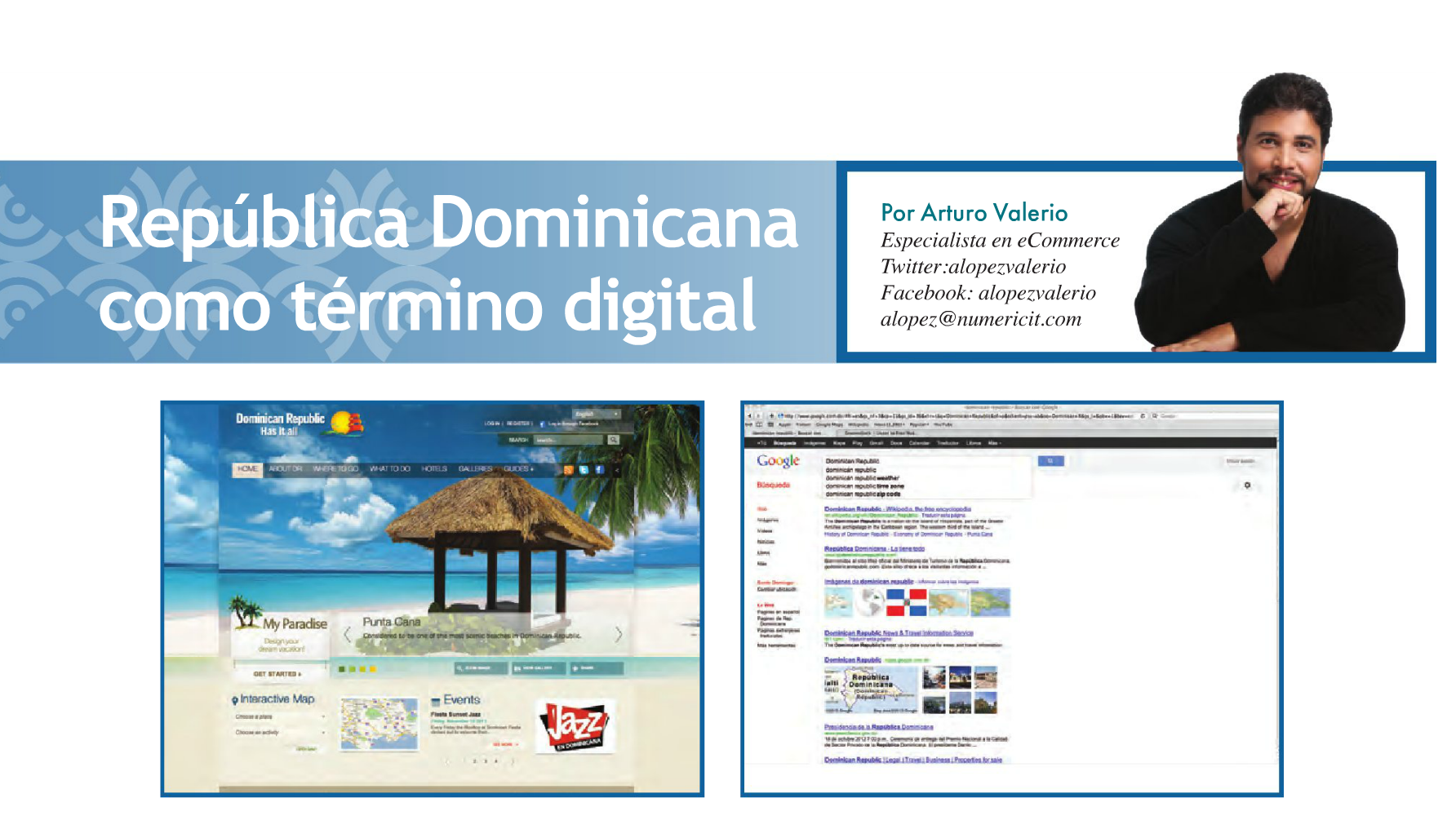
Some time ago we resumed the habit of analyzing trends around the term “República Dominicana” out of simple curiosity about how our country is positioned digitally, which is reason enough to set up the social monitoring tool.
What did we find when searching for “Dominican Republic” and “Republica Dominicana”, respectively?
On Google.com, the term “República Dominicana” is well represented by the ever-perennial Wikipedia link (in the first and second positions), and in third place we are represented by the Ministry of Tourism (godominicanrepublic.com). Thanks to Google's features, we can find a summary or country profile that saves visitors time in learning who we are and where we are located.
By contrast, if we use the English term “Dominican Republic” in the search engine, we again find Wikipedia in first position, along with the country profile that Google offers us. What I still regret is that there is no local reference among the next nine search results.
For those who work in the industry every day, it is well known that ranking for this term is extremely expensive and laborious in terms of Search Engine Optimization (SEO), because it is a high-volume search and, at the same time, there are some 456,000,000 sites that refer to our country and compete to appear among the first 10 results.
If we move on to social networks, taking Twitter as a first sample, we find the opposite effect. When using the term “Dominican Republic”, our first result is the Ministry of Tourism's English-language profile. By contrast, if we use the term “República Dominicana”, the results are conversations that reflect Dominican idiosyncrasy, but no official or commercial account. When we tried the same search pattern on Facebook, the number one social network in the Dominican Republic, we found a pattern different from the previous ones, which we list below:
- The term “Republica Dominicana” returns profiles of local brands in the home page's dynamic search.
- When you broaden the search with the same term, we find community pages and profiles of “popular” Dominicans or profiles related to the person running the search.
- The term “República Dominicana” returns no official page or tourism offer.
- The term “Dominican Republic” returns base profiles generated by Facebook in collaboration with Wikipedia –the same technique Google applies. Only one hotel offer appears.
- When you broaden the search for the same term, you find some personal profiles of people registered to the “Dominican Republic” network and tourism-sector companies that have personal profiles.
We need to consolidate our digital positioning
Search engines such as Google and social networks such as Twitter and Facebook have different algorithms for ranking and presenting results. We will never find homogeneity across these sites. Still, the data do show that, as a country, we are wasting the opportunity to position and consolidate ourselves on the Internet.
The task is simple: the effort we make in Spanish on a search engine or social network, we should apply to English (or another language) and vice versa. Criticism is often directed at how the Ministry of Tourism carries out its digital strategy, but if we look at the data we found, we will see that it is not only the State that is wasting an opportunity, but the private sector as well.
Our great challenge as a society –besides reducing the digital divide– is being able to update our positioning. An example of this situation can be seen in the site dominicanway.com, the only portal on the market produced in eleven languages with relevant information about the Dominican Republic, which is not necessarily among the top search results, a fact that makes us think about the difficulties Dominican companies face with positioning. Both Google and social networks are becoming more complex and advanced spaces. This means that with each passing year it costs more to position ourselves properly.
Written in October 2012 for Revista Bohío.
Published in Revista Bohío #170 (October-November 2012).