UBER: an experience on another level
One of the advantages any citizen of the world has when leaving home is the chance to live new experiences. Recently I decided to try the popular Uber app, which apparently will soon be available in the Dominican market.
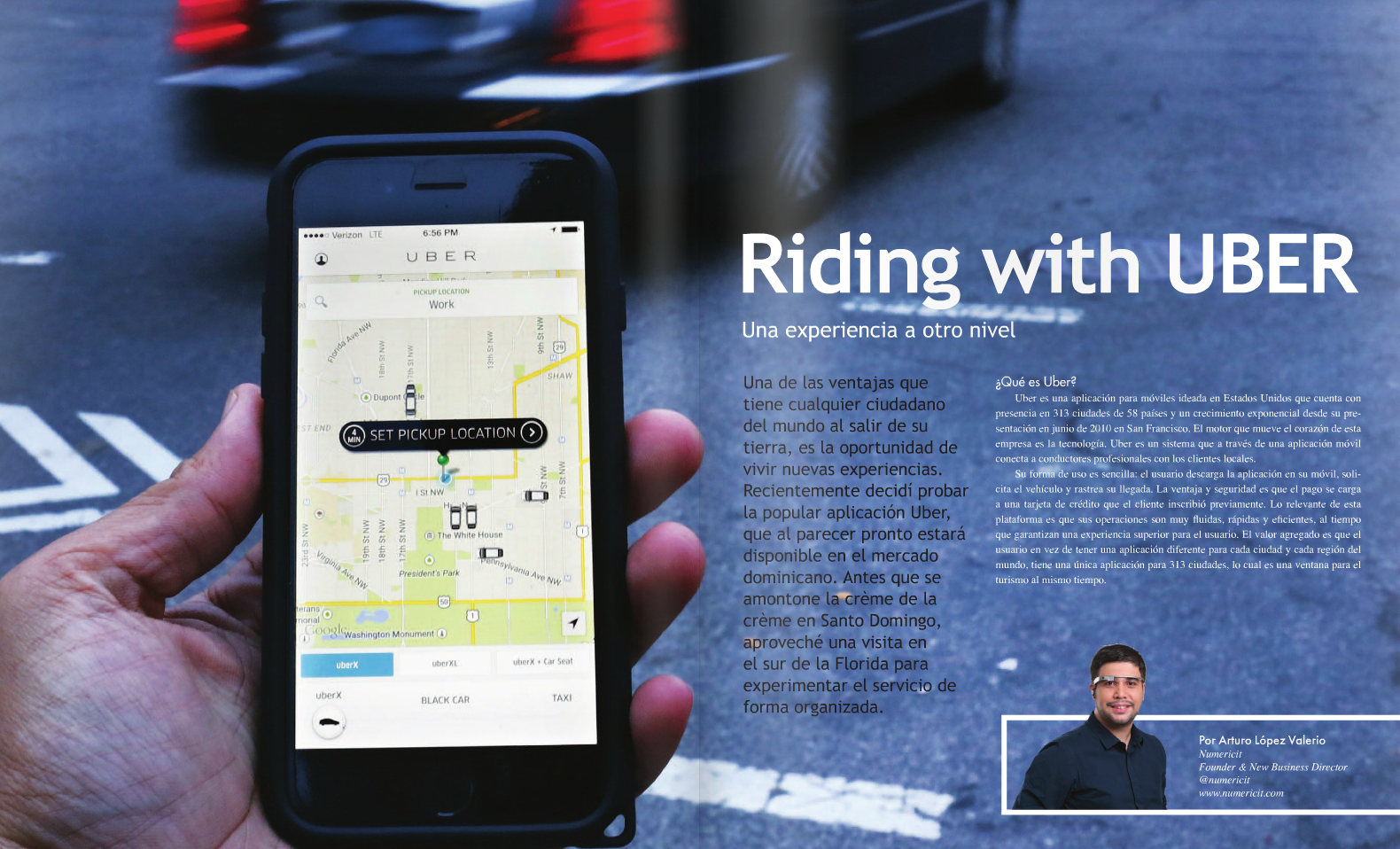
One of the advantages any citizen of the world has when leaving home is the chance to live new experiences. Recently I decided to try the popular Uber app, which apparently will soon be available in the Dominican market.
Before the crème de la crème piles up in Santo Domingo, I took advantage of a visit to South Florida to try the service in an organized way.
What is Uber?
Uber is a mobile app conceived in the United States, present in 313 cities in 58 countries and growing exponentially since its launch in San Francisco in June 2010.
The engine driving this company is technology. Uber is a system that, through a mobile app, connects professional drivers with local customers.
It is simple to use: the user downloads the app on their phone, requests the vehicle and tracks its arrival. The advantage, and the safeguard, is that payment is charged to a credit card the customer registered beforehand.
What matters about this platform is that its operations are very smooth, fast and efficient, while guaranteeing a superior user experience. The added value is that, instead of having a different app for each city and each region of the world, the user has a single app for 313 cities, which is also a window for tourism.
In no country does Uber own the vehicles or directly employ the drivers. The drivers are people who work independently (freelancers). What Uber does is intermediate.
In multiple markets it has been argued that Uber must operate –or stop operating– as a transportation company. That is the same as saying that a company like Alsuper.com.do –for example– is a supermarket.
For the readers' information: Uber is not a transportation company, and Alsuper.com.do is not a supermarket. Technology and the internet have allowed new business models to emerge.
Both companies are intermediating in a market with deficiencies, and through technology they have managed to meet needs that consumers have.
Uber availability in South Florida
The arrival of services like Uber and Lyft in South Florida has been a long battle, now about 16 months old. Counties such as Broward and Palm Beach have yielded to pressure from consumers who want to use the service, and have considered creating a regulatory framework for this type of company.
Miami-Dade County has also yielded, according to statements by its mayor, Carlos Giménez, who has promised a regulatory framework for the “near future”. “I will bring taxi drivers into the 21st century”, Jiménez said. “I am not taking Uber back to the 20th century”. So far, there are reportedly around 10.000 drivers working for Uber in Miami-Dade.
Meanwhile, taxi permits –called medallions– have risen in value to US$100.000 in Broward and US$300.000 when bought from a previous owner, according to the Miami Herald last month.
A 5-minute ride
I was at Kendall Mall, near 88 Street, enjoying a good Starbucks coffee. When I finished, I checked the Uber app for vehicles available in the area (they call it Eyeball) and chose the one with the best pickup time (about two minutes).
Once you select the vehicle, you can immediately see the make and model, who the driver is (photo included) and the driver's rating. I got a Nissan Altima and the driver was named Carlos; his rating was –up to that moment– 4,4 stars.
When I enter my destination, I can pay the estimate (in this case I was going to 62 Street) of US$ 5,08 with my credit card. Once the fare was paid, I had the option of contacting the driver by SMS or phone call. This was a great help, because I could tell him exactly where in the mall I was; GPS is still not that precise.
The distance took five minutes to cover, which gave me time to get to know Carlos, who is Cuban and studies Medicine at the University of Florida. His vehicle was in excellent condition. He told me that Uber fit his lifestyle perfectly, because few jobs offered him the flexibility he needed to continue his studies.
This shows us that the trend of the “sharing economy” is a reality that affects the lives of many people around the world. Traveling with Uber was a new experience and, at the same time, a lesson that technology can improve people's lives and solve needs that we still have as a society. Bravo to Uber, and I hope Carlos does well.
Published in Revista Bohío 188, November 2015.