Reading the data: the essence of journalism today
SIP meeting in the Dominican Republic: panelists say news websites still treat users as strangers.
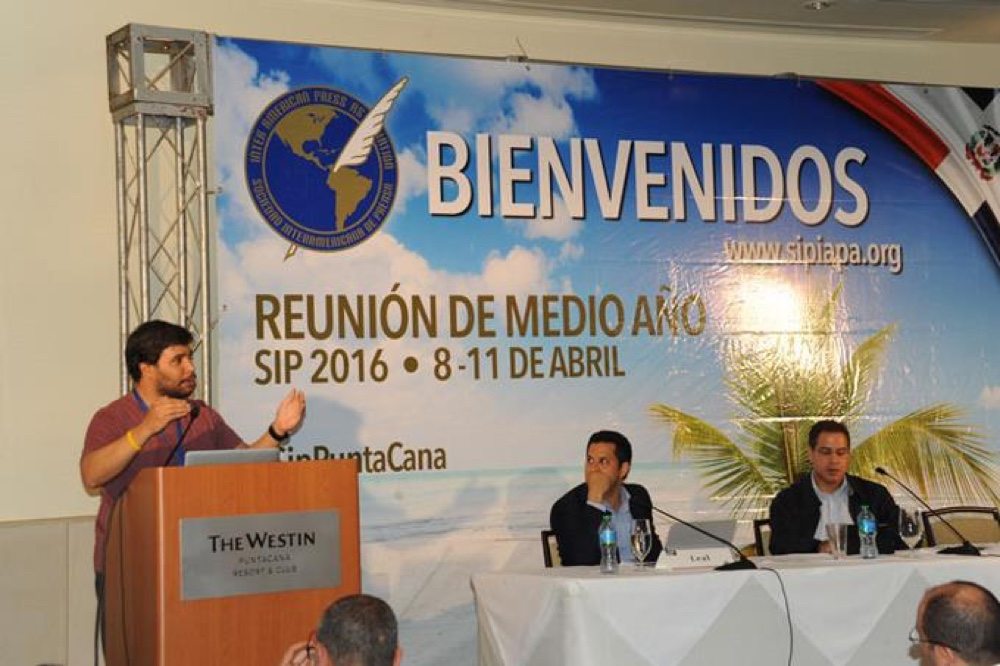
SIP meeting in the Dominican Republic: Panelists say web portals keep treating users as strangers.
Written by Juan Eduardo Thomas, Listín Diario.
The idea that may dominate the conversations between Venezuelan Saúl Leal and Dominican Arturo López Valerio is constant change.
Saúl carries 108 million followers on his back with his “Yo amo a mi familia” portals, and Arturo understands better than anyone the need to capture more and more information every day about the users who visit news portals, as a real quality add-on to advertising sales.
Saúl Leal has a working method that has delivered results: analyze the data his audience leaves behind and, once he finds response patterns, repeat the hit with his articles. For him, content that gets no “likes” on Facebook, that is neither commented on nor shared, works.
And he is so clear on this that when an article is not read, the writer is notified to rework the text until they find the key in the people, in their attention, in the huge chain of recommendations and spread. And to achieve that, he is clear about what he does not need on his websites: journalists.
“If we generate good content (highly shared and commented on) Facebook becomes our partner (companion), and we don't have to pay Facebook to promote our content; rather, they pay us”, says the founder of the “Yo amo a mi familia” websites.
Arturo López Valerio understands that more information can be extracted from audiences than the media use today for their sales. It is the opportunity, Arturo says, to understand people's behavior, so that audience data is no longer based on demographics.
When news media can give their advertisers more information about the users who read them, when they can provide data on readers' behavior, then it will be real added content, one that will expand the possibilities of those same clients.
One thing that worries him is that web portals keep seeing users as strangers, as first-time visitors, when in most cases the opposite is true: the audience is returning. His proposal is to personalize how those users are treated.
He also proposes not looking at traffic as unique users, but starting to tag it to obtain new information. The idea is to know what the unique user does on news media websites, where they move, what they look for, what their behavior is within the site.
Leal and López Valerio spoke at the workshop “Social Media and Millennials”, during the SIP semiannual meeting held in Punta Cana, La Altagracia.
They analyze media consumption patterns
Arturo López Valerio and Saúl Leal, experts in data analysis and content creation, focused on explaining who “millennials” are and what their information consumption patterns look like, along with a cautionary look at “Generation Z”, which is taking shape in our homes and whose defining characteristic is the search for opinions that give value to its concerns.
That brought up the rise of Snapchat as the predominant social network among the new generations, marked by a profuse migration of users from other social networks.
At that point, Dominican Arturo López stepped in to explain that this migrating behavior among social network users is natural, and that it usually happens as a kind of protection of their space.
He explains it with the examples of young people who fled from Facebook to Twitter, and from there to Instagram.
Of course, in every case there was the presence of their parents or of people outside their circle, which pushed them to move and find new habits. It is something the media will have to live with, he says.