Candidates can spend up to US$15 thousand a day on Google advertising
The amount falls within the range of prices that are set to be charged, according to a specialist.
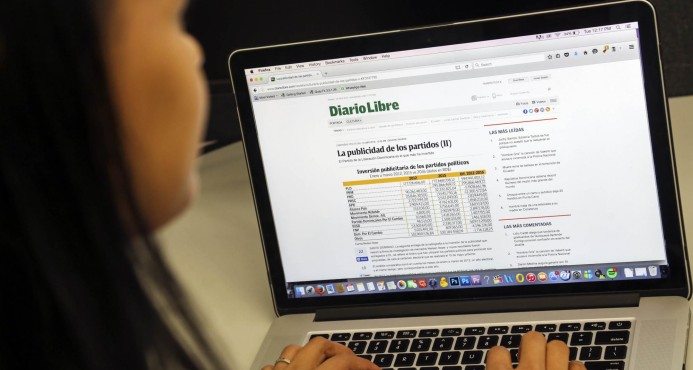
The amount falls within the range of prices that are meant to be charged, according to a specialist.
SANTO DOMINGO. While browsing a cooking recipe website, a banner appears urging users to “embrace change” and vote for David Collado, candidate for mayor of the Distrito Nacional. A few 10 seconds into a YouTube video of baseball player Johnny Cueto, an ad pops up claiming that Miriam Cabral, of the PLD, is the ideal congresswoman for the capital's first district. While playing on a cell phone, an image of President Danilo Medina appears on the screen promoting his reelection.
These are examples of the digital advertising, delivered through Google, that Dominican politicians use in their election campaigns. Some internet users interviewed by Diario Libre consider it invasive.
This constant penetration comes at a high cost. Some can pay US$5 thousand for a day or up to US$50 thousand for a month, according to Arturo López Valerio, an e-commerce specialist and CEO of Tabuga, a company that is a Google partner in monetization.
“Anyone can achieve it if they have a big budget; when we talk about a big budget, we are talking about more than 10 thousand dollars a month, even reaching 50 thousand”, López says. He also explains that with this investment the candidate can reach any device, including “Smart TVs”.
López points out that candidates can use an aggressive advertising mechanism called “Blast” to appear for 24 hours across the national territory, which generally costs between US$5 thousand and US$15 thousand a day. “I don't doubt that one of the candidates, when he wants a strong presence, if he is going to give a speech, whatever it is, will pay for this tool that Google makes available to any advertiser”, he says.
A study of advertising investment behavior by the market research firm Nielsen Ibope, published last week in Diario Libre, concluded that in the first three months of 2015, the sector that has received the most advertising money is television, followed by radio stations, cable systems, outdoor, newspapers and the internet.
According to the analysis, between January and March 2015, the ruling Partido de la Liberación Dominicana (PLD) was the political organization that invested the most in advertising overall, with RD$772.6 million, followed by the Partido Revolucionario Moderno (PRM) with RD$295.8 million and the Partido Revolucionario Dominicano (PRD) with RD$32.3 million.
How is advertising placed on Google?
López explains that Google has two ways of placing ads. One is known as “display” advertising, which consists of visual formats called “banners” or headers.
They are placed by uploading a creative piece that Google distributes to a network of sites that allow these promotions to be placed, and it shares a percentage of the clients' investment with the media outlets that display them.
The other is known as “search marketing”, which are the ads that appear in search engines. “When you search for a word, in the results (the ad) appears at the top or on the right side of the search engine”, López says.
The specialist explains that the internet giant has two ways of activating an ad: through an agency or by self-service. The latter, he says, has been the most used since 2004.
A campaign without a filter
López observes that some candidates in the general elections of next May 15 sometimes cover an unfiltered field of penetration when they advertise through Google.
“My criticism is that they are putting the campaign out to the general public, that is, they are showing up for children in their little games”, he says. “Digital platforms allow you to filter the audience, and the voting public is over 18 years old, so the audience segment has to be people over 18”.Arturo López Valerio
He understands that this lack of a filter wastes part of the budget and invades an audience that is not the target.
He explains that users can report out-of-context ads to Google by clicking the upper right corner of the ad. There they can indicate whether what they saw seems disrespectful, inappropriate or of no interest to them. The tech company will review the report and, according to López, will notify the advertiser or may stop showing the promotion.
Source: Diario Libre