Mobile payments: their options keep multiplying
Financial transactions available through smartphones (mobile payments) are diversifying and giving users fast, secure, low-cost methods.
Financial transactions available through smartphones (mobile payments) are diversifying and giving users fast, secure, low-cost methods.
Smart mobile devices are considered the spearhead of the revolution in the financial market worldwide.
The trend is clearly visible in the Dominican Republic, where smartphones (an English term) account for 51% of active mobile lines at the end of 2015, exactly 4.5 million units, according to GSMA Intelligence.
To understand the impact of this technology in the country, it is necessary to look at the Multi-Purpose Household Survey (Enhogar, 2015), published by the National Statistics Office (ONE), which indicates that 85% of households connected to the internet do so from a mobile device.
Digital wallets give users a fast, secure, low-cost method to use, secure and send money over the internet from their mobile device.
The evolution is clear and even ironic: after financial institutions invested large budgets to replace credit card technology, users have adopted their phones as their financial instrument.
The study Financial Services Technology 2020 and Beyond: Embracing disruption by PricewaterhouseCoopers (PwC) shows that almost half of US millennials prefer to pay small amounts with their phones rather than in cash.
The same report introduces stronger indicators than the previous one on retail banking published last year; digital wallets represent the evolution of the traditional wallet and are at the center of the battle between traditional financial service providers and disruptors, or fintechs.
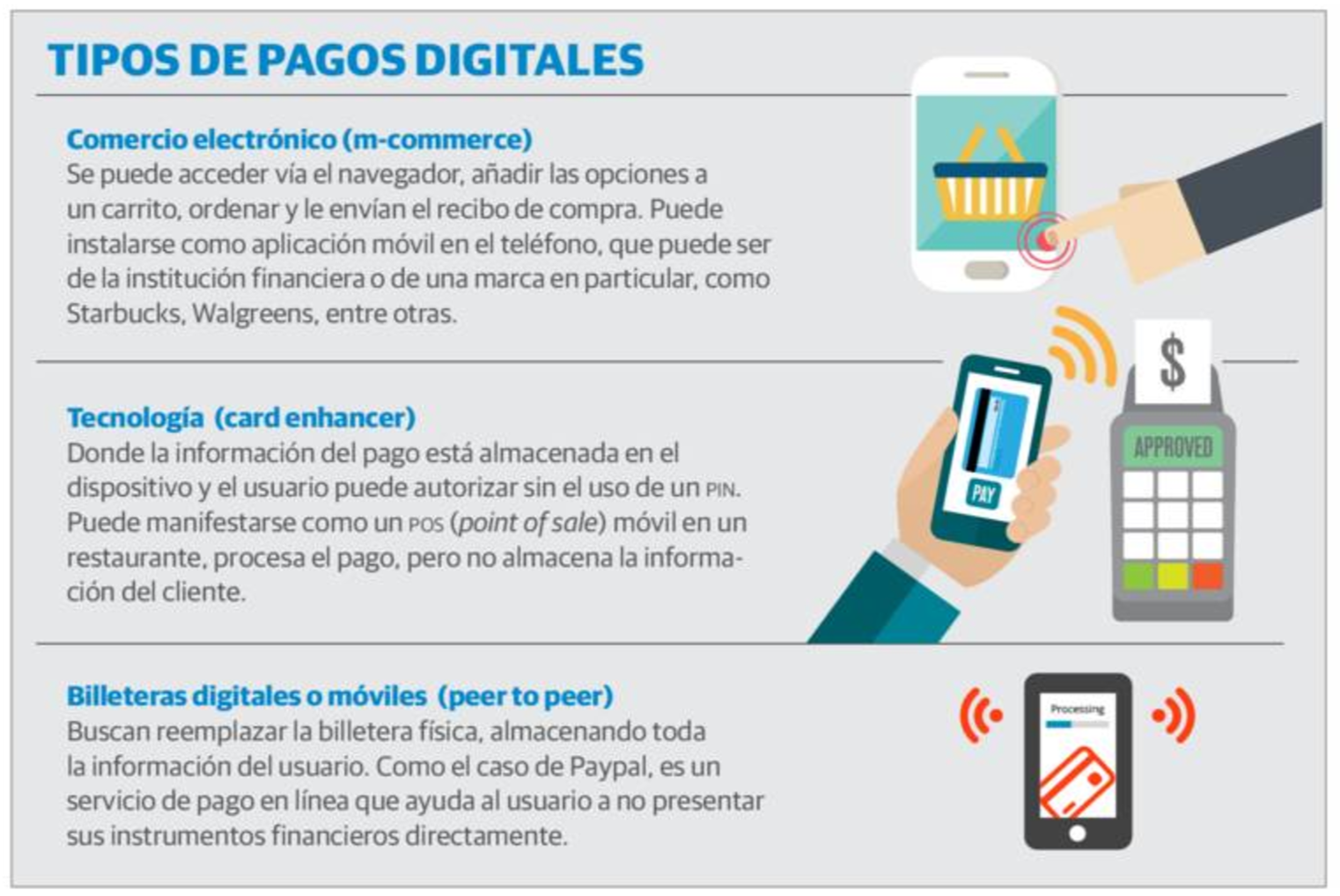
The digital payments ecosystem is split across multiple technologies that have evolved over time but are all active at the same time.
This is a challenge for merchants, since at some point users may prefer a form of payment that is not available, which becomes a barrier to sales and customer satisfaction.
Among these technologies are commerce, or e-commerce, contactless technology (contactless) and the mobile wallet.
US$25,000 million is estimated to be generated by the Internet of Things (IoT) as a substitute for mobile payments per year 2020.
With the advance of fintechs, mobile payments are no longer limited to the smartphone or the tablet. This is thanks to the technology applied in beacons such as Bluetooth Low Energy (BLE), which send one-way signals at predefined intervals, allowing a business to detect the customer and charge a predefined account.
Examples include PayPal's beacon and iBeacon. The evolution continues with near field communication (NFC). This feature allows a transaction simply by bringing the mobile device close; the information is stored on it and authorizes the purchase of goods or services. Other examples are Apple Pay, Android Pay and Samsung Pay.
10 per month is the average number of transactions made by an active user in the Dominican Republic, versus a global average of 3.5 monthly transactions.
Businesses can enable BLE and NFC to connect to mobile devices. Keep in mind that BLE can be used for coupons because the connection is continuous, while NFC is best activated for one-to-one interactions, such as payments at the checkout.
Mobile payments in the Dominican Republic
The history of mobile payments in the Dominican Republic has been different. The SMS trend at the beginning of the millennium did not affect the financial market as it did elsewhere, when it was thought that telecom companies would be the banks of the future. Despite the use of technologies such as PayPal, the catalysis, or transformation, of the market took place in 2010, with the arrival of tPago.
For Manuel Alejandro Grullón, executive president of GCS Systems, the company that markets tPago, the Dominican Republic is a regional benchmark because of the success of the existing solutions, above all in transactionality; even more so considering that in this country approximately 30% of banked users have access to a mobile payments service.
«In this scenario tPago has played an extremely important role, putting new tools in users' hands to manage their financial lives and offering the country a leading solution, capable of playing a major part in matters such as financial inclusion», says Grullón.
tPago's performance in figures is impressive: in its first year of operation the system had more than 135,000 users, and it now benefits more than 600,000 Dominicans. Since its launch, more than 50 million transactions have been carried out, for more than US$300 million.
One of the pillars of the tools' success is their ecosystem which, according to Grullón, «is made up of the 10 of the country's main banks, more than 80,000 affiliated merchants and the main telecommunications companies, thus covering 98% of the Dominican Republic's mobile phone market».
The catalysis induced by tPago caused the market to start filling up with other solutions, such as Orange m-peso and e-fectivoMóvil from the telecom operator Claro.
Enter Paypal
In the year 2015 Paypal formally landed in the Dominican market hand in hand with Banco Popular, providing an alternative for users who make transactions internationally and want to transfer the balance of their virtual wallet to their local account. The official number of Dominicans who use the tool is still a matter of speculation, but the figure is estimated at about 500,000 users.
Azul strikes back
A year later, the Dominican Republic became the second country in the Caribbean to introduce NFC technology, through AZUL, the commercial brand of Servicios Digitales Popular. Rollout to the market began with the restaurant chain Wendy’s, the first local business to accept contactless cards.
54% of Dominicans over 12 years old use the Internet at home, according to the ONE.
In retail, this feature allows a transaction to be made simply by bringing the mobile device, or the credit or debit card, close to the payment terminal, with no need to insert or swipe it. The card must also have this technology, which in the country is currently found only on Popular Bank credit cards. Unofficially, users of Apple Pay, Android Pay and Samsung Pay can make their transactions on the terminals.
Paradigm shift
The survey carried out by Boston Retails Partners in the United States (2015) reveals that 40% of businesses accept Paypal, 60% would accept Apple Pay within the next two years and 31% Google Wallet.
In the opposite context, Paypal is not accepted as a means of payment by local businesses. By contrast, mobile solutions such as tPago are available today at 80,000 physical points. Consider also the 4,401 establishments authorized as banking agents, according to the Superintendencia de Bancos, which exceed the total number of bank branches across the country.
As time goes by, technology empowers retail more, and that mythical separation between online and offline no longer exists. We have a great opportunity to embrace concepts such as data management process (DMP) to centralize consumer data; cloud services to operate from anywhere; and business to business (B2B) to enable dynamic comparison among suppliers.
There are also other concepts, such as business to consumer (B2C) to learn, at an individual level, the user's mobile devices and wearables; and bring your own device (BYOD), which enables a fully remote business, together with third party big data models, none of which should be ignored by today's business community.
Digital platforms have become a cross-cutting component of the physical world. Every company must build the technological context that maximizes its relationship with its customers.
A unique relationship is built over time; a hard thing to achieve with a turnkey solution and a few months on a schedule.
Published in Forbes Magazine, October 2016. Photograph courtesy of Alejandro Escamilla (alejandroescamilla.com).