‘Computer skills’ are going from bad to worse
In 33 rich countries, only 5% of the population has high-level (computer skills), and only a third of people can complete tasks of medium complexity.

In 33 wealthy countries, only 5% of the population has high computer-related skills (computer skills), and only a third of people can complete tasks of medium complexity.
A recent study has quantified the gap between the ‘broad population’ and the ‘tech elite’.
The data were collected from 2011 to 2015 in 33 countries and published in 2016 by the OECD (Organisation for Economic Co-operation and Development, a club of industrialized countries).
A total of 215,942 people were tested, with at least 5,000 participants in most countries.
The large scale of this study explains why it took a few years to publish the results.
The research aimed to test the skills of people aged 16-65, the age range the report calls «adults».
While it is true that people over 66 are rare in the workforce (and therefore of less interest to this workforce-oriented project), they are an important user group for many websites.
The work of firms such as Nielsen Norman Group, with users over 65 has found many important usability problems for this age segment, which often has lower technology skills than younger users.
Therefore, when evaluating the OECD results, we must remember that the full user group has lower skills than the study data show.
‘Computer skills’ levels
The researchers defined 4 proficiency levels, based on the types of tasks users can complete successfully.
For each level, here is the percentage of the population (averaged across OECD countries) that performed at that level, along with the report's definition of what people at that level can do.
-
«Below level 1» = 14% of the adult population
An example of level 1 is: «find all the emails from John Smith».
-
Level 2 = 26% of the adult population
An example of level 2 is: «you want to find a document about sustainability that John Smith sent you last October».
-
Level 3 = 5% of the adult population
An example of level 3 is: «you want to know what percentage of the emails John Smith sent last month were about sustainability».
-
Cannot use computers = 26% of the adult population
The numbers for the 4 skill levels do not add up to 100% because a large proportion of respondents never attempted the tasks, being unable to use computers.
In total, across OECD countries, 26% of adults could not use a computer.
‘Computer skills’ by country
We have to keep in mind that system design is not being done with OECD member countries in mind.
They are only designing for the rich, privileged country where they probably live. Jakob Nielsen.
The conclusions do not change much (whether the country is poor or rich), even when we look at the richest countries, as the following chart shows (sorted in ascending order by the number of people at the highest skill level).
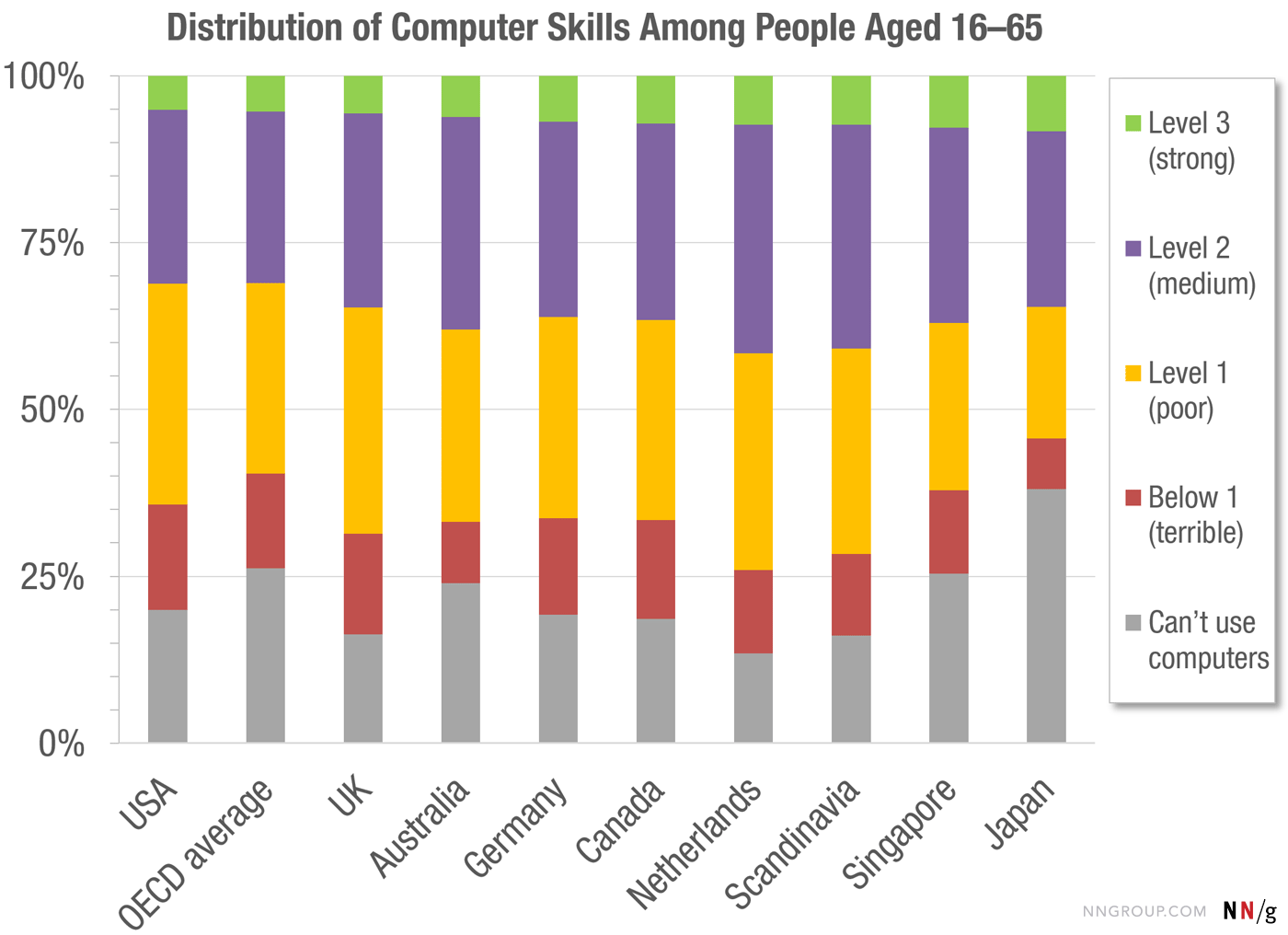
You may be in the top category of computer skills, that is, level 3. I just want to sketch the picture:
- In the United States, only 5% of the population has these high computer skills.
- In Australia and the United Kingdom, 6% is at this level;
- In Canada and across northern Europe, the number rises to 7%;
- Singapore and Japan do even better, with a -3 percentage of 8%.
Toward a mobile world with fewer skills
We have strongly criticized the fact that the accelerated push toward mobile devices is producing more consumers.
Artificial Intelligence will be displacing the ordinary citizen from the skills needed to master a computer.
They will use a complicated interface even less, and a ‘nice’ one even less.
For this reason, —although we do not have ‘official figures‘, WhatsApp is the most widely used interface locally, for the following reasons:
- Little or no navigation is required to reach the information or commands needed to solve the problem.
- Few steps and a minimal number of operators.
- Solving problems that require the user to apply only explicit criteria (without implicit criteria).
- Few monitoring demands (for example, having to check progress toward the goal).
- Identifying the content and the operators through a simple match (with no need for transformation or inference).
- There is no need to contrast or integrate information.
Those are characteristics of a Level 1, a major pending task in closing the digital divide.
It is not only infrastructure; rather, it is digital transformation.
Photograph courtesy of Carl Heyerdahl (carlheyerdahlphotography.com)