Sentiment Analysis Through Comments
When a marketer opens a brand's door to social media, there are several angles or variables to keep track of. One of them is Sentiment Analysis.

When a marketer opens a brand's door to social media, there are several angles or variables to keep track of, and one of them is Sentiment Analysis.
Through comment analysis we can measure the sentiment of our users' conversations and understand —through a semantic reader— their opinion on different topics.
Sentiment Analysis reviews, one by one, the comments made on Facebook posts to determine whether they were: very positive, positive, negative or neutral.
With this type of tool we get a closer idea of how much users love our brand and, as a result, we can make decisions to improve our conversations.
In the digital analytics market we find all kinds of tools that can help us collect the necessary indicators, notably the following: Sysomos, BrandWatch, Trackur, IBM, Hootsuite, among others.
Benefits of sentiment analysis
- Understand the conversation from an emotional point of view.
- Make decisions to build response strategies on social media.
- Identify which of our followers are satisfied and which are dissatisfied, in order to then launch campaigns and services targeted at them.
- Find out whether certain topics generate negative interactions, in order to then improve the conversation.
- Get to know our community.
Sentiment analysis measurement in Latin America
For several years now, the social conversation measurement tool TopicFlower has been working to provide precise key indicators on the interaction of a community across multiple social networks.
From the province of Córdoba in Argentina, this startup incorporates multiple features.
We are currently measuring 50 brands in the Dominican market with the tool. This way we fulfill our mission of understanding the conversations that take place on social networks, in order to build user archetypes that help our clients.
Exporting your reports
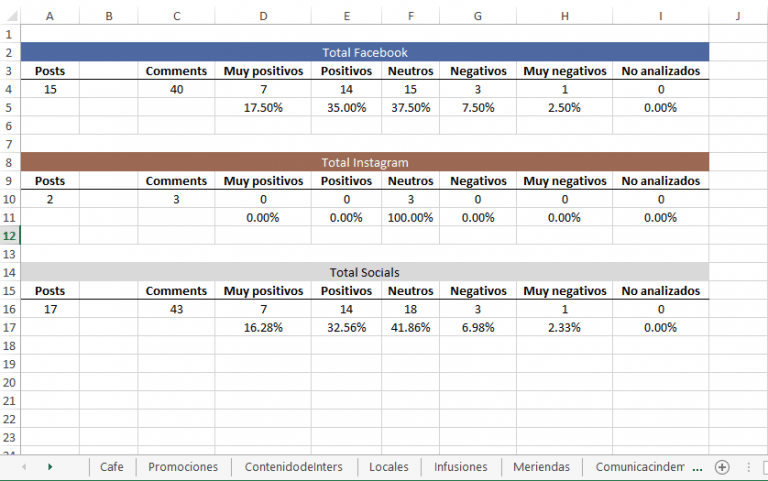
The system lets you export the report to Excel to work on the necessary data cross-tabs, mainly a distribution of sentiment for each social network. The image above shows an example with Facebook and Instagram.
One interesting feature lets you correct the artificial intelligence's errors, since most APIs work for the English language.
Our friends at TopicFlower have managed to refine their reading, delivering satisfactory results.
A very peculiar dashboard
Topicflower has a dashboard that lets you visualize social conversations through a flower diagram, or Nightingale Rose.
With the diagram, marketers can sort interactions into categories and topics to group the different elements of their social strategy.

The indicators for each category and topic are represented as spheres called Pollen, and it also includes a filter for the “Comments Sentiment Analysis“. By clicking on each Pollen, you can see the list of people who commented on the topic.
- Each color represents the type of comment.
- In the green Pollen, we see the positive and very positive comments.
- In the red one, the negative and very negative ones.
- And in the gray one, the neutral ones and those not yet analyzed.
- In addition, the outline depends on the social network.
- Blue for Facebook and brown for Instagram.

Without a doubt, the way digital tools evolve shows the inventiveness of those working in social media, mainly when it lets marketers get a deeper understanding of their community.
Findings in the Dominican market
Although I cannot provide names or direct details of the brands I manage —given nearly 250 years of accumulated signed confidentiality agreements, I will share some findings I have been able to uncover from consumer behavior patterns among Dominicans on social media.
- Reactions are misused. In the records of more than 32,000 posts processed in the 2016, we first noticed that 20% of Facebook reactions matched the comments made on the posts. Reactions such as sadness and anger are mostly used ironically.
- Service brands do not answer uncomfortable questions, which generates more negativity. Recently in the mutability of digital marketing we mentioned that community managers avoid responding to negative comments, and this trend shows in the sentiment of the comments.
- Dominican users have many doubts. The questions —if we separate the genuine ones from those with venom— are neutral, since they seek an answer in order to then define an emotion. Practically 30% of the sentiment in Dominican users' comments consists of doubts that brands must answer.
We have more information available, which we will share soon in an infographic. Interested in the information? Write to me to talk about the topic.
I'm sharing a video about the features of Sentiment Analysis.