Original Content, a Convenient Bet
When Netflix reported its fourth-quarter results last Wednesday, it became clear that the video streaming and original content provider can look back on a fairly successful year.

When Netflix reported its fourth-quarter results last Wednesday, it became clear that the video streaming and original content provider can look back on a fairly successful year.
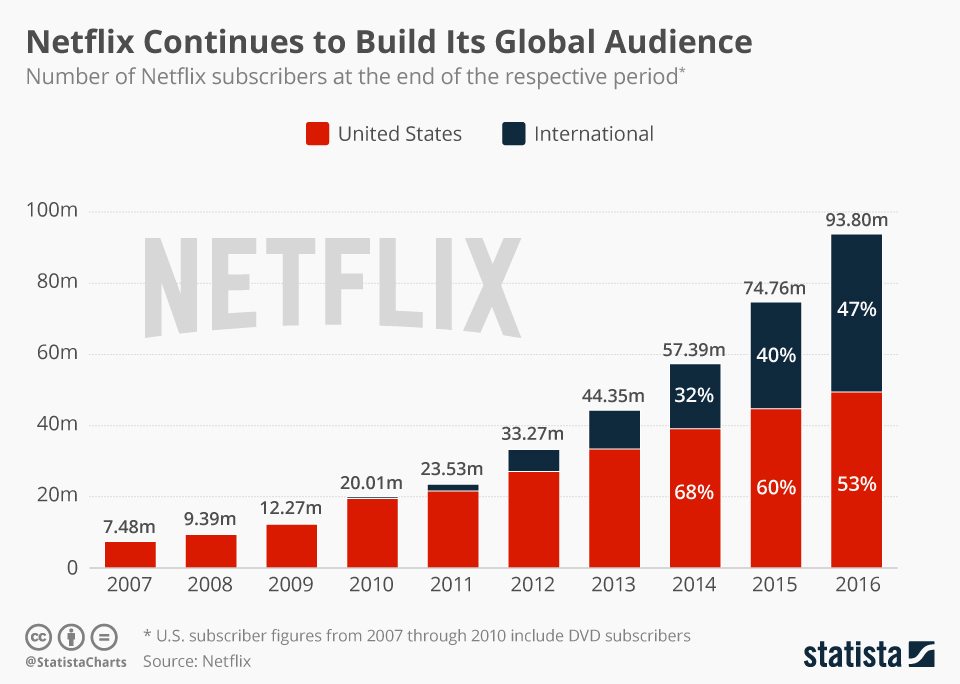
Having made its service available in 130 additional countries 12 months ago, 2016 was a year in which Netflix truly went global.
As its results show, the company added US$19 million in subscribers in 2016, 14 of which belong to the international market.
International subscribers now account for 47 percent of Netflix's subscriber base and will likely surpass subscribers in North American territory this year.
Original content as the recipe for success
Through 2017, Netflix will continue to invest heavily in original content to attract new subscribers, a strategy that appears to be paying off.
Including original and licensed content, Netflix plans to invest more than US$6 billion in programming this year, 20 percent more than last year's content budget.
Netflix quickly became a content creator, earning 54 Emmy nominations last year. ??
Netflix surpasses DVD/Blu-ray sales
Another relevant development marking a milestone in the evolution of digital formats for home entertainment is the increase in video streaming subscription revenue —the first time it has surpassed DVD/Blu-ray sales in the United States.
While American consumers spent US$6.230 million on subscriptions to services like Netflix (as of 2015), DVD and Blu-ray sales fell 9,5 percent, to US$5,499 million, according to the firm's year-end report Digital Entertainment Group.
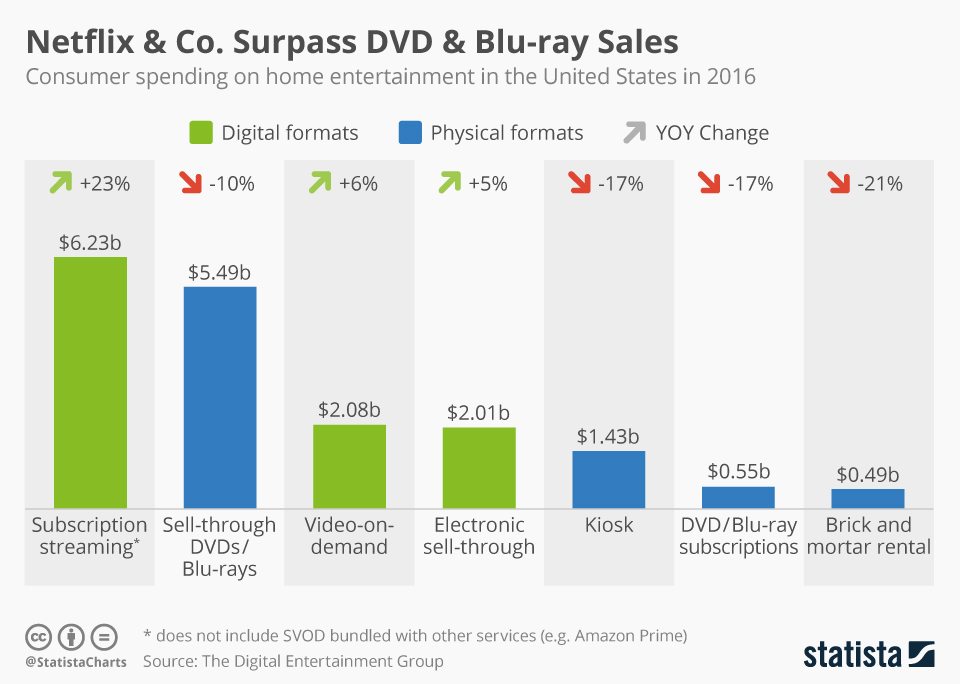
Looking at the home entertainment market as a whole, it is clear that the future of video distribution is digital.
While consumer spending on streaming subscriptions, à la carte and electronic sell-through grew by 2016, all physical formats, both for sale and rental, suffered double-digit declines.
Digital business models now account for 56% of home entertainment spending and could soon surpass revenue from the box office to become the largest source of revenue for the entertainment industry.
A convenient bet
Hundreds of movies disappeared from Netflix over the course of 2016, as a result of the streaming subscription service's decision to end licenses for key content owned by studios and distributors.
The term «a Netflix original production» has become synonymous with quality.
The company has reported that, so far this year and last, it has produced some 600 hours of original content and aims to raise that figure to 1,000 hours this year.
The push for original content has gained momentum thanks to the agreement with the BBC, the British company with a tradition of producing short series (mini-series), a favorite format among Netflix users. They understand that HBO could follow suit and co-produce series for its audience.
The strength of the global bet lies in removing distribution barriers for users. For this reason, the company is eliminating content contracts that carry geographic restrictions.
One example is the addition of Brazilian productions —the sci-fi series called «3%», aimed at a Portuguese-speaking audience, but which has turned out to be a surprise for the North American audience, who have added it with pleasure.
All in all, the open, multilingual vision is generating major dividends.
Photo courtesy of Frank Okay (frankokay.com)