Entrepreneur 10%, projects 20%
The typical entrepreneur assumes that to get an idea off the ground, they must work on it full time and invest a large sum of money to create their company. This can often be risky.

The typical entrepreneur assumes that to get an idea off the ground, they must commit full time and invest a large sum of money to create their company. This can often be risky.
«Being an entrepreneur makes sense, but quitting your job to do it does not», says Patrick McGinnis, author of the book Emprendedor 10%.
Patrick J. McGinnis, in his book Emprendedor 10%, proposes that entrepreneurs continue with their professional careers and devote only 10% of their free time to developing their idea.
McGinnis's thesis emerged after American International Group (AIG) —where he worked, collapsed as a result of the financial crisis of 2008.
Examples of the entrepreneur at 10%
As an example in his book, McGinnis mentions my esteemed colleagues Alex Torrenegra and Tania Zapata, two Colombians who created Bunny Inc —now Voice Bunny, a portal for voice-over artists, after investing only a percentage of their time while Alex worked as a programmer and Tania as a receptionist at a radio station in Miami.
The book is full of other examples that confirm the idea of growing professionally and as an entrepreneur at the same time, in the author's words: “you can experiment with the ideas you would like to pursue full time, but without putting all your eggs in one basket or risking your lifestyle”.
Recently in the Dominican Republic, the StartLab, an initiative by Altice to boost the entrepreneurship ecosystem, was launched. According to one of the project's advisors, it seeks to support veteran entrepreneurs who know how to catalyze ideas.
In our country, successful entrepreneurs generally start after age 30, since they have the experience and the accumulated capital —when it is not inherited, to push forward the ideas accumulated over a professional career.
For this reason, the book comes in handy.
Projects at 20%
When we began our path as entrepreneurs 9 years ago, we had gone through a transition from formal employment, then consulting, to the formalization of the company.
Those years were quite entertaining: angel investors were incipient, and there was no entrepreneurship culture, nor the much-mentioned ‘ecosystem’ of today.
Although I could not start a venture at 10%, at the company we adopted a methodology we learned from our first partner, Google, of investing 20% in research projects.
Within your daily schedule, you should devote 20% of your time to:
- researching,
- thinking,
- polishing,
- testing,
- taking things apart (desbartar),
- poking around,
- breaking paradigms,
- trying to save the planet.
It is an exercise that gives each employee a personal challenge and that we decided to apply immediately. Each of us has our own projects, which we develop with determination and commitment.
One of those projects, to which we devoted time, was a mix of technology and marketing, back when neither digital marketing nor social media marketing existed.
Everyone likes trees, but hardly anyone likes planting them. Anonymous.
The project 20% is now a company with 4 years of operation, which won recognition from media across Ibero-America last year.
It doesn't matter whether you invest the 10% within your job or the 20% of your routine as an entrepreneur: it is always good to have a ‘An ace’ up your sleeve.
Book description
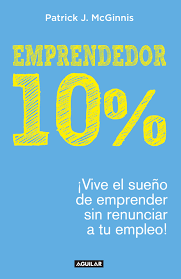
Patrick McGinnis, a successful entrepreneur with more than a decade of experience on Wall Street, explains the many paths you can follow to invest your money, time and experience in a startup.
You don't need millions of pesos on hand to be an Entrepreneur 10%. When you apply McGinnis's principles of action, you immediately start accumulating small wins that become the key pieces for building a successful and highly effective career.
January Book of the Month 2017. Cover photo courtesy of Ben Duchac.