Key Catalysts of the Golden Age of TV Series
Although live television, premium cable and other traditional TV models are being challenged by online services and changing viewing habits, many argue that we are witnessing the golden age of television. It is rather the golden age of TV drama…
Even though live TV, premium cable and other traditional television models are being challenged by online services and shifting consumption habits, many argue that we are witnessing the golden age of television.
It is more accurately the golden age of scripted TV drama, which enjoys a level of attention and appreciation like never before.
Barely a decade ago, it would have been hard to find an established, successful Hollywood actor willing to take a major role in a television series.
“TV actor” was used as a derogatory term for those who had failed to make an impression on the big screen.
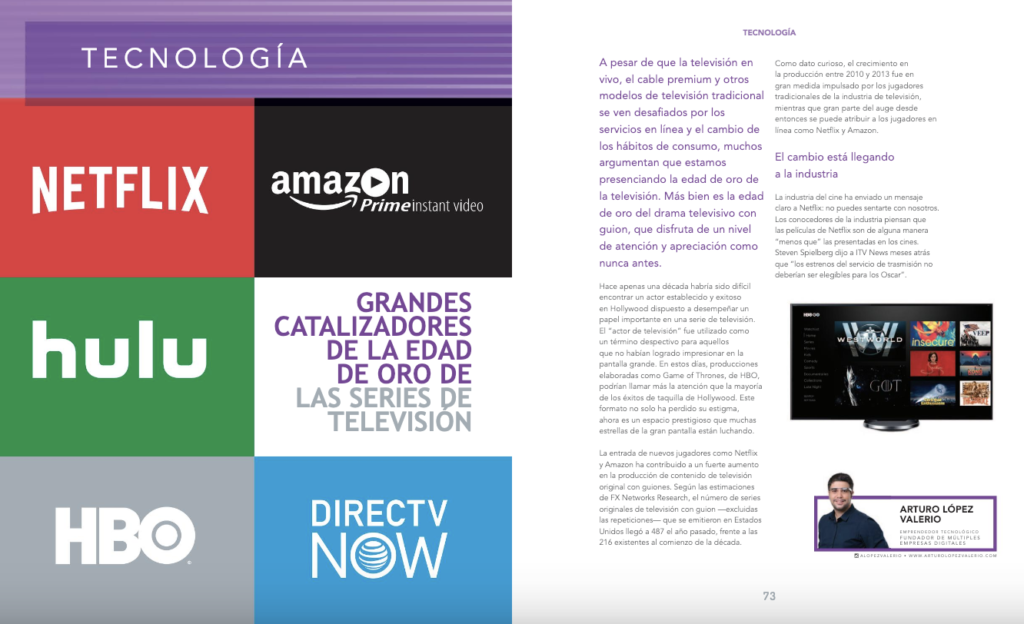
These days, elaborate productions such as HBO's Game of Thrones may draw more attention than most Hollywood blockbusters. This format has not only shed its stigma; it is now a prestigious space that many big-screen stars are fighting to get into.
The entry of new players such as Netflix and Amazon has contributed to a sharp increase in the production of original scripted television content.
According to estimates from FX Networks Research, the number of original scripted television series —excluding reruns— aired in the United States reached 487 last year, up from the 216 that existed at the start of the decade.
As a curious fact, the growth in production between 2010 and 2013 was largely driven by the traditional players in the television industry, while much of the boom since then can be attributed to online players such as Netflix and Amazon.
Change is coming to the industry
The film industry has sent Netflix a clear message: you can't sit with us.
Industry insiders think Netflix movies are somehow “less than” those shown in theaters.
Steven Spielberg told ITV News months ago that “releases from streaming services should not be eligible for the Oscars”.
Instead of lashing out at Netflix, the industry could benefit by embracing some of what that company and Amazon are doing right, just as the television series industry is taking advantage of it.
Christopher Nolan made it clear to IndieWire that he “would never work with the company”.
Cannes banned Netflix films, which led that company's chief content officer, Ted Sarandos, to pull all its films from the festival, even those that could not win anything.
“We want our films to be on fair ground with other filmmakers”, Sarandos told Variety. And why shouldn't they be? They star A-list actors (Will Smith, Adam Sandler), and are directed by respected directors (Martin Scorsese, Noah Baumbach).
And they compete with theatrical films, earn Oscar nominations and win other prestigious awards.
Even the snobbiest film buffs cannot deny that Netflix is contributing something positive to the world of cinema.
Instead of lashing out at it, the industry could benefit by embracing some of what that company and Amazon are doing right, just as the television series industry is taking advantage of it.
The film industry might want to take more risks. Giving lesser-known filmmakers or independent story ideas a chance has paid off for Netflix. It might also want to reconsider its pricing model.
Instead of pouring money into more of these top-quality screenings, the industry could focus on making movies more affordable.
One way to do it would be to follow Netflix's subscription model, which is winning followers by providing more quality content and variety at low cost, and without ads.
If the success of Netflix, Amazon, Hulu and all the subscription services of the TV networks mean anything, it is that (screen size) really doesn't matter.
A great lesson on paradigm shifts from which other industries can learn: the consumer takes control.
Published in Revista Bohío issue 204, June 2018.