A digital era of video, music, photos and messaging
Over the last two decades, technology has been “taking over” the world; so much so that it is constantly stressed that humanity lives in “the digital era”. Although the telephone was invented to make voice communication easier, and the internet to share knowledge and look up information, the pairing they have formed through…
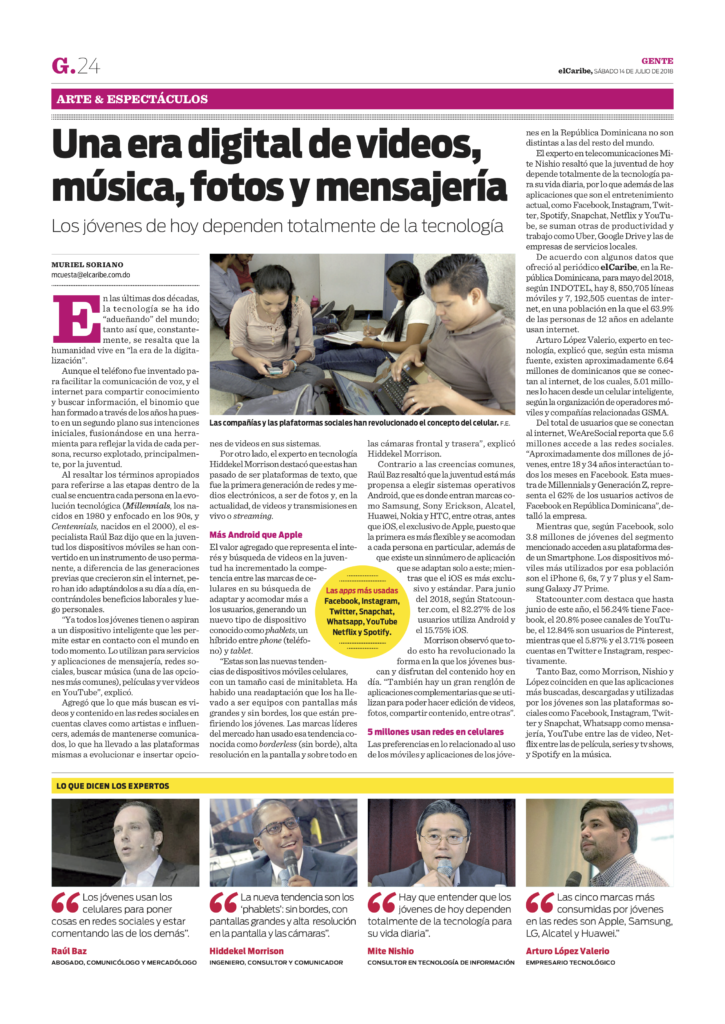
Over the last two decades, technology has been “taking over” the world; so much so that it is constantly pointed out that humanity lives in “the digital age”.
Although the telephone was invented to make voice communication easier, and the internet to share knowledge and search for information, the pairing they have formed over the years has pushed their original purposes into the background, merging into a tool that reflects each person's life, a resource exploited mainly by young people.
In pointing out the appropriate terms for the stages of technological evolution each person is in (Millennials, those born in 1980 and focused on the 90s, and Centennials, born in the 2000), the specialist Raúl Baz said that among young people mobile devices have become an instrument of permanent use, unlike previous generations, who grew up without the internet but have gradually adapted these devices to their daily lives, finding work benefits first and personal ones later.
“Nowadays all young people have, or aspire to have, a smart device that keeps them in contact with the world at all times. They use it for messaging services and apps, social media, searching for music (one of the most common uses), movies, and watching videos on YouTube”, he explained.
He added that what they look for most is videos and content on social media, on key accounts such as artists and influencers, in addition to staying in touch, which has led the platforms themselves to evolve and add video options to their systems.
On the other hand, technology expert Hiddekel Morrison pointed out that these have gone from being text platforms, which was the first generation of networks and electronic media, to being photo platforms and, today, video and live-broadcast or streaming platforms.
More Android than Apple
The added value of young people's interest in videos, and their search for them, has increased competition among cell phone brands as they try to adapt to and accommodate users better, generating a new type of device known as phablets, a hybrid of phone (teléfono) and tablet.
“These are the new trends in mobile phones, with a size almost like a mini tablet. There has been a readaptation that has led to devices with larger, borderless screens, which are the ones young people prefer. The leading brands on the market have used that trend known as borderless (sin borde), high screen resolution and, above all, high-resolution front and rear cameras”, explained Hiddekel Morrison.
Contrary to common belief, Raúl Baz pointed out that young people are more inclined to choose Android operating systems, which is where brands such as Samsung, Sony Ericsson, Alcatel, Huawei, Nokia and HTC, among others, come in, rather than iOS, Apple's exclusive system, since the former is more flexible and adapts to each individual person, and there are also countless apps that work only with it; iOS, meanwhile, is more exclusive and standardized. As of June 2018, according to Statcounter.com, 82.27% of users use Android and 15.75% use iOS.
Morrison observed that all of this has revolutionized the way young people search for and enjoy content today. “There is also a large segment of complementary apps used for editing videos and photos, sharing content, and more”.
5 million use social networks on cell phones
Young people's preferences regarding the use of mobile phones and apps in the Dominican Republic are no different from those in the rest of the world.
Telecommunications expert Mite Nishio pointed out that today's young people depend entirely on technology for their daily lives, so in addition to the apps that make up current entertainment, such as Facebook, Instagram, Twitter, Spotify, Snapchat, Netflix and YouTube, there are others for productivity and work, such as Uber, Google Drive and those of local service companies.
According to some data he provided to the newspaper elCaribe, in the Dominican Republic, as of May 2018, according to INDOTEL, there are 8, 850,705 mobile lines and 7, 192,505 internet accounts, in a population in which 63.9% of people aged 12 and over use the internet.
Arturo López Valerio, a technology expert, explained that, according to this same source, approximately 6.64 million Dominicans connect to the internet, of whom 5.01 million do so from a smartphone, according to GSMA, the organization of mobile operators and related companies.
Most-used social networks
Of the total number of users who connect to the internet, WeAreSocial reports that 5.6 million access social networks.
“Approximately two million young people between 18 and 34 years old interact on Facebook every month. This sample of Millennials and Generation Z represents 62% of active Facebook users in the Dominican Republic”, the company detailed.
Meanwhile, according to Facebook, only 3.8 million young people in that segment access its platform from a smartphone. The mobile devices most used by this population are the iPhone 6, 6s, 7 and 7 plus, and the Samsung Galaxy J7 Prime.
Statcounter.com notes that as of June this year, 56.24% have Facebook, 20.8% own YouTube channels, 12.84% are Pinterest users, while 5.87% and 3.71% have accounts on Twitter and Instagram, respectively.
Baz, Morrison, Nishio and López all agree that the apps young people search for, download and use the most are social platforms such as Facebook, Instagram, Twitter and Snapchat, WhatsApp for messaging, YouTube for video, Netflix for movies, series and TV shows, and Spotify for music.
Published in the Periódico El Caribe, July 14 2018.