Post-Mortem Culture
Failures are an unavoidable part of innovation, and they can provide excellent data for improving products, services and organizations. Today, companies such as Google, Amazon, Netflix, Facebook and Microsoft use post-mortems to capture lessons from mistakes. According to the firm CB Insights, the 70% of tech startups that exceed 20…

Failures are an unavoidable part of innovation and can provide excellent data for improving products, services and organizations. Today, companies such as Google, Amazon, Netflix, Facebook and Microsoft use post-mortems to capture lessons from their mistakes.
According to the firm CB Insights, the 70% of tech startups that make it past 20 months after their first funding round treat their operations as a software problem, which shows how important it is for business units to react to errors.
If your company actively works to build a corporate memory, then it is ready to establish a post-mortem culture.
When an incident occurs, the goal is to solve the problem and return services to normal conditions. If left unchecked, incidents can grow in complexity or even cascade, overwhelm the business's systems and its operators and, ultimately, affect customers.
An error in an internal IT system at a financial institution that lacks a modern data-feed architecture for its mobile applications (based on an Application Programming Interface, API) can cause:
- those applications to appear to be out of service for the user,
- when what is really at stake is a problem of optimizing communication between those systems.
- The Marketing department will complain to Digital, and Digital in turn
- will say the problem belongs to IT.
- The customer loses.
Post-mortems matter when incidents occur: they let us carefully clarify, document and share the lessons from any error, and so avoid Corporate amnesia and the endless cycle of bad customer experience. This model can be applied to any activity that involves the use of software.
To start a post-mortem culture, we must document a few scenarios: visible service interruptions; impacts on data integrity; slow customer responses or error detection.
These should be displayed on a dashboard to keep the whole team attentive to the indicators; startups such as Nequi, the virtual bank of the Bancolombia group, use this good practice of openness and transparency in their operations.
The next step is to create a written record of the incident that addresses its impact, how it was resolved and how it will be prevented. The lessons learned should feed the corporate memory to build the capacity to recover from and prepare for future problems.
By talking about failures in public and working to investigate their causes, everyone has the chance to learn from each incident and take part in the next steps.
The documentation provides a lasting resource that other teams in the organization can turn to when needed.
Keep these principles in mind when developing a post-mortem culture:
- Encourage a constructive, blameless response.
- Remove blame from the post-mortem so the team feels more psychological safety to escalate problems without fear.
- Emphasize improvement and learning to recast failure as an opportunity for growth and development.
- Promote an iterative ((repeatable)) and collaborative process.
- Real-time collaboration and an open feedback system for post-mortems will allow data, ideas and solutions to be gathered quickly.
- Regularly acknowledging post-mortems with your team and senior management can increase support and response effectiveness.
- Circulate a monthly newsletter with success stories from the post-mortem culture.
Consider running an exercise built around this habit, or start a discussion with your team, to begin a healthy practice that will help improve internal processes, the quality of the work climate and the steady feeding of your organization's corporate memory .
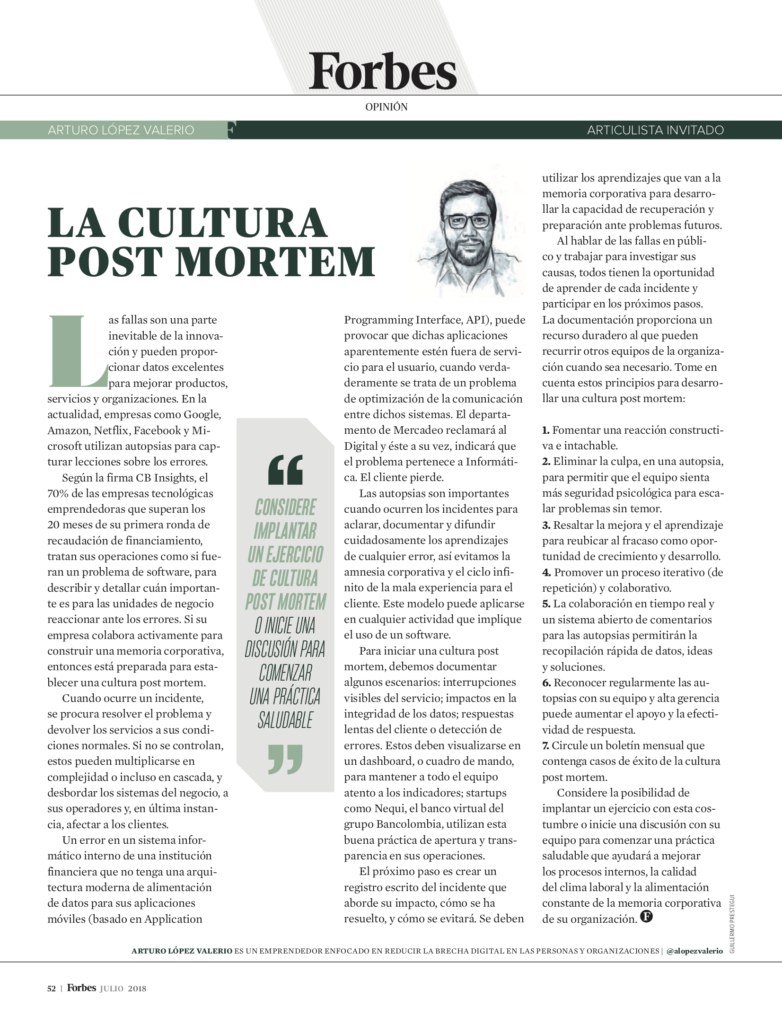
Published in Forbes Magazine, July-August 2018.