Business intelligence without losing human interaction
The human touch will always be an important part of digital transformation. It drives authentic customer relationships, collaborative work environments and sustainable long-term change. It is no longer unusual to see in the news, again and again, that some large retail chain has declared itself…
The human touch will always be an important part of digital transformation. It drives authentic customer relationships, collaborative work environments and sustainable long-term change.
It is no longer unusual to see news constantly reporting that some large store chain has declared bankruptcy or is about to close. It is a sign of the times, or as tech entrepreneur Arturo López Valerio defines it, the “retail apocalypse”.
Business Intelligence and eCommerce Trends
Indeed, the shift in global e-commerce (electronic commerce) trends is already showing a pattern that, if not properly studied and analyzed, may cause various retail chains (companies specialized in selling goods) to “throw in the towel”.
Several factors explain it. One is that people are becoming more and more selective, saying “give me a reason, tell me why I should spend my gas to get to your store”, especially when a large number of staff have been laid off and, if information is needed, nobody is available to provide it.
This work, one way or another, can be replaced with new technologies. The impact of new technologies on society grows over time, mainly in the way human beings interact with one another, but also in other habits and customs such as buying goods, products and services.
However, for 2020 it is estimated that barely fifteen percent of global retail transactions will be made via e-commerce.
The Internet of Things (IoT)
Within that scope, López Valerio highlights the growth of the Internet of Things as essential, a trend that helps different devices interoperate seamlessly while connected to the internet.
“When we walk into a store we will find different sensors that not only collect information on the consumer's steps and patterns inside the establishment, but also communicate from one device to another whether a customer is passing by or whether an item has been moved”, among other things, says López Valerio.
He adds that human beings are social individuals, so even though we are stuck to electronic screens and save time and money through digital relationships, we still miss interaction.
In that sense, owners of traditional stores who are looking at technologies to implement in their space should consider three factors for the transition that will help win the attention and interest of the new consumer.
Smart places
For López Valerio, the first requirement is that a smart place must have on-demand logistics, meaning inventory is adjusted to consumer behavior, studied through the data collected on that behavior.
The second is traffic business intelligence, which is obtained by installing a business intelligence system connected to the store itself. However, technology alone is not the definitive solution, since the human touch must not be lost.
“No matter how much technology we put into things, training is still necessary, now more than ever”, notes the tech entrepreneur.
In that sense, staff must be trained and a base of resources and human capital built that is as excellent as the technology being purchased.
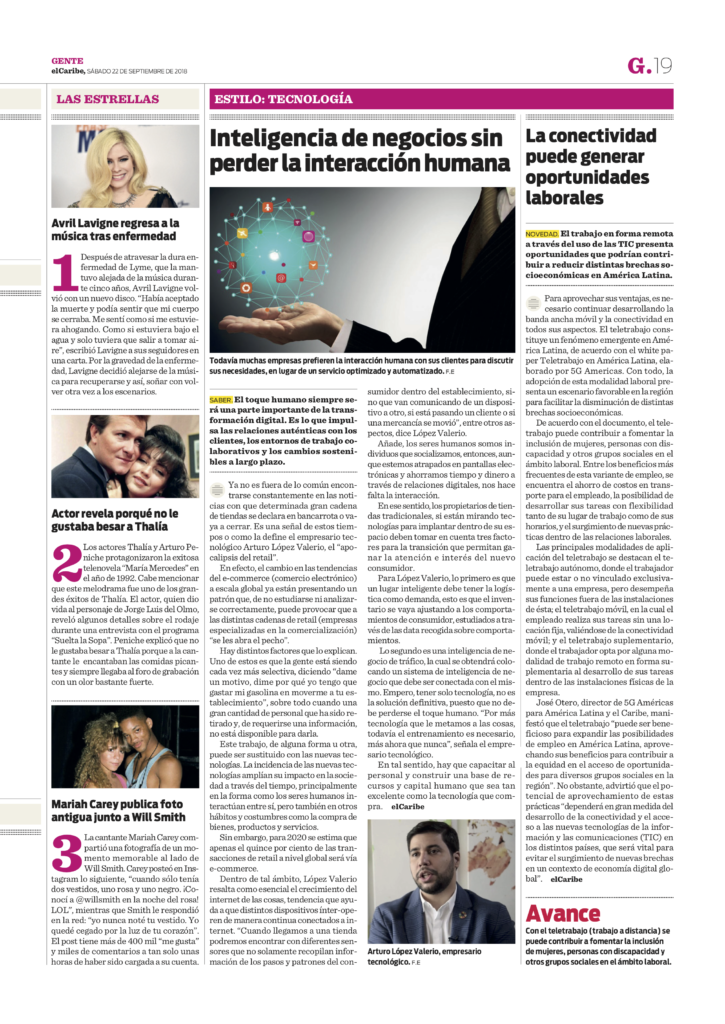
Published in the newspaper El Caribe, 22 September 2018.