DR cannot keep depending on foreign technology forever, warns Mite Nishio
The first surprise Mite Nishio got on his most recent trip to China was an environmental one. “It was not as polluted as some reports had claimed, because almost everything has been switched to electric vehicles”. For that reason, every major city in the Asian giant has a dedicated lane for bicycles and…
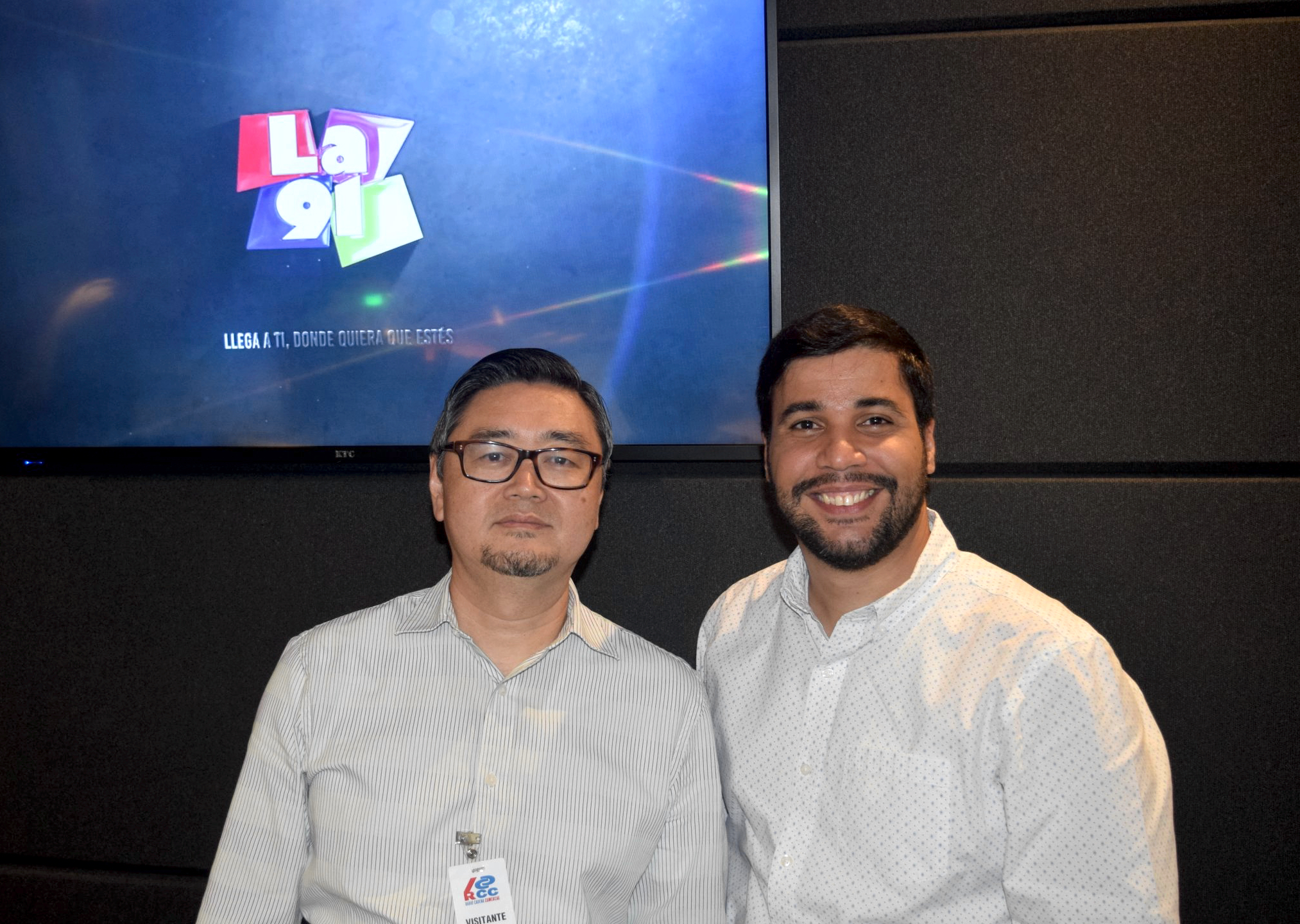
The first surprise Mite Nishio had on his most recent trip to China was an environmental one. “It was not as polluted as some reports had claimed, because they have switched almost everything to electric vehicles”.
For that reason, every major city in the Asian giant has a dedicated lane for bicycles and electric vehicles. “His expectation was very different; he thought he was going to a city polluted by smog”.
The telecommunications specialist and director of the research and development center at Altice Dominicana shared his impressions with the technology entrepreneur Arturo López Valerio during the “Martes Tecnológico” that both produce for the Matutino de Teo Veras, which is broadcast on La 91.3 FM.
Mite Nishio on an Expedition to China
Mite's expedition to the most populous country on the planet –made last August— was sponsored by the technology manufacturer Huawei, together with 30 Latin American journalists and bloggers specializing in technology, in order to visit the company's main facilities in the city of Shenzhen, “which is like China's Silicon Valley, where almost everything related to the company is manufactured” or, as Mite puts it, “all the technology in the world”. They then traveled to Beijing, the capital, to visit the research and development centers.
It is worth noting that although Huawei is known in the Dominican Republic for its smartphone models, these are only one of its many product areas. In fact, Mite points out, “its main business is building telecommunications networks for more than a thousand 300 telephone companies around the world, to which it supplies the actual technology”. Three of them are in the Dominican Republic.
Huawei is a fairly young company, founded in 1987, and is almost the same age as the city of Shenzhen. It started with capital of 3 thousand 500 dollars, and by last 2017 it reported 92 billion dollars in profits, becoming the world's largest manufacturer of telecommunications equipment and its second-largest manufacturer of smartphones.
Returning to the facility visit, Nishio says they were taken to a showroom of new technologies, where photography was prohibited, and were shown equipment prepared to work with 5G technology, from which, –he recalls,— a download speed standard of 20 gigabits per second is expected.
A Bet on the Cloud
Another of the company's bets on the future is related to the cloud. “They even have three business models right now: consumers, businesses, and telephone companies”, he says. He adds that artificial intelligence is also weighing heavily, and that their latest phones already include the first artificial intelligence processor, which will serve not only for games but also for taking photographs with professional quality.
On this topic, he adds that the artificial intelligence used in the camera of these devices will be able to recognize whether the subject being photographed is a person, an image, an object, a landscape… “and adjusts to it, even when it is being taken under artificial light”.
Huawei mobile phones come with the Android operating system, but Mite points out that each manufacturer customizes it. “No two Androids are the same. There is a fragmentation of hundreds of different Android devices, so Huawei also has its own customization layer”.
Asked by López Valerio about the end of the strategic alliance between mobile phone manufacturers and telephone companies, Mite Nishio's view is that she does not believe it was ever really an alliance “because it is a relationship between customers and suppliers. So in this globalized world you can't have a single distribution channel in a country”, she adds. She defines them as business alliances that can also be called distribution channels.
Innovation, a pending task on our island
Another aspect worth highlighting from this trip is innovation. Mite says that Huawei's vision, and something strongly emphasized during the visit, is to “become the global iconic brand that represents innovation and the number one in mobile phones”.
They are already fighting seriously for that position, and it is given importance within company policy. Proof of this is that of the brand's 180 thousand employees, 80 thousand are dedicated exclusively to research and development in 16 centers around the world. “They place great importance on creating patents”.
Comparing with the Dominican case, Mite warns that part of development is not only investing in universities and private companies, but also in research and development.
“It is not simply about being consumers of technology that comes from abroad; it is also about contributing something to the creation of new technologies that will dominate the world, mainly those related to mobile connectivity and software, where I believe we have the best opportunities”, she stresses. “We cannot keep depending on foreign technology forever”.
Patent Opportunity
For Mite, the country has the opportunity to create several patents in the field of mobile, web and business applications, as well as in software, which, “being intangible, gives the Dominican Republic potential, and since it is an area that constantly renews itself, there comes a point where “everyone is at the same level if they get started now”.
This opportunity, of course, will depend on the “right approach” of the authorities, the private sector and academia, in the sense that each has its share. “We have to be looking for that point of innovation we truly lack and that we, as a country, are waiting to arrive”.
Posted by Ensegundos.do, September 25 2018.