News Media Have Had to Reinvent Themselves on Digital Platforms
The information industry is not outside the digital transformation already experienced by telephony, tourism and Dominican television. This change, driven by consumer preference, has pushed traditional media outlets to establish a presence in digital format. This can be through a web page…

The information industry is not outside the digital transformation that Dominican telephony, tourism and television have undergone.
This shift, driven by consumer preference, has led traditional media outlets to establish a presence in digital format.
That presence can take the form of a website or social media accounts.
The immediacy, hyperconnectivity, multimedia capabilities, constant updating and interactivity these channels offer have led the main print media outlets to establish a presence on the web. But not only on that platform: also on social networks such as Facebook, Instagram and Twitter, which they use to attract more followers who become readers.
Websites
Another format that has grown considerably in recent years is the thematic portals or regional and provincial blogs, says Cristal Acevedo of the Observatorio Nacional de Medios Digitales.
“This change in the media landscape gives outlets new alternatives when informing the public, since the reader has gone from being passive to being an active user”, Acevedo told EL DÍA.
For his part, IT specialist and consultant Melvyn Pérez says that media outlets have been forced to reinvent themselves and offer more attractive content to the public.
From this perspective, print newspapers have changed the way they deliver digital information, bringing credibility to social networks, since these have become a channel of information between websites and users.
Challenges of information and digital transformation
This technological revolution is a challenge for media managers, since new tools and applications keep appearing, and they demand a different way of expressing the same message across different media, said communication specialist Vladimir García.
“Media outlets now present the why behind the information, in-depth reports and news with added value”, García emphasized.
He noted that media with a digital presence have had to adapt to quick-read writing with hypertext, videos or “storytelling” (telling stories) and other resources.
Digital laggards
Television programs, whether news, opinion or entertainment, maintain a digital presence, although they are updated less frequently than print newspapers. Only 11.8 % of programs have their own portal, and of those, 9.5 % publish regularly, while 65.7 % of television stations have a website, but only 47.7 % have updated content, according to the study “La televisión de provincias en la República Dominicana” (Provincial Television in the Dominican Republic), by the Centro de Investigación de la Comunicación of the Fundación Global Democracia y Desarrollo.
Meanwhile, traditional newspapers update their information every hour or half hour throughout the day.
Presence on social media
The study also notes that 65.7 % of channels have Facebook accounts, but fewer than half, 47 %, are up to date; as for programs, only 26.1 % update their content.
There are more than 100 online media outlets in the country, said digital marketing specialist Alex Madera. He points out that despite this growth in digital media, they have not managed to increase their share of advertising investment. He states that only 10 % of total advertising spending goes to these platforms.
“Advertising agencies tend to invest more in social networks than directly in web portals”, he said.
Toward the digital economy
—1— Investment
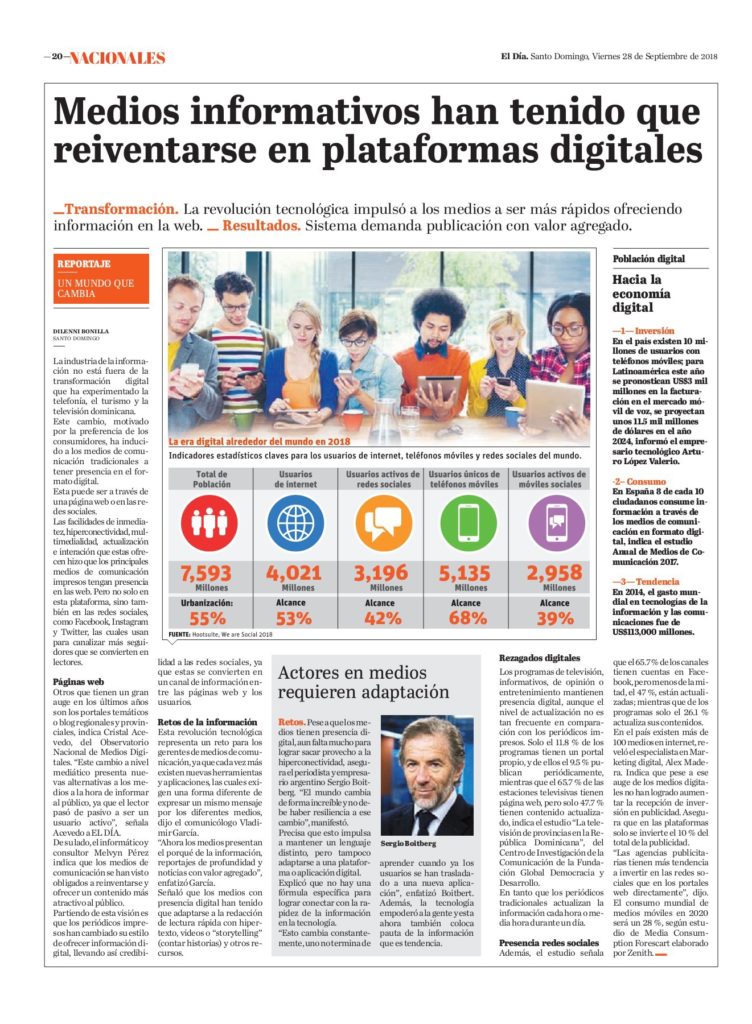
The country has 10 million mobile phone users; for Latin America this year, US$3 billion in mobile voice revenue is forecast, and some 11.5 billion dollars are projected for 2024, said technology entrepreneur Arturo López Valerio.
-2– Consumption
In Spain, 8 out of every 10 citizens consume news through digital media, according to the Annual Media Study 2017.
—3— Trend
In 2014, global spending on information and communications technologies was US$113,000 million.
Media players need to adapt
Challenges. Although media outlets have a digital presence, they still have a long way to go before they take advantage of hyperconnectivity, says Argentine journalist and entrepreneur Sergio Boitberg. “The world is changing at an incredible pace, and there should be no resistance to that change”, he said.
He notes that this pushes outlets to maintain a different language, but not to adapt to a single digital platform or application.
He explained that there is no specific formula for keeping up with the speed of information in technology.
“This is constantly changing; you haven't finished learning one thing when users have already moved to a new application”, Boitbert stressed.
In addition, technology has empowered people, and they now also set the agenda for the information that trends.
Written by Dilenni Bonilla, published by the newspaper El Día, 28 September 2018.