Toward More Effective Digital Positioning for the Dominican Republic
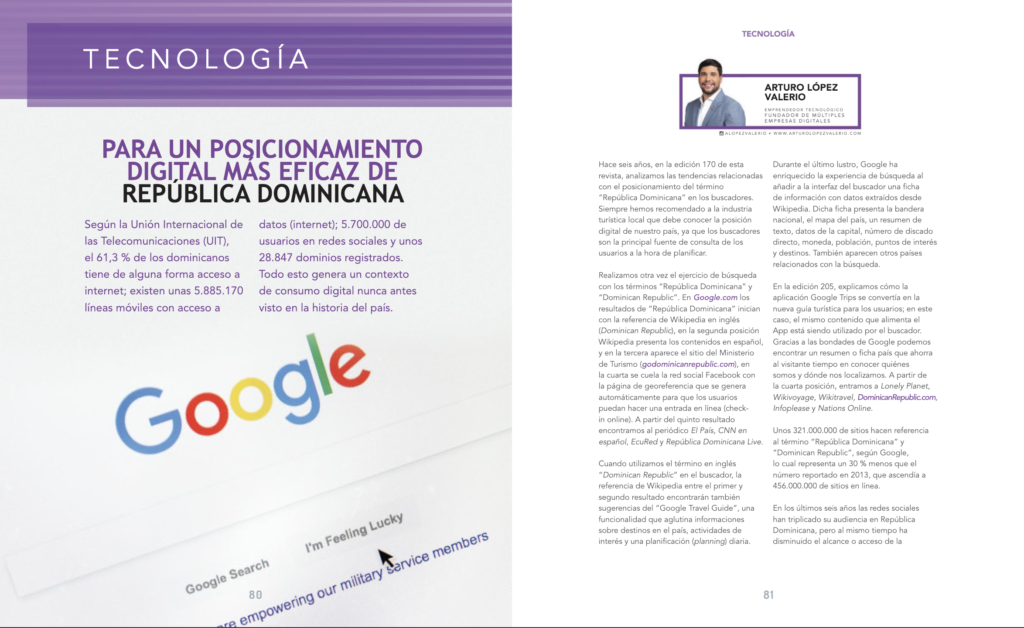
According to the International Telecommunication Union (ITU), 61,3% of Dominicans have some form of access to the internet; there are about 5.885.170 mobile lines with data access (internet), 5.700.000 social media users and some 28.847 registered domains. All this creates a context of digital consumption unprecedented in history…

According to the International Telecommunication Union (ITU), 61,3% of Dominicans have some form of internet access; there are about 5.885.170 mobile lines with data access (internet), 5.700.000 social media users and about 28.847 registered domains.
All of this creates a context of digital consumption never before seen in the country's history.
Six years ago, in edition 170 of this magazine, we analyzed trends related to the ranking of the term “República Dominicana” in search engines.
We have always recommended that the local tourism industry should know how our country is positioned digitally, since search engines are users' main source of information when planning a trip.
We ran the search exercise again with the terms “República Dominicana” and “Dominican Republic”.
- On Google.com, the results for “República Dominicana” begin with the English-language Wikipedia entry (Dominican Republic),
- in second position Wikipedia presents the content in Spanish
- and in third appears the Ministry of Tourism site (godominicanrepublic.com,
- in fourth, the social network Facebook slips in with the georeferenced page that is generated automatically so users can post an online entry (check-in online).
From the fifth result on, we find the newspaper El País, CNN en Español, EcuRed and República Dominicana Live.
When we use the English term “Dominican Republic” in the search engine, between the first and second results, the Wikipedia entry is also accompanied by suggestions from the «Google Travel Guide», a feature that brings together information on destinations in the country, activities of interest and daily planning (planning).
Over the last five years, Google has enriched the search experience by adding to the search interface an information panel with data drawn from Wikipedia.
That panel shows the national flag, the country map, a text summary, data on the capital, direct-dial code, currency, population, points of interest and destinations. Other countries related to the search also appear.
Google Trips
In edition 205, we explained how the Google Trips app was becoming the new travel guide for users; in this case, the same content that feeds the app is now being used by the search engine.
Thanks to Google's features, we can find a country summary or profile that saves visitors time in learning who we are and where we are located.
From the fourth position on, we get to Lonely Planet, Wikivoyage, Wikitravel, DominicanRepublic.com, Infoplease and Nations Online.
About 321.000.00 sites refer to the term «República Dominicana» and «Dominican Republic», according to Google, which is 30% lower than the number reported in 2013, which amounted to 456.000.000 online sites.
Impact and Decline of Social Media
In the last six years, social media has tripled its audience in the Dominican Republic, but at the same time, the reach, or the audience's access to the content published by the various social profiles, has declined.
- Digital investment is concentrating on social media, according to a report by the firm Tabuga.
- The 80% of digital ad spending in our country is going to social networks —counting YouTube as a social network–, while barely 10% goes to SEM (Search Engine Marketing).
- Social networks are known as the “closed web”, since they are communities where you need a username and password to view the information they contain.
For tourism promotion at the global level, “open web” strategies (such as search engine positioning) support free access to information and are key for the sector to keep growing in cyberspace.
The scandals over security breaches and vulnerabilities in social networks show that the closed web model has its challenges and therefore cannot be the absolute basis of digital growth, above all for the positioning of one of our country's most important industries.
Focus on search results
Tourism must continue building content within the open web model.
If you don't yet have a website model that can rank effectively, or if you haven't yet invested in SEO, I recommend that marketing teams lean on Wikipedia and add references to their products and activities in the many pages that refer to our country, provinces and tourist attractions.
The social media fever seems to be on the sheet, and when we have to change it, search engine results will always be the ideal capture channel for the growth of an economic activity that does not stop.
Findings from the digital audit we carried out on terms and their positioning:
- The term “Republica Dominicana”, besides returning tourism pages, mostly gives access to international news content that refers to the country. On the second page of results, local stores and brands appear, an example of how the local digital ecosystem is taking advantage of Search Engine Optimization (SEO).
- The term “Dominican Republic” is filled with direct references to tourism, but dominated by the many guides competing online. The great threat to them is Google itself, which for years has created shortcuts and summaries to make life easier for its users, but in open competition with this content model. On the second page of results, sources such as the CIA, the New York Times, the BBC and TripAdvisor, among others, stand out.
- Hotel offers are not visible for either term. This is due to the high cost of investing in a country term, since bids climb too high and it makes sense for neither party.
- Legal services and quickie divorces, visible five years ago, are now relegated to niche strategies instead of trying to capture attention with a country term.
Published in Revista Bohío #207, December 2018.
Thanks to the team at Tabuga for the online audit data.