Made in China 2025
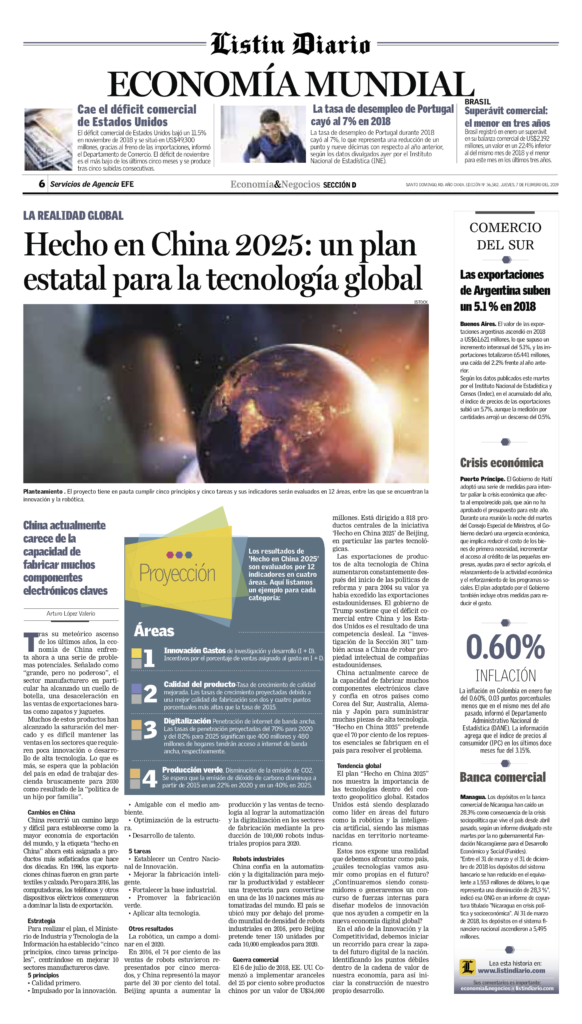
A state plan for global technology. The global reality After its meteoric rise in recent years, China's economy now faces a series of potential problems. Labeled "big, but not powerful," the manufacturing sector in particular has hit a bottleneck, a slowdown in sales of cheap exports…
A state plan for global technology.
The global reality
After its meteoric rise in recent years, China's economy now faces a series of potential problems. Described as «big, but not powerful», the manufacturing sector in particular has hit a bottleneck, a slowdown in sales of cheap exports such as shoes and toys.
Many of these products have reached market saturation, and it is hard to sustain sales in sectors that require little innovation or high-tech development. What is more, the country's working-age population is expected to drop sharply by 2030 as a result of the «one-child policy».
Changes in China
China traveled a long and difficult road to establish itself as the world's largest export economy, and the label «made in China» is now attached to more sophisticated products than two decades ago. In 1996, Chinese exports were largely textiles and footwear. But by 2016, computers, phones and other electrical devices had begun to dominate the export list.
Strategy
To carry out the plan, the Ministry of Industry and Information Technology has established «five principles, five main tasks», focusing on upgrading 10 key manufacturing sectors.
5 principles
- Quality first.
• Innovation-driven.
• Environmentally friendly.
• Structural optimization.
• Talent development.
5 tasks
- Establish a National Innovation Center.
• Improve smart manufacturing.
• Strengthen the industrial base.
• Promote green manufacturing.
• Apply high technology.
Indicators
The results of ‘Made in China 2025′ are evaluated through 12 indicators in four areas. Here we list one example for each category:
- Innovation Research and development expenditure (R&D). Incentives based on the percentage of sales allocated to R&D spending.
- Product quality Improved-quality growth rate. Projected growth rates due to better manufacturing quality are two and four percentage points higher than the 2015 rate.
- Digitalization Broadband internet penetration. The projected penetration rates of 70% for 2020 and 82% for 2025 mean that 400 million and 480 million households, respectively, will have access to broadband internet.
- Green production. Reduction in CO2 emissions. Carbon dioxide emissions are expected to fall from 2015 by 22% in 2020 and by 40% in 2025.
Published in Listín Diario, February 7, 2019.
Continues in the article: Results of the Made in China Plan 2025