The Engelbart Mural: A Mirror for Development
Engelbart's mural is a mirror that speaks of progress without demagoguery. Some events were isolated and others consecutive, and together they produced exponential progress, but with a single common factor: Collective Intelligence, beyond a collaborative digital economy. 51 years ago, on December 9, 1968, Douglas C.…
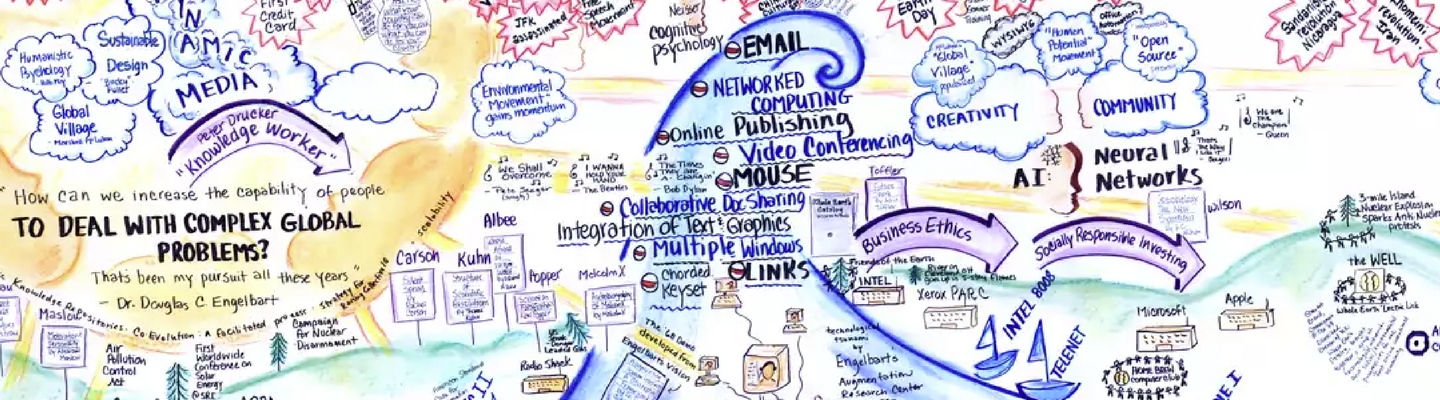
Engelbart's mural is a mirror that speaks of progress without demagoguery. Some events were isolated and others consecutive, and together they generated exponential progress, but with a single common factor: Collective Intelligence, beyond a collaborative digital economy.
51 years ago, on December 9, 1968, Douglas C. Engelbart and a group of 17 researchers working with him at the Augmentation Research Center of the Stanford Research Institute in Menlo Park, California, gave a 90-minute live public demonstration of the NLS system (oN Line System), which the team had been working on since 1962.
This demonstration is called “Mother of All Demos” (“The Mother of All Demos”, in Spanish) where the “mouse” was one of the elements presented. That demonstration is regarded as one of the modern catalysts in technology, and it paved the way for the tools we enjoy today.
But the “mouse” was only one of the many innovations presented that day, including hypertext, object addressing and dynamic file linking, as well as the shared screen that allowed two people in different places to collaborate over a network with an audio and video interface.
Yes, this was in 1968. You can watch the video of the “Demo”, courtesy of Stanford University.
Origin of the Mural
On the occasion of the 40 anniversary of “The Mother of All Demos” and in honor of Douglas C. Engelbart, a mural was made (4 x 27 feet) that describes the evolution of culture and technology from 1925 to the present day, from the perspective of the life of Engelbart, inventor of the computer mouse and other technological advances that changed the world.
If you look closely, we can see on the mural a purple band that marks the eras of the Co-Evolution of Human Systems and Tool Systems, where we can clearly see the following eras:
• “Industrial”, begins in 1935 and ends in 1963.
• “Information”, begins in 1964 and ends in 1989.
• “Knowledge”, begins in 1990 and ends in 2008 (many do not agree on this date).
• “Concept”, according to experts, begins with “the paradigm shift about paradigms”.

Engelbart Mural
This mural is very interesting; I had seen it online a few months after it was made. The first time I saw it in detail (ofF Line) was thanks to Frederic Emam-Sade, who had the mural printed and framed at full size. In fact, our conversation changed subject that day, as I was astonished to see human Co-Evolution at a single glance.
A mistake in the “Age of the Concept”
As a nation, we still keep a discourse that prioritizes connectivity in the country, given that the digital divide covers 45 % of the population. A call is being made for Dominicans to get connected and become part of a digital republic, without borders, without distances, where only those who refuse to leap into the world of information and knowledge remain excluded.
This pins us down in the “Age of Knowledge”.
As a nation, we keep investing to see immediate results, when our main challenge is to produce more and better human development. In the “Industrial and Information Age” there were two variables to overcome: Electricity and Education.
If those are still pending matters to date, how can we move toward the age of the concept?
How, then, can we approach an orange economy that belongs to the age of the concept?
Producing development means working on education in the initial links of the value chain, where it is not visible, because it is still medium-term work; that work is of no use for communication and propaganda, for campaigns and the electoral whirlwind that always threatens organic plans.
The formulas of pushing what is visible in ICT, entrepreneurship, innovation and competitiveness, through investment in centers and equipment purchases, and mass talks, have not been effective; above all if, as a nation, we still face the challenge of having an efficient electricity service, and when our wireless communication services are fragile.
Dominicans are being invited to connect to an “age” that has expired, where it is not clearly defined how we produce enough development to make the next leap. It is evident that the penetration of mobile phones in our country has caused this setback to go unnoticed.
To give you an idea, according to the ONE (National Statistics Office) in its ENHOGAR survey since 2013, Dominicans use the mobile phone at home more than television and radio.
We repeat the claim: to reduce the digital divide, we have to increase mobile connectivity. But with a view to the “Age of the Concept” we are very late; increasing mobile access will help create more digital consumers, but not necessarily people who can think and, even more, produce development.
Our mirror
There are many economic formulas on how to reduce the digital divide and create a digital republic, if we are honest, understanding that a mandate will not produce innovation, but rather the conviction that there must be human networks that address problems sincerely and define lasting solutions to many endemic ills.
But those are words that have not been part of the picture in the Dominican Republic in the last 20 years; even so, they will persist in the Engelbart Mural.
Published in the newspaper El Caribe, Saturday, April 27, 2019.
Published originally in 2009.