10 national industries that will be transformed by 5G
5G is the next generation of wireless technology, set to improve connectivity across networks. This matters especially as the number of Internet of Things (IoT) devices grows, along with the amount of data consumed by video views, which according to Facebook are growing 3.6…

5G is the next generation of wireless technology, set to improve connectivity across networks. This is especially important as the number of Internet of Things (IoT) devices grows, along with the amount of data consumed by video viewing, which according to Facebook grows 3.6 times per year.
The next generation of wireless technology will offer new commercial and consumer applications, with near real-time connectivity.
This technology will enable faster data transfer speeds (from 1 Gbps to 10 Gbps with 4G). As a result, 5G creates a great opportunity for numerous industries, but it also sets the stage for large-scale disruption. Deployments of the 5G network are expected to be important for 2020, and a projected 4.1B IoT connections will use 5G worldwide for 2024, according to Ericsson.
Our country has been a pioneer in telephone services, so 5G technology will have a significant impact not only on productivity, but also on how citizen interaction is planned and on the relationship between the digital world and the analog world.
For this reason we analyze 10 Dominican industries that should take the necessary steps to make the most of the rollout of 5G on the island.
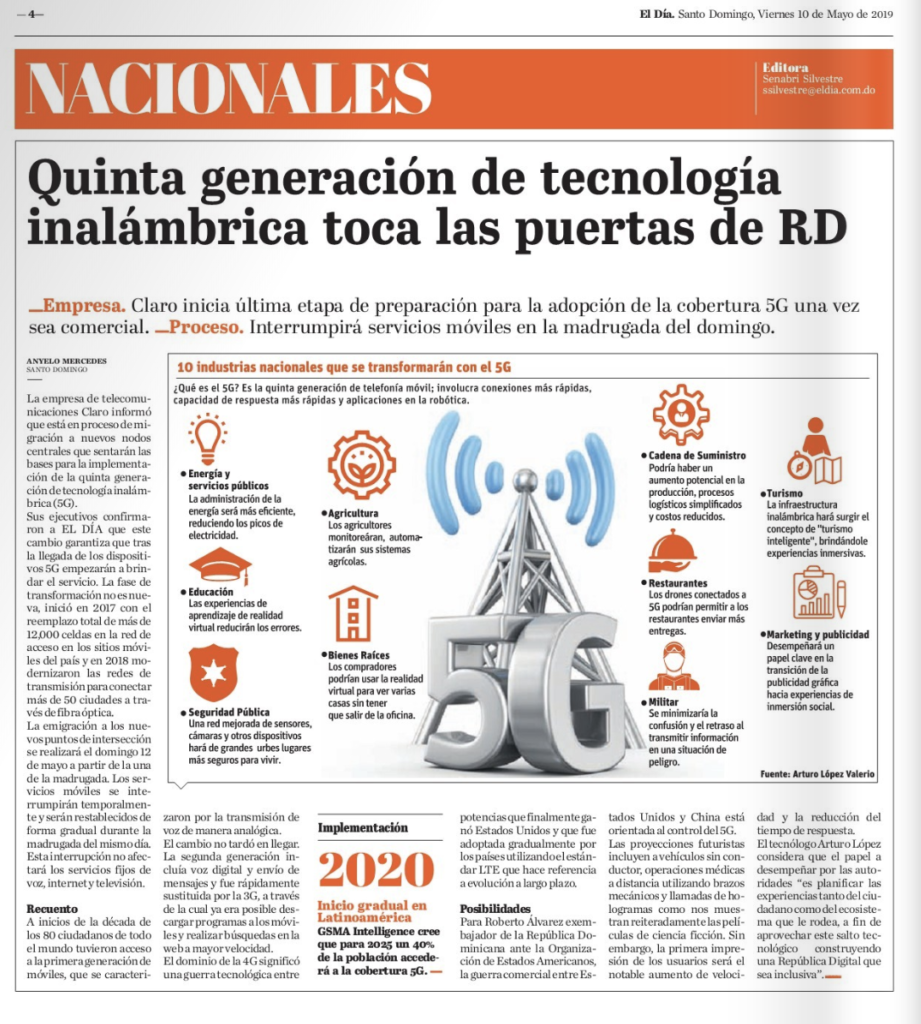
Energy and utilities
5G could lead to innovative solutions in the production, transmission, distribution and use of energy. It is also expected to unleash the next wave of smart-grid features and efficiency.
With more connected smart grids, energy management will be more efficient, reducing electricity peaks and overall energy costs.
In addition, 5G dramatically extends the battery life of battery-dependent devices, sometimes up to 10 years. This makes the mass deployment of IoT sensors a more practical solution for the energy industry.
5G will also allow the use of drones to monitor and maintain the transmission of production assets, leading to better network uptime. This alone could generate a 30% reduction in costs. We will see innovations like this from companies such as the Consorcio Energético Punta Cana Macao (CEPM).
Agriculture
Farmers around the world are using IoT technology to optimize agricultural processes such as water management, fertigation, livestock security, crop communication and aerial crop monitoring. 5G technology could lead to greater adoption of the IoT devices that make this possible.
5G could provide real-time data for farmers to monitor, track and automate their farming systems, resulting in greater profitability, efficiency and safety. In a high-risk industry like agriculture, these gains in output and precision are vital, especially as climate change poses new threats to farmers worldwide.
Currently available technologies are not advanced enough to handle the enormous amounts of data and the speeds required for smart agriculture.
In the United Kingdom, for example, approximately 80% of rural areas are outside 4G range. In the U.S., more than half of rural Americans lacked access to broadband service as of 2015.
It is important to note that the agricultural industry will have to wait longer than most industries to get the benefits of 5G, since 5G networks will be deployed largely in urban areas first. Here we look at how the Ministry of Agriculture can start taking steps to bring 5G to the countryside.
Education
5G has the potential to transform the education of children and adults. As the technology paves the way for better Augmented Reality and Virtual Reality experiences, teachers could use these technologies in a variety of new teaching techniques. For example, students could take virtual field trips around the world, from the pyramids of Egypt to the Great Wall of China.
Augmented Reality and Virtual Reality educational platforms offer a number of benefits over traditional educational methods, including cost-effectiveness, lower risks and greater retention. A study by Next Galaxy Corp and Nicklaus Children’s Hospital found that medical staff retained up to 80% of course material after receiving Virtual Reality training, compared with retaining only 20% of the information from a traditional training session.
For students in high-risk fields such as medicine and aviation, these virtual reality learning experiences could prove especially useful in reducing errors caused by lack of experience. A major challenge for the Ministry of Higher Education, Science and Technology.
Real estate
The real estate industry could be affected as 5G paves the way for emerging technologies such as Augmented Reality and Virtual Reality.
Real estate agents could begin offering virtual tours of their homes. Prospective buyers could use virtual reality to view several houses without leaving the brokerage office, directly affecting traffic flow in cities like Santo Domingo and Santiago.
For those looking to buy or rent a property in a different province or country, access to Virtual Reality tours through a mobile app would be invaluable. People could virtually walk through vacation rentals before booking, for example. 5G technology would allow these applications to run more efficiently than any process that exists today.
5G small cells could also provide an additional revenue stream for many properties, since millions of new small cells will need to be installed and leased in buildings around the world.
However, this could ultimately create a liability for real estate. If 5G small cells turn out to be harmful to public health, property owners could end up being held responsible for installing them near human populations, which means the Ayuntamiento del Distrito Nacional (ADN) needs to work on an urban regulation for this technology.
Public safety
Improving public safety capabilities is a challenge for the authorities; 5G could optimize emergency response times.
Through the 5G network, applications such as real-time video, secure communications and media sharing can be used to help first responders handle emergencies. Firefighters, for example, could use augmented reality to move through a house when they have no visibility.
5G networks could improve information sharing within the public safety community, with secure and reliable exchange of video from bodycams —cameras built into uniforms, drones, group chats, file sharing and location sharing.
In post-disaster situations, drones connected to 5G could deliver relief supplies and help locate missing persons —This is because a drone never loses line of sight on a 5G small cell.
An improved network of sensors, cameras and other automated devices would help build a more complete picture of any public safety situation, making cities such as Santo Domingo safer places to live.
Supply chain management
Installing 5G-enabled IoT sensors in products could make a large amount of data available to supply chain stakeholders in real time.
The data can include location, temperature, humidity, pressure and other information that can be crucial for properly managing products in a supply chain, especially refrigerated products.
Introducing 5G IoT sensors into supply chains could mean fewer losses due to manual inefficiency or misplaced containers. As 5G technologies bring smarter supply chain management, there could be a potential increase in production, simplified logistics processes and lower costs.
The use of smart corridors implemented by the Ministerio de Obras Públicas y Comunicaciones would be a major transformation of the «circunvalaciones» (ring road) model.
Restaurants
The way restaurants interact with customers, prepare food and deliver it will continue to evolve as 5G is adopted.
5G-enabled IoT devices could improve food tracking and waste disposal. Order-capture platforms such as Uber Eats and Globo, from menus to drive-throughs, could evolve into more immersive and interactive experiences for customers, as 5G enables better performance with higher speeds and lower latency.
Drones connected to 5G could allow restaurants to make more deliveries, reducing motorcycle delivery in areas with tall buildings such as Piantini.
Kitchen staff could be trained using Augmented Reality and Virtual Reality experiences connected to 5G, saving valuable inventory. 5G connectivity could also finally allow widespread adoption of robotics in restaurants.
With all these new 5G technologies, the restaurant industry is likely to see lower costs, more efficient food production and better consumer experiences.
Tourism
The smokeless industry. For tourism, 5G is providing the wireless infrastructure for the concept of «smart tourism» to emerge. It could attract more tourists to destinations and offer them more immersive experiences.
Many tourism organizations are already researching and developing 5G-connected technologies to improve their tourist destinations.
For example, the West of England Combined Authority has awarded a grant of 5 million euros to test Virtual Reality and Augmented Reality experiences at the main tourist attractions in Bath and Bristol. The BBC, Aardman and the University of Bristol will work on developing content and technology for the project.
“Imagine a virtual Roman soldier showing you the Roman baths. Imagine this 360 degree movement on your mobile phone at a resolution you have never experienced before. That is what 5G” technology can offer, said London's deputy mayor, Tim Bowles.
Ericsson has partnered with the Russian telecommunications operator Rostelecom to deploy a 5G test network at the Hermitage Museum in St. Petersburg, one of the largest art museums in the world. Ericsson's 5G technology is currently being used to enhance museum visits and even to restore art with remotely controlled robotics.
Military
Communication is key in military strategy. Real-time data collection and transmission to devices within communication networks are crucial, and 5G technology could minimize data transmission latency.
Improved connectivity could reduce confusion and delay when transmitting information in a life-threatening situation in places such as the border zone, where current coverage is almost nonexistent.
5G technology will also be important in maintaining the military supply chain. Better data collection on the use of materials can help the National Congress with the future military budget by providing a clearer understanding of spending and resource distribution.
Marketing and advertising
5G could play a key role in the shift from display advertising to immersive social experiences, bringing content and audiences closer together.
According to Intel research, mobile screen advertising is expected to become a US$178 billion global market by 2028. 5G could help companies overcome the problems of scale, delivery and measurement they currently face when dealing with mobile advertising campaigns. In short, transparency in spending.
5G could help with the commercialization and the transition of advertising from banner-based ads to moving images and video. It could even give rise to new ad formats in Virtual Reality and Augmented Reality. 5G could also make it possible to measure ad effectiveness in real time through eye tracking and biometrics.
Challenges for the rollout of 5G
In addition to fiber infrastructure and the deployment of small cells, 5G speeds also require radio waves at extremely high frequencies. These frequencies need line of sight within a small radius in order to communicate successfully.
In other words, growing demand for wireless coverage, speed and consumption requires the use of new bands within the radio wave spectrum. A band is a specific frequency range in the radio wave spectrum. They range from very low frequencies (3 to 30 kHz) up to extremely high frequencies (30 to 300 GHz).
This is a regulatory challenge for the Dominican Institute of Telecommunications (INDOTEL), since the proper allocation of the radio spectrum is fundamental for the advancement of 5G and of emerging technologies. With pending issues such as the «analog switch-off», many questions remain to be cleared up on the horizon.
While 5G service may begin to be more widely available in different parts of the world by next year, 4G will remain the default service in areas outside a few select, densely populated cities. Widespread 5G coverage could take more than a decade, and as for broader industrial applications of 5G, estimates suggest that adoption will take off in the early 2021.
Our job as a society is to plan the experiences of both citizens and the ecosystem around them, in order to take advantage of this technological leap and get it right for the first time in the history of technology and telecommunications in the Dominican Republic. That is how we will build a true «inclusive digital republic».
Infographic published in the newspaper El Día, 10 May 2019.