Digital innovation and its social impact: a challenge for sustainable development
Digital technologies are among the main drivers of the United Nations agenda toward the Sustainable Development Goals (SDGs), due for review in 2030. For technologies to serve that purpose, we must always think about applying best practices, and also about sharing experiences in a professional setting on how…
Digital technologies are one of the main drivers
of the United Nations agenda toward the Sustainable Development Goals (SDGs) to be reviewed in 2030.
For technologies to serve that purpose, we must always think about applying best practices and also share, in a professional setting, our experiences on how social innovation and entrepreneurship can be encouraged for a sustainable impact on society.
The World Economic Forum in Davos estimated in 2017 that digital transformation would bring more than 500 million dollars in benefits and 4,5 million jobs worldwide.
What impact do those figures have on society? From the Davos Summit we take one relevant figure: 95 % of the benefit will go directly to the population.
A visit for sustainable development
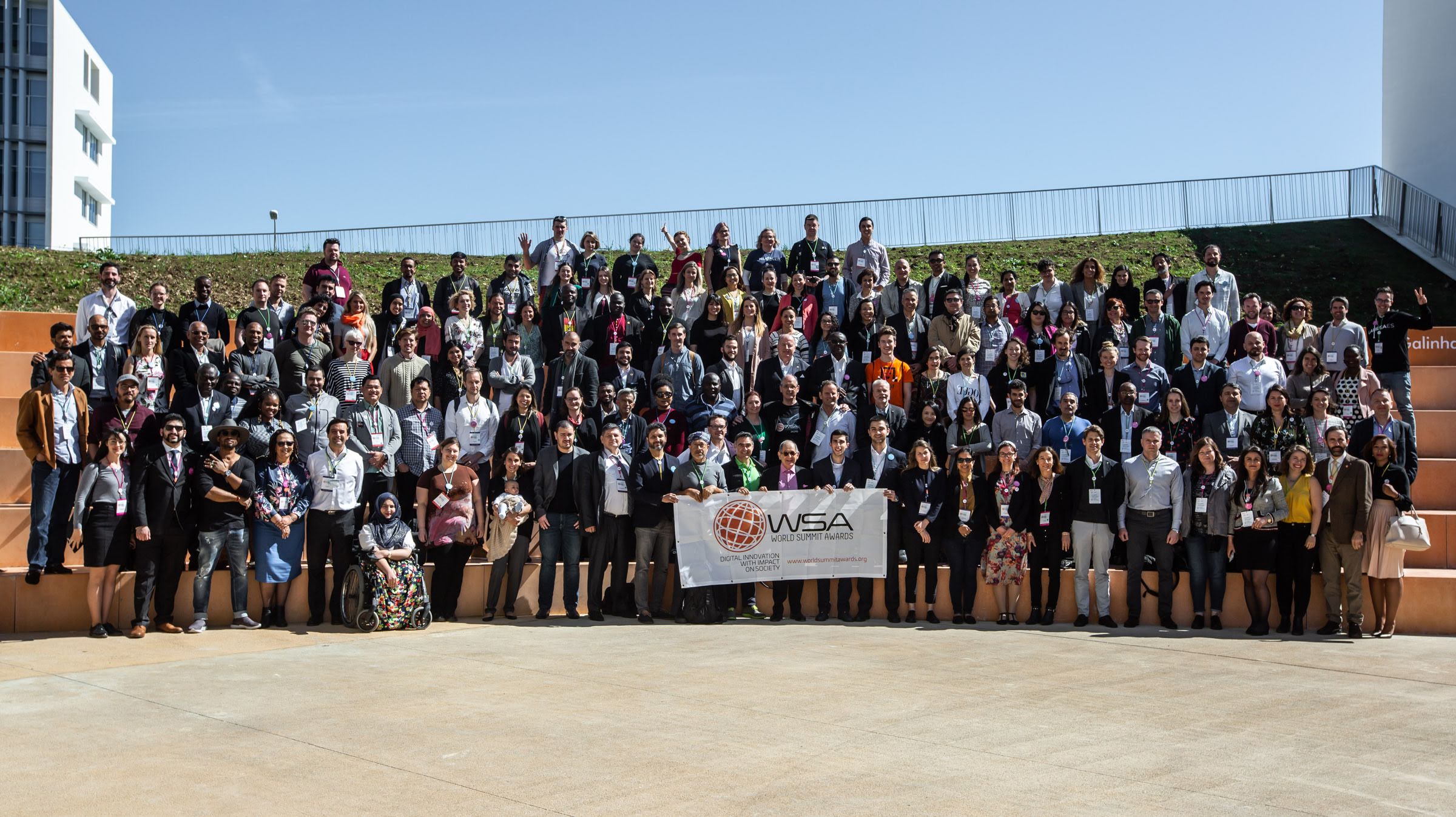
For this reason we visited the Portuguese Riviera to take part in the World Summit Awards (WSA) Global Congress, a gathering of actors from around the world that rewards digital innovation with social impact.
Our work, following our appointment as “national expert for the Dominican Republic”, is to empower people with clear goals for change in the country so that they can submit initiatives.
The WSA connects with the 17 SDGs promoted by the United Nations through the “Agenda 2030”.
It is a space that looks not for ideas but for solutions already having a positive impact in the countries where they are carried out.
The event awards eight categories, which focus on the 17 Sustainable Development Goals
For the 2019 edition, 422 applications were received from 91 countries, of which 60 came from the Latin America/Caribbean region; six of them were winners.
Another vitally important figure is that 55 % of each country's winners were women.
Closing the digital divide remains the great global challenge, though not the only one; where there are disparities there is also gender inequality, water scarcity, energy crises, among other problems that affect the human species equally or even worse.
Such obstacles can be addressed through content that raises awareness and creates change.
And content has one essential characteristic: it is distributed faster thanks to digital platforms.
Finalists for the first time
We have spent eight years contributing to the organization as representatives of the Dominican Republic, and this time, for the first time, a national proposal has gone far enough to be included among the finalists.
We thank Eco-mensajería, represented by Edison Santos, for its support and enthusiasm throughout the process.
Our visit to the WSA congress was about using the networking opportunities to look at success stories in other latitudes and see what we are missing in the Dominican Republic.
Our fundamental problem is that we are not building technology into our business models.
A study by the Universidad Nacional de General Sarmiento, in Argentina, finds that technology entrepreneurship in our country is “practically nonexistent”.
We need more articulation and less risk
Technology will help maximize business models, but it will not become an expense.
The Dominican entrepreneurship ecosystem operates on a perception of communication of actions and actors who feel the need to draw attention by doing work that is not theirs to do, because they understand that this brings more visibility.
Whoever controls the chain chokes the ecosystem, something the actors involved must not allow. We must collaborate so that other mechanisms exist that incentivize and foster entrepreneurship.
Digital oversight for sustainable development
One case for Dominican society to analyze and implement is the strengthening of digital oversight.
If we already have a digital republic, civil society and citizens must start applying technology to build a counterweight that goes beyond complaining on Twitter and instead creates civic awareness.
Civil society organizations need “more hands” to move forward and manage this oversight.
We can take advantage of the cameras and the power of the mobile devices Dominicans already have; five million smartphones can be the eyes and agents of change.
Applications for sustainable development
One example of digital oversight is SuperCívicos App, by Humberto Contreras and Arturo Hernández, from Mexico, which uses social media to create a platform where users help detect problems.
When everything is fine, nothing happens. Innovation cannot exist without problems or challenges. When people think about problems and their possible solutions, innovation will appear. Not doing so is “denying reality”.
Arturo López Valerio
There is also CitiBeats, by Iván Caballero from Spain, which identifies and synthesizes opinions about what is happening in the different areas of the city.
Through an artificial intelligence and analytics model
based on “machine learning” to understand what is happening in conversations and dynamically create topics from the data collected on trending subjects.
Digital oversight models
These models are an example of support for digital oversight, because sometimes the subject is not well understood or, worse, citizens tend to believe fake news.
If at some point you feel that no one defends you socially, you should look for peaceful ways to create some protection.
In that sense, the internet is the “first frontier” where society is obliged to build capacities to ensure that our families have a comprehensive development.
Published in Revista Bohío 211, on August 28, 2019.