Generation Z and the Digital Update of the Market
Individuals from Generation Z prefer companies that have implemented new technologies. Immediate financial compensation sets them apart from earlier generations. The importance of generations lies in the impact they have on the world's markets and economies. Today, the generation with the largest share of the workforce is the…

Gen Z individuals prefer companies that have implemented new technologies. Immediate financial compensation sets them apart from previous generations.
The importance of generations lies in the impact they have on the world's markets and economies. Today, the generation with the largest share of the workforce is the millennials, according to Pew Research studies. But it is Generation Z that has the world's eyes on it, because of what it will represent in the coming years.
Generation Z is made up of individuals born between 1997 and 2010, who are at most 21-24 years old, according to Pew Research data.
Dell Technologies Generation Z Study
Data from the report by Dell Technologies state that Generation Z could account for 20 percent of the total workforce in this 2020. The company Tabuga conducted a study with young vocational and university students across the country. The study covered 197 locations nationwide with 760 respondents, of whom 43 percent have had some exposure to work.
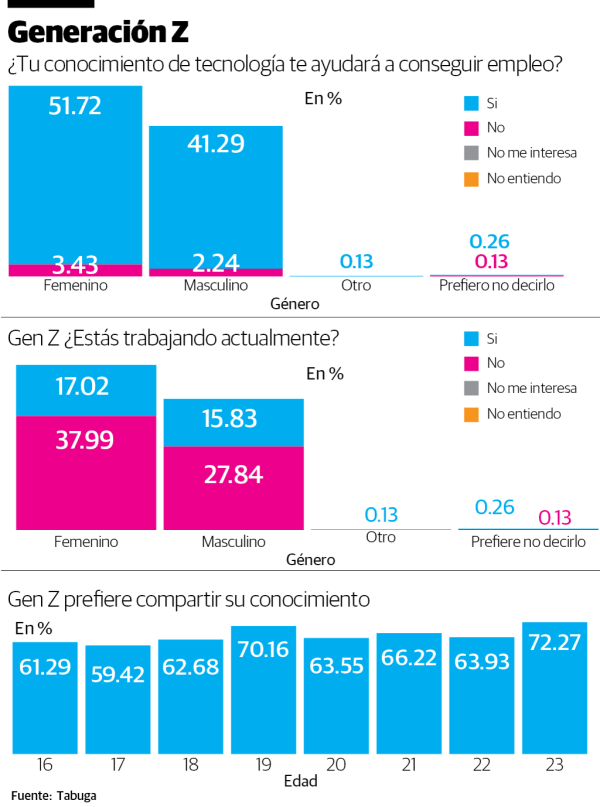
The following data was provided exclusively to Diario Libre by the general manager of Tabuga, Arturo López Valerio.
Generation Z: digital natives
One of the main characteristics of this generation is that it grows up and develops in an environment surrounded by technology, which is why its members are called “digital natives”. This has an effect on the study's findings: candidates from this generation are drawn to companies that implement technologies, and 59 percent take this into account when choosing between similar job offers.
However, the study's participants said that, although they can use cutting-edge technology, they can adapt to the tools available in companies. In addition, 44% of candidates expressed a preference for going to a workplace, and 43% prefer to interact in person with their coworkers over any other tool, since 41 percent expect to learn from their colleagues at work.
Self-awareness: a challenge for the business sector
Two important findings are that this generation is aware of its skills but prefers to refine them before taking a job; that is, candidates prefer to finish their studies before starting to work. And, on the other hand, they prefer to be paid for their work, even if it is their first job. However, 52 percent said they want a job with a purpose beyond simply receiving a paycheck.
This represents a major challenge for the business sector, since one of the traditional requirements employers demand, and the one on which an employee's salary is often debated, is work experience; and this generation wants to be paid well for its knowledge, more than for its work experience.
Much has been said in the world of marketing and its strategies about how current generations prefer experiences and respond to them. And the study conducted by Tabuga found that 86 percent of participants want to learn new skills and have new experiences.
Use of technology
Other data from the study show that 33 percent of participants want to work with cutting-edge technology in their future careers. Meanwhile, 71 percent are willing to act as technology mentors for other colleagues at work.
In educational terms, 78% said they used technology as part of their formal education. Meanwhile, 75% acknowledge that technological literacy is important. In addition, 89% rated their technology education as good or excellent; 92 percent are confident they have the technological skills employers want.
In the current digital era, cybersecurity is one of the major concerns of companies and citizens; among Generation Z, 89 percent of the study's participants rated security as a high priority.
Meanwhile, 68 percent of them said they are doing what they can to protect their data. And 90 percent say they are careful about what they post on social media because it could affect their future professional career.
The study presents the results of the first phase, through which it seeks to offer a broad view of Generation Z's tastes and ways of operating.
Published in the newspaper Diario Libre, 10 March 2020.