QR Code: a «retro» trend gaining strength in the Dominican Republic
The QR code (short for Quick Response Code) is a type of matrix barcode (or two-dimensional barcode) first designed in 1994 for the automotive industry in Japan. Recall that a barcode is a machine-readable optical label that contains information about…
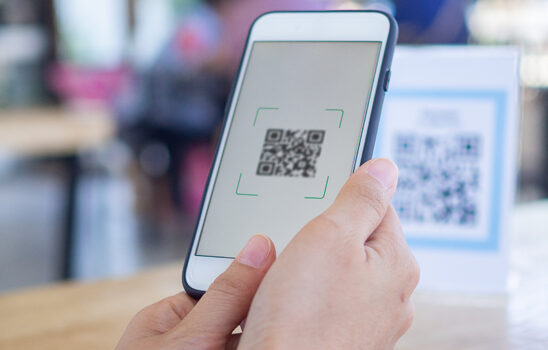
The QR code (short for Quick Response Code or QR code) is a type of matrix barcode (or two-dimensional barcode) first designed in 1994 for the automotive industry in Japan.
Recall that a barcode is a machine- readable optical label that contains information about the item it is attached to.
A QR Code uses four standardized encoding modes (numeric, alphanumeric, byte / binary and kanji) to store data efficiently.
Rise and popularity
The quick response system (QR Code) became popular outside the automotive industry because it is easy to read and has a greater storage capacity than the standard UPC barcodes used in the retail industry.
Its applications include product tracking, item identification, time tracking, document management and general marketing.
The most distinctive visual feature of the QR Code is black squares arranged in a square grid on a white background. It can be read by an imaging device, such as a camera, and processed using Reed-Solomon error correction until the image can be properly interpreted. The required data are extracted from patterns present in the horizontal and vertical components of the image.
It should be understood that this is a legacy technology, since its underlying principle is very basic. Its use has been declining in the United States since 2015, but it has been revitalized by the Chinese and Indian markets to bring financial activity to the common citizen at scale.
Its incidence in marketing communication
QR codes have become common in marketing communication. Usually, a smartphone is used as a QR code scanner, which reads the code and converts it into a useful form (such as a standard URL for a website, which saves the user from having to type it into a web browser).
It is an interesting piece in the mix of an advertising strategy, since it offers a way to reach a brand's website faster than by manually entering a URL. Beyond the simple convenience for the consumer, what matters about this capability is that it increases the conversion rate: the likelihood that contact with the ad turns into a sale.
It draws interested prospects past the conversion funnel with little delay or effort, taking the viewer straight to the advertiser's website, where a longer, more specific sales pitch could lose the viewer's interest.
Its impact on advertising in the Dominican Republic
In our country they began to be used around 2010, as their use became popular through smartphones and through activations that were taken up by the national press, which applied the codes to its publications.
Their adoption was short-lived, since at the time they required smartphones with reading software installed, or users simply did not have a data plan to view the content. As a result, uptake kept declining and the codes were quickly dropped from communication campaigns. Having failed in advertising, they were written off as a commercial technology despite their potential.
Multiple uses beyond advertising
Mobile operating systems
QR codes can be used on several mobile device operating systems, allowing QR codes to send metadata to applications already on the device.
Virtual stores
The use of QR codes for «virtual store» formats began in South Korea and Argentina, but is now expanding worldwide. Amazon, Google, Walmart, Procter & Gamble and Woolworths have already adopted the virtual store concept.
Payment QR Code
QR codes can be used to store bank account or credit card information, or they can be designed specifically to work with the apps of particular payment providers. In developing countries such as India and China, paying with a QR Code is a very popular and convenient method.
Its adoption in Europe between 2012 and 2013 paved the way for its use in Asian markets.
In the United States, Near Field Communication (NFC) technologies were pushed instead, which require a special component in the smartphone. The QR Code became the official local solution for payments in vulnerable areas and for cryptocurrencies.
Website login
QR codes can be used to log in to websites: a QR Code is shown on the login page on a computer screen, and when a registered user scans it with a verified smartphone, they are logged in automatically. In 2012, Google built its own reader into its Chrome web browser.
WiFi network login
By specifying the SSID, the encryption type, the password/passphrase, and whether or not the SSID is hidden, mobile device users can scan and join networks quickly without having to enter the details manually.
Since January 2018, iPhones have had this function built into the camera app since iOS.
Funerary use
In 2008, Ishinokoe, in Yamanashi Prefecture, Japan, began selling gravestones with QR codes produced by IT DeSign, where the code leads to a virtual tomb of the deceased.
Other companies, such as Wisconsin-based Interactive Headstones, have begun to put QR codes on gravestones.
Its rediscovery
The establishment of trade relations between the People's Republic of China and the Dominican Republic has driven an exchange that has produced a technological catalysis that can help Dominican entrepreneurs break many paradigms.
Thanks to this catalysis, the usefulness of the QR Code has been rediscovered, along with its capacity to create frictionless interaction between service entities (whether private or governmental) and the citizen.
Scanning is the simplest form of interaction, even faster than voice; China's bet on this technology has proved much more accurate than the world of voice commands that the big entrepreneurs in the North American market are pushing.
One sign that the format is viable is its recent application in Amazon's mobile app, within the features of Amazon Pay, where the Western giant of online sales is seeking to take on WeChat and Alibaba, Asian giants that have doubled their volumes of digital sales this year compared with the United States.
Why does it work in China and Asia?
1) In its early days, WeChat made it a built-in feature and offered it to millions of users. It was later used wisely as part of Tencent's O2O (Online to Offline) strategies.
2) When O2O became almost a craze, more tech giants noticed the high adoption of the QR Code and its power. They reinforced the concept by building it into their products.
3) An interesting fact is that those giants were not the ones that actually pushed the QR Code onto the population. It was the countless merchants who use the QR Code to advertise.
4) And stepping outside the business world, I would like to examine some underlying cultural factors.
It began as an access strategy, then a commercial one, and finally it reaches marketing communication.
Opportunity for banking
The local financial ecosystem has managed to learn from the mistakes of other industries and has taken advantage of the new technology approach to redefine interactions in financial products on the island, reducing communication time among the sector's players.
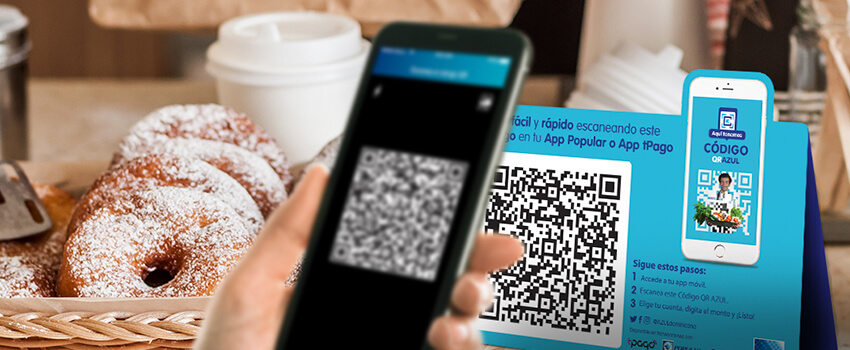
The Banco Popular Dominicano, launched a new feature in its App Popular, which lets customers pay merchants affiliated with AZUL from their mobile phones by simply scanning a QR Code, contactless.
As part of its ongoing innovation in payment methods, the QR codes guarantee immediacy and security in information processing, plus the benefit of making physical distancing easier, which is necessary in the current circumstances of the health crisis.
Feature enables immediate contactless payments to merchants
This QR Code payment solution is the result of the investment in technological innovation made jointly by Banco Popular Dominicano, Servicios Digitales Popular, through its AZUL brand, and GCS International, a prominent fintech in the country and Latin America, in its role as processor. With this feature, the payment options available to users expand, improving their service experience.
This is an important moment for chambers of commerce across the country and the new authorities for industry and commerce, science, innovation and technology to begin specializing their programs around enabling a local ecosystem of digital transactions; a responsibility that belongs not only to banking, but to all the actors in the national economy.
Original piece broadcast on the Martes Tecnológico on La 91.3FM, on November 27, 2018