Experts discuss information as a public good
On the occasion of World Press Freedom Day, the UNESCO Chair in Communication, Democracy and Governance at the Pontificia Universidad Católica Madre y Maestra (PUCMM) and the UNESCO Regional Office for Culture for Latin America and the Caribbean organized the panel «Information as a public good: challenges and future perspectives…
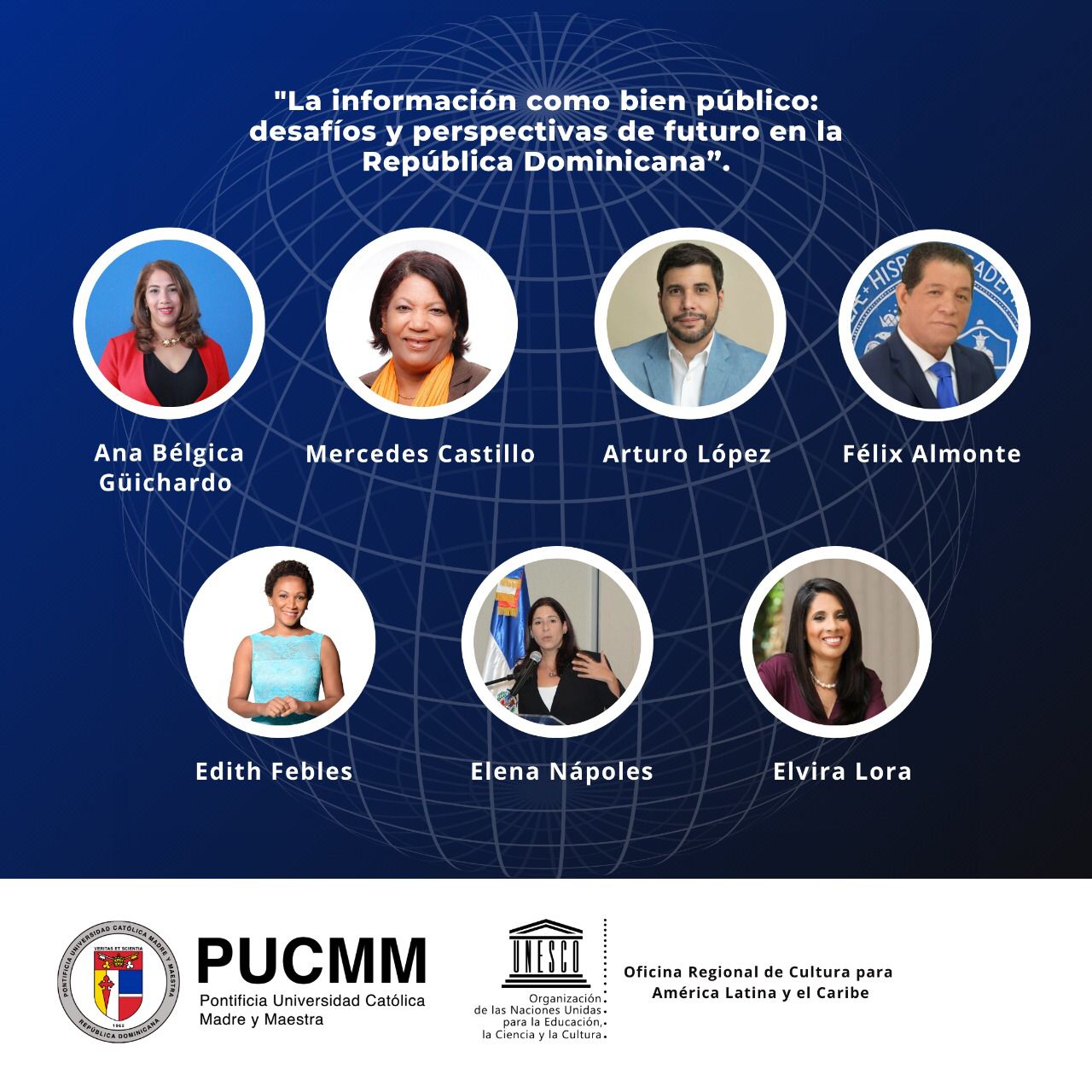
On the occasion of World Press Freedom Day, the UNESCO Chair in Communication, Democracy and Governance at the Pontificia Universidad Católica Madre y Maestra (PUCMM) and the UNESCO Regional Office for Culture in Latin America and the Caribbean organized the panel «Information as a public good: challenges and future prospects in the Dominican Republic».
Dr. Ana Bélgica Güichardo, director of the UNESCO Chair at Madre y Maestra and of the School of Communication at the Santo Domingo Campus (CSD), moderated the panel. «We thank each of you who have joined this important dialogue, which will set a course for continuing to insist on the need to preserve the work and safety of journalists in the virtual world», Güichardo said.
For his part, Dr. Mariano Rodríguez, dean of the Faculty of Social Sciences, Humanities and Arts, said that with the proliferation of media outlets, press freedom must be defended even more. In that regard, Mercedes Castillo, president of the Colegio Dominicano de Periodistas (CDP), noted that journalism is not just any information, «it is current information that connects with democracy, and democracy helps us practice the profession».
Meanwhile, Félix Almonte, president of the Association of Communication Schools of the Dominican Republic (ADECOMRD), referred to citizen journalism, stating that «it is a profession that must be studied, that has technique, that has regulations, and that requires knowing the language in order to handle it correctly».
Dr. Elvira Lora, Communications director at the Ministry of Economy, Planning and Development (MEPyD), shared the results of the first national survey on cybersecurity for journalists. Referring to journalists, she emphasized that «recognition is being given not only to who we are, but to how content is distributed and received, in order to strengthen journalistic practice and advance transparency and empowerment without leaving anyone behind».
Likewise, Arturo López Valerio, president of Cámara TIC and a member of the Inter American Press Association, said during his participation that the journalist's work has expanded with the amount of information being handled and the immediacy with which it occurs. Meanwhile, Elena Nápoles, officer of UNESCO's Communication and Information Programme, considered: «Citizens must know what to expect from the media, in any of its formats, because it is citizens who have to demand a press that increasingly delivers more transparent journalism, not mediated by interests».
The event took place on Thursday, 6 May 2021, on a virtual platform.
Published by PUCMM, 12 May 2021.