A Tech Hub for the World
Opening remarks at the first ICT Week, on November 30, 2021, in the Piantini Ballroom of the JW Marriott Hotel, in my capacity as president of the Cámara TIC.
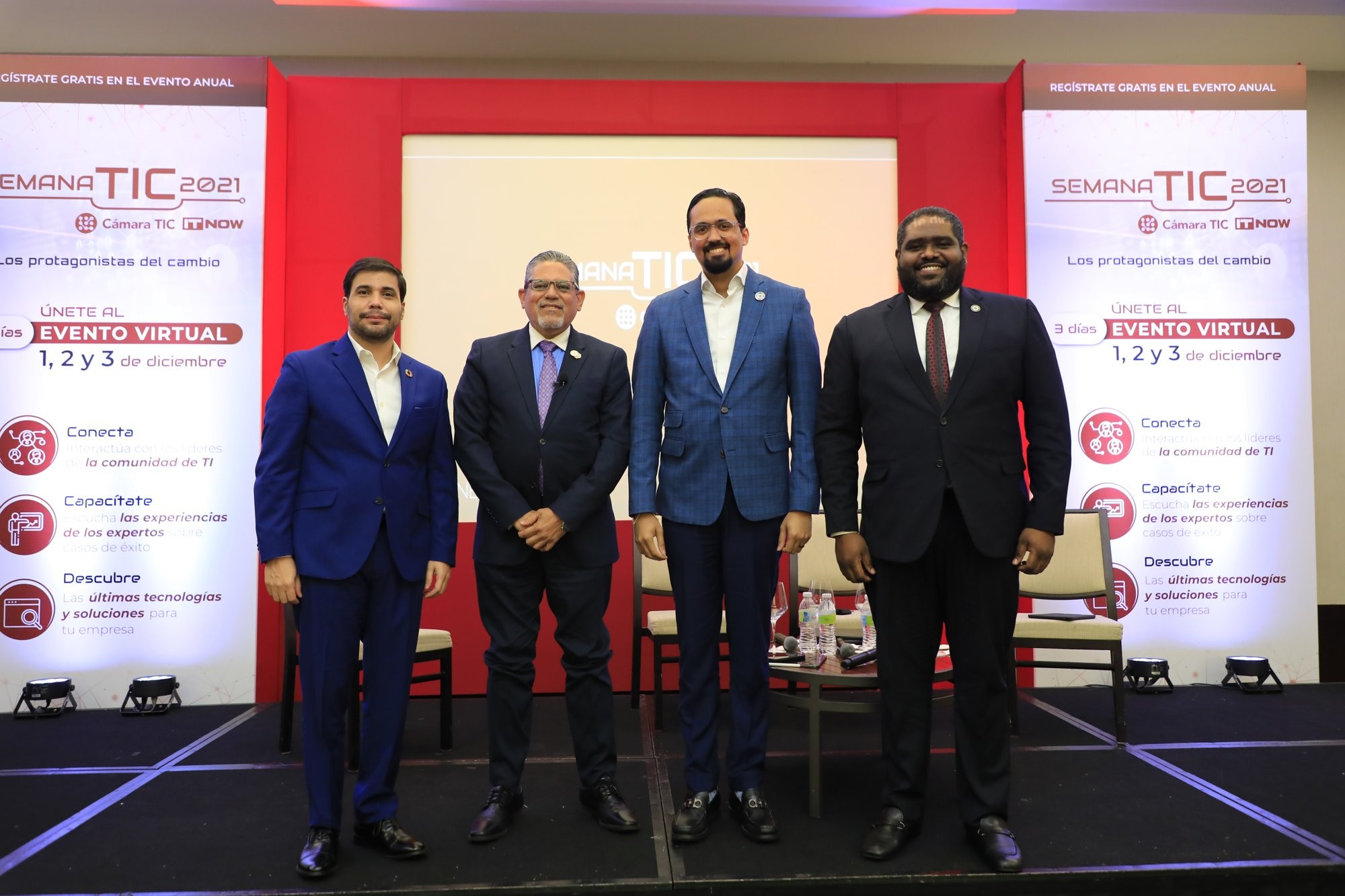
Opening remarks at the first Semana TIC, on November 30, 2021, in the Piantini Room of the JW Marriott Hotel, in my capacity as president of the Cámara TIC.
Good evening. First, thank you for answering our call. Before starting we were saying that, given the traffic and today's rain, it seemed a bit hard to expect many people to gather here, and you have defied any forecast or low expectation. So I ask you to give yourselves a round of applause, because we at Cámara TIC feel very good, above all with the support of allies, friends and colleagues. After two years without in-person events, we are meeting again, if only for a short time.
I want to thank the authorities who are here with us: José David Montilla, Vice Minister of Digital Agenda; Pedro Quezada, director general of the Government Office of Information and Communication Technologies (OGTIC); Bartolomé Pujals, executive director of the Innovation Cabinet; Julissa Cruz, director of the Dominican Telecommunications Institute (INDOTEL). Also Armand Toonen, Vice President of B2B and International Business at Altice, and, virtually, José Otero, who will be connecting with us, Vice President for Latin America and the Caribbean of 5G Americas.
This Semana TIC was an idea that we managed to co-create thanks to the team at Conecta B2B, our great ally in this event: an event that we hope will be the starting point of many Semana TIC editions over the years. Also, without our sponsors, whom I would like to mention —Altice, Cecomsa, Cstisa, Huawei, DiDi, Uber, Grupo Universal, OGTIC, Sendiu and Tabuga—, this event would not have been possible either.
The Dominican Chamber of Information and Communication Technologies, Cámara TIC, is an entity founded in 2010. It is a focal point where different actors of national life converge, and its purpose, since its founding eleven years ago —and I speak as one of its founding members—, has been essentially to look at the whole digital context and its evolution.
This morning we saw how exporting digital goods and services is feasible in this country, and earlier this afternoon I was talking with José David about history. The Digital Agenda 2030 that we have now is the product of efforts by authorities, technologists, enthusiasts, people who love the country but who also understand that technologies are the means of development for our nation.
During the institution's eleven years we have seen challenges, changes, oversight actions, advances, exchanges, speeches and achievements, but I can sum it up in one word: resilience. Above all, that we are here after the pandemic. The institution would not have come this far —and I take the liberty of saying so— without the work of previous boards, nor of its presidents. Let me mention Rosario Sang and Armando Tavárez, because they paved the way to what we have today and what we have built.
The pandemic stopped the world in 2020 and hit the institution hard. That was a year of challenges the institution had never faced before. We began the 2020-2022 board with a minimum number of members and the big task of repositioning the institution before the ecosystem and the new government authorities.
I want to thank the Board of Directors, especially our vice president, Mite Nishio, for accompanying us on this journey. Over the years, Mite has been more than a colleague: a friend who has always been by our side.
Twelve months have passed since we outlined the work plan 2021 and the result has been impressive; today is a sample of it. The Chamber is focusing its repositioning on the digital economy. If we look at the North American Industry Classification System (NAICS) classification of 2017, it introduced a radical change for ICT in terms of including the different activities enabled by the internet industry. Then, almost five years later, the digital economy is an engine of change for activities across the entire value chain, accounting in the country for 4,3 % of gross domestic product in 2020, and projected to reach 5 % of gross domestic product this year.
At Cámara TIC we are working so that the technology sector and its various classifications can serve as catalysts in the country's economic recovery. As an institution, we are a consultative actor in the business ecosystem, working to generate human development and opportunities for all Dominicans through information technologies.
When we took on the challenges of the 2020-2022 board, we set two fundamental objectives. First, to serve as a consultative actor for the national business community, because technology is a cross-cutting axis for business development. Second, to size the digital economy as an accelerator of the democratization and growth of the ICT sector in the country.
With the objectives clear, we proceeded to draw up the institution's work plan. The main challenge we found was paradigms. We set out to operate like a startup: digitalizing as much as possible, connecting through software and using resources minimally.
We have an inside joke that at the Chamber we are 1 ½, and that counts its president —here, executive director— and Evina Davis, who is around somewhere, always virtually. Many met Evina only after almost two years; many will have interacted with her virtually, because we believe technology enables, creates flows, creates processes and creates value.
We also defined the strategic axes. The first was administrative normalization: we automated the processes of the digital operation and now we have a digital linkage from enrollment through to the registration of memberships. The second was effective communication with stakeholders, to position the Chamber as a consultative actor, as an actor that works across sectors. The third, strengthening the institution, working on membership growth and collaboration tables. We have a public example in the digital economy table, where, faced with the challenges of the Tourism Cabinet, INTRANT and the digital platforms, we were able to work so that they could reach an agreement, and the process has been very interesting. In the words of the table's participants, no organization on the continent had paid attention to the platforms in such a short time to produce a position for regulators in less than three days, which makes me very proud of the Chamber's work team and also of the work of Evina Davis, who has always supported every initiative.
As part of the journey we focused on those axes so that the Chamber could join the multisector conversation. First, through the appointment to the Digital Economy table of the Digital Transformation Cabinet, decree 71-21. The appointment to the Investment and Innovation table of the Innovation Cabinet, decree 464-21. In the conversations on the National Innovation Policy. Also, as a fundamental and strategic part, in the National Strategy for the Export of Modern Services, thanks to the call of the Dominican Republic Services Coalition. Taiana Mora is around here somewhere: thank you for your support and for always trusting Cámara TIC, since its beginnings. Also in the conversations on the digital economy bill being prepared by Deputy Orlando Jorge Villegas, and in the National ICT Statistics System, together with the National Statistics Office (ONE) and INDOTEL.
All this progress has been possible thanks to the support of the institution's allies, who since December 2020 gave us their backing in the effort to strengthen associativity in the technology sector, which includes technology experts but also the companies that consume technologies, because this ecosystem is growing more every day. Thanks to the Santo Domingo Chamber of Commerce and Production, the Santiago Chamber of Commerce and Production, the Federation of Chambers of Commerce (FEDOCÁMARAS), the Santo Domingo Economic and Social Development Council (CODESSD), the Dominican Association of Commercial Communication Companies (ADECC), the Dominican Association of Electronic Security Companies (ADESE), the Association for the Promotion of Renewable Energies (ASOFER), 5G Americas and the Dominican Republic Services Coalition. I also want to thank the national press, which has spread the institution's various presentations and activities throughout this year: we have had practically an average of one conversation a week over the last eleven months.
The Chamber's true role, and one of the findings I came upon after going through the institution's archives —remember that we went through a digitalization process; I had to read about 20.000 emails—, is that we were able to recover the institution's history and the responsibility it carries, because it is a responsibility to the country. International organizations ask the Chamber for validation of activities carried out by the State and by governments. Since its founding and throughout its history, the institution has made agreements with three different governments. That is, we have seen time go by; perhaps José David Montilla has been a constant presence in the conversations over the years.
The Chamber is here to carry out its oversight function as a civil society actor; therefore, we remind you that it is important to involve the institution more so that adequate consultation mechanisms can be established. We are an institution with a cross-cutting role, hence the importance of alliances across the entire national technology fabric, hence our allies from different sectors. The consultations carried out by the ITU, ECLAC and other bodies require a constant look at each subsector.
When we look at the sectors going through labor pains, we realize they did not prepare for the change. Nor should they change suddenly: we understand that they must integrate solutions quickly, on the belief that it is better to start with an imperfect solution and then improve it than to spend a long time lobbying for the wrong one. Can we design the future without technology? No. Technology goes with us; it is a central issue for every business leader. We have to recognize that interfaces will be more personal, language less technical, and that user interfaces will continue to hand power to the consumer. They will always choose the best option on the market. For this reason it does not surprise us that the digital economy reaches 5 % of the Dominican Republic's GDP this year 2021.
We cannot hide this reality, but it is also changing the way organizations work. Work in 2021 no longer flows the way it did a decade ago. Thanks to this digital growth we have seen that local digital talent can plug remotely into multiple markets, and that the fourth industrial revolution is accelerating opportunities for professionals in the ICT sector and modern services. The future of our sector lies in the capacity to enable a technology hub not only for the region, but for the world.
Good evening, everyone. Thank you very much.