Interview on Líderes TV
"EDUCATION doesn't have what the MARKET is demanding of TALENT", Arturo Lopez Valerio. https://www.youtube.com/watch?v=I9BlyqDs1eo&list=PL3rigUZ7nlY8NnjxprFidbhY5TDizs4Y1&index=100 Orlando S. Jorge Villegas- We are with Arturo López Valerio, president of the Cámara TIC, (the Dominican Chamber of Information and Communication Technologies), who has been a great ally of this program since the early years of “Líderes”…
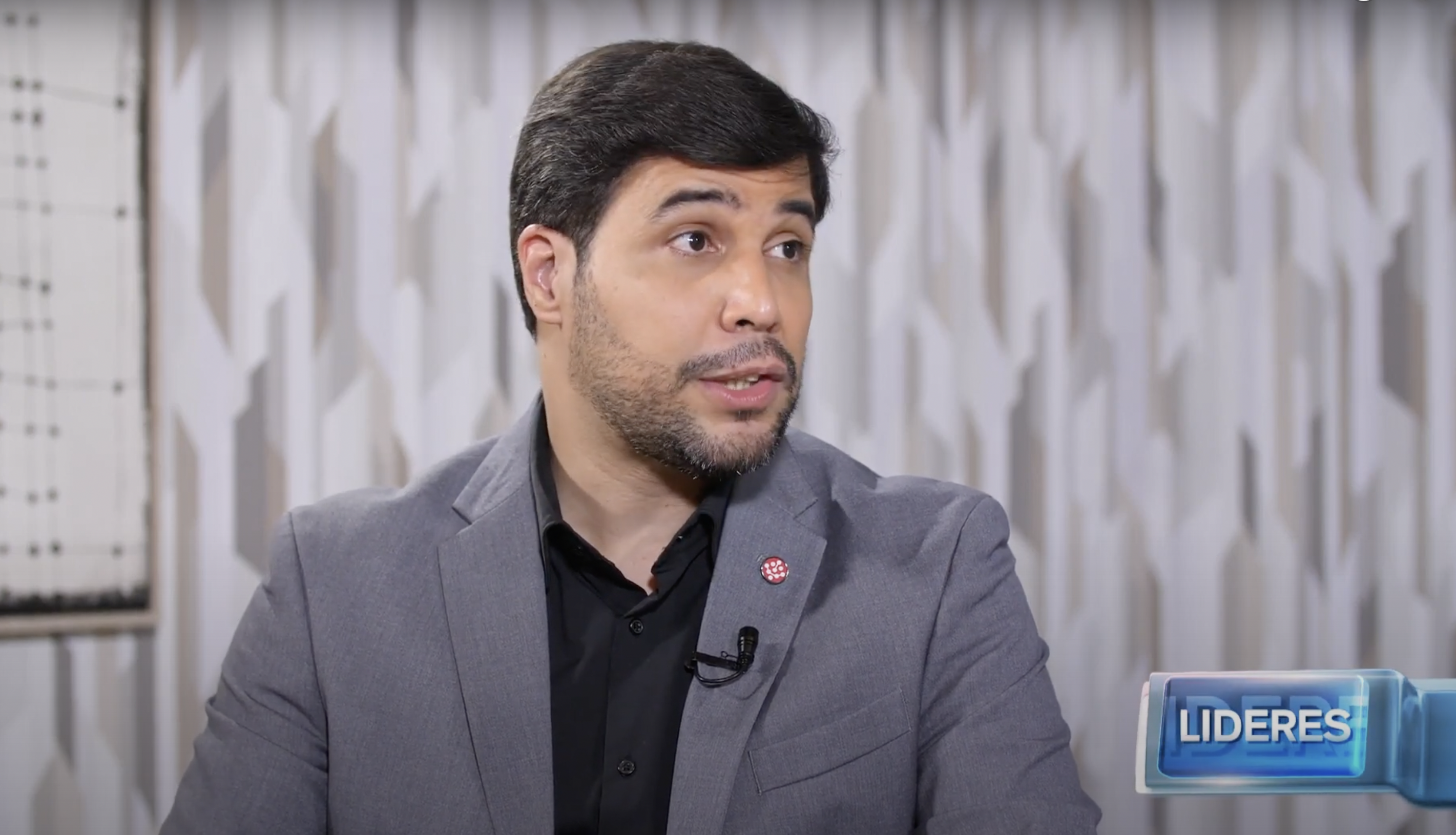
«EDUCATION doesn't have what the MARKET is demanding of TALENT», Arturo Lopez Valerio.
Orlando S. Jorge Villegas- We are here with Arturo López Valerio, president of the Cámara TIC, (the Dominican Chamber of Information and Communication Technologies), who has been a great ally of this program since its first years of “Líderes” alongside my father, Orlando Jorge Mera.
Arturo, thank you for joining us.
As always, on Líderes we go over topics related to technology and the digital economy with you, and I'd like to start there. Today, what is the state of the digital economy in our country?
Arturo López Valerio- The digital economy in the Dominican Republic currently represents 5.86% of gross domestic product this year 2022, according to the projections at our consulting firm Tabuga. Last year it closed at practically 5% of GDP, which shows us the level of organic adoption Dominicans have of technologies and how they are applying them in their daily lives.
Jorge Villegas- We have talked on several occasions about creating a legal framework for the digital economy of the Dominican Republic.
We have seen how other countries have already adopted one, whether through a law or some kind of decree or regulation, depending naturally on each country's administrative rules. In the Dominican Republic, as I mentioned, there is the share of GDP it represents, but this is a growing industry, and naturally the newer generations in particular are sharpening their aspirations toward the businesses and industries that are part of the digital economy. From a regulatory standpoint, what do you see that we need right now to push the digital economy even further?
López Valerio– I believe we need a special type of law that helps us standardize the language between the strong sectors, which have means of production that predate the digital economy, so that they can align with the growth and the need for digitalization the world has. The current framework practically governs what already exists, and we need to develop a set of laws that first help young people win room to grow, above all in new technologies.
Take NFTs (non-fungible tokens), for example. In other countries they are treated as commodities, but in our financial regulatory framework there is still no specification, and what happens is that they are rejected until they are understood.
I understand that disciplines like eSports and elements like cloud computing need a framework that allows demand to grow, because there is something important here: if the country can open up to greater adoption, digital linkage and a digital value system will help generate demand, and when there is demand, it can help the foreign companies that govern this technology to establish themselves in the country, not the other way around. So I understand that the framework will help us, and above all will help different public-sector entities understand the dynamic of the digital economy, which is first incentivized and can then be regulated.
Jorge Villegas- By the way, in our role as legislators we have pointed out that, because our legal system has no mandate to review laws periodically, we have this gap where a digital economy law is concerned. We have the telecommunications law, which dates from 2000-2001, obviously when it was enacted, and it has not been updated. So these laws will create the framework for these industries to keep growing in an orderly way, but the digital economy changes so much. How do you see a framework, one we manage to achieve at some point, being able to keep pace and develop even as new things come along? How can legislation keep up with the speed of technology?
López Valerio- I have always said that innovation will always precede regulation. But if there is a commission constantly watching the changes so it can update and make the necessary amendments, which is not done today, since many laws are enacted and their implementation is left hanging, the idea is that the law itself could have its own mechanism, through a body or some kind of council that can keep those elements updated against indicators, which is what we often don't see in our country across different sectors.
If we can establish what are defined as key indicators within a legal framework, we would even be doing something novel, because we would be telling the country “when we reach this target, we will adjust”, because that means the world has changed.
Jorge Villegas- Speaking of the digital economy, something else we have emphasized, and I would like your opinion as president of the Cámara TIC, is STEM education. We have to instill in children, from an early age of course, the disciplines linked to STEM education (Science, Technology, Engineering and Mathematics) so they understand that they have a future within the digital economy. How do you see this in our country? STEM education is being implemented in some sectors, but how would you see a framework, or a plan, for the public sector to instill STEM education?
López Valerio- STEM education is still incipient, and unfortunately it has to do with adoption factors, because much of the educational material, or capacity-building material, as I like to call it, is practically not produced in the country; we depend on importing it.
There is one key detail: if we manage to create a model in which education itself is decentralized, without removing the central authority that approves who is doing the educating. For example, we have a case in Mexico where STEM education is open to free competition, so the ministry or secretariat of education simply certifies. There is a curriculum, it is endorsed, but if an actor decides to incorporate more innovative elements, the game doesn't get stuck. Since the Ministry certifies, it is stipulated that STEM education did take place. In fact, we have the platform “Capacítate para el empleo”, run by the Carlos Slim foundation and brought to this country, where those who pass certain certifications practically receive a diploma from Mexico's Secretariat of Education.
I believe it is time to change the paradigm, because if we wait for public policy and official instruments to catalyze STEM, we will end up in a lethargy. In the market, the kids are already getting their hands on it, as we say in good Dominican, because STEM is needed as a 21st-century capability. I think this decentralization model would be fundamental to accelerate and standardize this kind of education in the country.
Jorge Villegas- We have many liceos (secondary schools) in the Dominican Republic. Would you see a kind of STEM education platform in converting the liceos into polytechnic schools, within a plan perhaps in the short or medium term?
López Valerio -Yes, and it would be useful to take advantage of the existing structure, but note that STEM education also depends on the syllabus and the program, so we can't build it in stone. As you said earlier in one of your questions, this keeps being updated, so we need a framework that allows that innovation, which generally emerges in the private sector, to take place, and public actors who keep updating the program. But if you and I want to set up this room and want to educate, we should have the facility to do so, because now everything that adds up contributes, and we can't spend a long time getting organized as a country because we will run out of time and the world will move on to yet another stage, and we would be out of date again.
Jorge Villegas– I was referring, because your point is very valid, not only to the existing structure of the liceos but, for example, to the polytechnic model, which already has technical careers or disciplines. Couldn't it serve as a model that already exists, with the STEM component added so that it becomes something more complete, including the technical careers it already offers?
Referring to the polytechnic model that exists in our country as it is conceived, where many young people leave the polytechnic schools already prepared to go to the private sector for a first job, which is very important to say. Given that conception of polytechnic schools already in place, wouldn't it be an ideal platform to quickly introduce STEM education into the public sector?
López Valerio -I believe that if the polytechnic model is allowed to update itself, STEM gets integrated immediately, because it is the next stage. I am not going to teach a kid plain, simple electricity now; that electricity can serve robotics, so why don't we integrate robotics? Because there is no resource and no design, no program that updates itself. But there is another reality, which is that the polytechnic may be long in a world where the economic reality demands building capabilities immediately. So what we propose is that there be, and in fact we have discussed it in different forums, really a national skills framework in which a person can learn a skill that helps them become employable, because if they have to wait two years, and two years is a long time given the reality of our young people, many then choose to train on their own, perhaps on platforms that are not certified, simply because they have an urgency, not of the market but of the world.
That being so, I believe the polytechnic model is ideal for a two-year type of training, which I understand is still long. We need to define more models; we can't have the university, which is long by nature, and then the polytechnic still long. There are even international platforms that offer nanodegrees, or nano-diplomas, which are practically short careers, but who is sponsoring them? Technology companies that need resources and can't wait long. So talent decides “I want to study now and just do one thing, or I want to pursue a professional career and have more options and more growth”.
Not all of us run at the same pace in this global race, and I believe we have to open up the possibility for our youth.
Jorge Villegas– This skills framework you mention exists in process, because the law on the national qualifications framework has still not been submitted again to the National Congress. I understand it is a good method for the country to organize what requirements the private or public sector has in terms of work and employment, and which skills obviously need to be taught in academic centers so that this professional profile is created.
On what you mentioned about how technology companies are creating courses, even academic centers, to prepare professionals: are we in the Dominican Republic right now experiencing a brain drain, with young people opting to leave the country in search of opportunities in the digital economy?
López Valerio- I wouldn't call it a drain, because they no longer leave the country. I call them the invisibles. They go to the supermarket, pay ITBIS, go to the movies, watch an Avengers film, return home, program, earn their money, get paid by deposit, maybe earn more than any of us, and they have no interest in formalizing because they are already global actors. It's not for lack of interest but because there is no incentive. Why go back to working for micro-enterprises if as independents they literally bill 15,000 and 20,000 dollars, a good professional.
So, in the global reality, talent doesn't need to leave home. It's like the case of Mohammed and the mountain: now the mountain comes to Mohammed, and talent knows that what it has to do is prepare itself. That's why many are bypassing formal education, or skipping it, because education often doesn't offer what the market is demanding of talent. And that's within the skills framework, where we need to understand that we can't keep walking; we need to jog and even run, because in the end new technologies are defined by private companies, not by governments.
Consequently, when, for example, Facebook changes a data-access privacy policy, it immediately impacts 1 million companies globally, and the professionals here have to adapt to that Facebook change, while a university may arrive in five years and a liceo in three, but the kid is going to read a blog and the company itself tells him how to do it. Therefore, we have to understand that there is an atomization of the concept of work and, as a consequence, an atomization of the concept of education.
If I know something about one particle of a process that you don't, I have a competitive advantage, not local but global these days.
Jorge Villegas– Arturo, the first Open Data Commission was recently sworn in. What is the Cámara TIC's view, and what are the commission's purposes at present?
López Valerio – An excellent question. The Open Data Commission is there to organize the government's open data program and to find the procedures needed to carry it out. From the Cámara TIC, our job as a representative of civil society is to provide a space for validation and consultation, because many times the state builds and looks at its own navel, as I sometimes say as a good consultant, and civil society needs data.
There is something we need to understand, and I raised it at the committee's first meeting: open data and public data are two different things. The state decides when to open a dataset, but that doesn't necessarily make the data public, because if something is public it always will be. So we need to understand that, for many special needs, portals will be made available with access to data, but we need to go the extra mile.
What does this mean? We have very important data, for example on incidents, accidents, and the classification of the real estate registry. In other words, there is so much data that can help businesses, and above all companies, to do digital planning, an opportunity that is often being lost. What the Cámara TIC wants to bring is this private-sector approach: the state can help companies much more through data, without even trying to, simply by putting together a good dataset with API (application programming interface) systems where I can pull a piece of data. Take something all of us who have built a system in the Dominican Republic have programmed: the list of provinces.
The OGTIC already has that list public as an OGTIC service, but not as an open data model. So the interest is in how we can ask the state, and negotiate with it, to keep opening datasets that can help citizens, because they will be included in the national productive chain through applications and other services. I am quite satisfied with the fact and the spirit of the commission's meeting, first, and second, with the openness the state and the current government have to apply a data policy that is relevant, current, and needed by the technology sector to keep contributing innovations.
Jorge Villegas– How do you see the digital agenda 2030 being pushed by the digital cabinet of the Ministry of the Presidency in this government?
López Valerio– I have always been very transparent about my positions on programs and plans. In fact, I told Vice Minister Montilla that the agenda urgently needs to define and make transparent its key indicators, because we can make an extensive plan, but if we don't know the indicator, and how the indicators chain together, then even though it is very well regarded, won an international award and the Cámara TIC has supported it, the agenda also needs to work from the focus of the technologies themselves. Let me explain: without indicators, an agenda is practically a plan but one we won't be able to evaluate. The Cámara TIC has clearly defined its purpose and its role of carrying out efficient digital oversight, so we are still waiting for the agenda to present the indicators, and with those indicators we will be able to have another layer of organization. What has been presented is the plan, which is very well done, but again, a plan needs indicators to measure its future success.
Jorge Villegas– I'd like to go back briefly to when you mentioned that you call “the invisibles” the many young Dominicans who haven't formalized but provide services linked to the digital economy. You said there is no incentive, let's say, to formalize. What have you envisioned as an incentive for these young people to formalize and have visibility in our society?
López Valerio – These young people generally, besides buying a good chair and computer, that is, spending, invest in research and development. Currently there is no mechanism in the Dominican Republic to tell a small entrepreneur, a technology MSME, which we can define by these young people's billing level, that they would get a return on the taxes they should pay when they formalize. So if that exchange mechanism existed, where I pay taxes and formalize, but I can present for tax purposes all my investments in research and development that produce innovation for the Dominican Republic, that compensation would be created. It already exists in Brazil, Mexico, Colombia, Argentina and Chile, and it would help catalyze the entrepreneurial movement across Latin America.
Jorge Villegas– Well, Arturo, we want to thank you for joining us and discussing these very interesting topics linked to the digital economy, the reality of invisible young Dominicans. I liked that term, because we have to make them visible. I think the positions you have taken, and the public policies that remain to be made, are a commitment of ours. It won't happen overnight, but naturally there are synergies among drivers in the public and private sectors to achieve, over different timeframes, many of the advances we need as a country in the digital economy. Again, our thanks, and as always we count on you to discuss these topics, since you started with my father at the end of the 2000 decade. And with that we say goodbye to today's program, God willing we'll see you here on Líderes.
López Valerio- Thank you.