When Open Data Becomes a Myth
Opening remarks at América Abierta, on September 27, 2022, in Santo Domingo, in my capacity as president of the Cámara TIC.
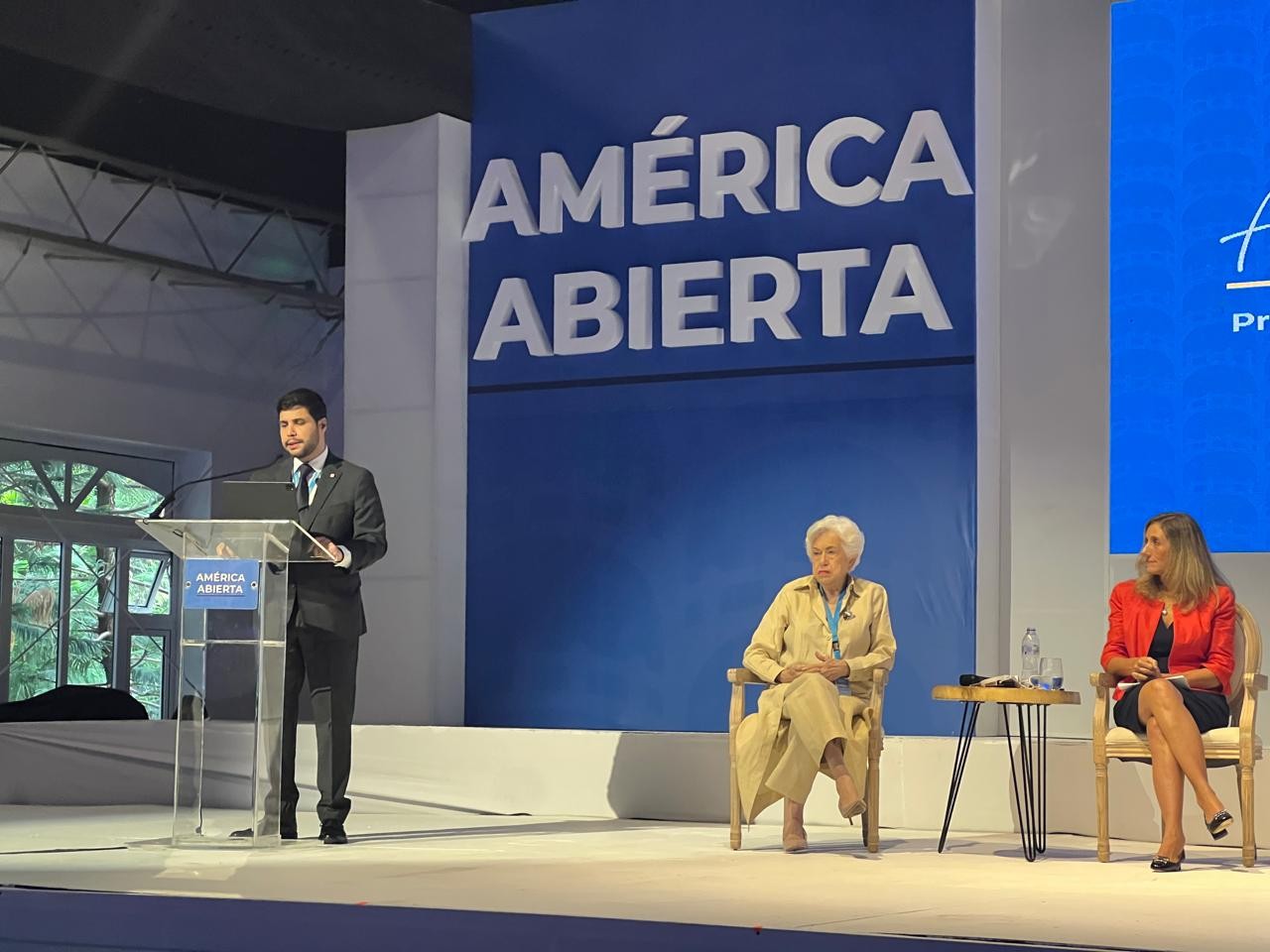
Opening remarks at América Abierta, on September 27, 2022, in Santo Domingo, in my capacity as president of the Cámara TIC.
Good morning.
Most Excellent Mr. President, Luis Abinader Corona, and through him we greet the other ministers and government officials who are with us. Distinguished Ms. Milagros Ortiz Bosch, adviser to the president on ethics, transparency and anti-corruption, and director general of Government Ethics and Integrity. Mr. Sanjay Pradhan, representative of the Open Government Partnership; Ms. María Fernanda Trigo, director of the Department for Effective Public Management of the Organization of American States; Ms. Anabel Cruz, director of the Instituto de Comunicación y Desarrollo (ICD) of Uruguay and of the Regional Initiative Rendir Cuentas; Mr. Fabrizio Scrollini, executive director of the Latin American Open Data Initiative. Your Excellency, ambassadors and diplomats, representatives of the business sector, academia, civil society, and friends of the press. Ladies and gentlemen.
Latin America and the Caribbean is «the most unequal region in the world», according to the United Nations Development Programme (UNDP), but also —and this is relevant given Storm Fiona— our region is the second most prone to natural disasters, according to data from the UN Office for the Coordination of Humanitarian Affairs. The UNDP report shows that, over the last two decades, 548 natural events have been recorded that caused losses of more than 12 billion dollars in just 12 of those occasions, and that have also affected more than 53 million people.
Brazil, for example, is among the countries with the largest populations exposed to this type of catastrophe, and Colombia records the highest number of people affected in recent years, with more than 10 million. They are followed by countries such as Panama, Costa Rica, Venezuela, Peru, Bolivia, Uruguay and Argentina, which have also been affected. And you may ask: what about the Dominican Republic? To our surprise, when we looked deeper into the statistics, we found that the last event that required international assistance was recorded in 2007. Events that require this type of assistance generate data that is captured, stored and processed by international organizations; hence the regional record excludes data from the country.
Ladies and gentlemen: we could speak about any other social, political or economic issue in which the freedom and equality of data play a decisive role in this 21st century. However, the context obliges us to pay attention to this one in particular, as it is the most recent and the one with the greatest impact in recent years: we are referring specifically to Hurricane Fiona.
In an article published in the newspaper El Nuevo Diario, we called attention to the scarcity of open data on atmospheric phenomena in the Dominican Republic, which represents an enormous challenge, but not an impossible one to overcome. It is precisely in the face of phenomena like these that data are the means by which citizens, in their various compositions, can act and organize more effectively in emergencies, and support the authorities and the Government.
Releasing homogeneous, accessible, manipulable data allows the invisible functions between the State and citizens to flow better and with less bureaucracy. This is a small but significant example of how open data, particularly hyperlocal data, can raise the problems that matter to people so that collective awareness can address them more efficiently.
On another note, the announcement of the Dominican Republic's National Open Data Policy has generated enthusiasm among development experts, donors, the government and the technology community, even though a large part of that audience has been left behind. One of the reasons for this lag is that open data has been turned into a myth. That is why we promote moving toward «data literacy» across the whole spectrum of users, with special attention to the media, NGOs, unions, professional associations, religious groups and universities.
The sociologist Alex Howard, of O’Reilly Media, believes that these particular groups can help demystify data, so that it is understandable to the general population and not only to statisticians. Another journalist, the veteran Justin Arenstein, calls these people «mass mobilizers of information», and Bono, the lead singer of U2, calls this factivism.
Dear friends: the Dominican Chamber of Information and Communication Technologies, Cámara TIC, proposes that the approach to overcoming this challenge is to institutionalize data literacy at all levels. This requires a public-private alliance that contributes human and financial resources, since we firmly believe that open data has the potential to change the rules of the game when it comes to meeting the 2030 Agenda for Sustainable Development. We must defeat this and all myths, in order to ease and shorten the time it takes to release data.
Today, technological tools for processing and visualizing data are increasingly easy to use and, moreover, freely accessible. As a technology consultant for more than two decades, I understand that the level of information exchange between organizations is key to making a difference. However, the norm is not exchange, but rather a model of institutional replication in which one organization focuses on reproducing the operating structure of another institution, rather than observing and reusing data. Ladies and gentlemen, this must change.
Another proposal we make from the Cámara TIC is that nonprofit organizations use their data only for social purposes and rely on a «voluntary subscription» option for the use of their data. We also believe they could develop a data «donation» model, in the same way that financial operations are protected. We believe that, by allowing donors the option to «participate», nonprofits will obtain better and more useful data, and will maintain public trust.
At the private or business level, we understand that the default should be to share as much data as possible. This is one of the most important paradigms we must change in the Dominican Republic, so that private organizations move beyond sharing only information about their work, or in meetings with their own staff, simply because that was how it was done in the world before the internet.
Today, the State generates large amounts of data; it is, if not the largest generator of data, one of the main ones, so much so that many institutions can no longer handle their data requirements with in-house solutions. Data is not just a matter of putting it out there, in any format and only to comply with regulations: it must be «actionable», meaning information presented in a way that can easily be used to drive citizens' decisions. It must be shown in its proper context, with precision, and in a place where the people who need it can see it. From the Cámara TIC and its Data Lab, we promote the adoption of analysis tools that help convert, process and filter the data the State collects, so that it becomes actionable.
According to Craig Hammer, of the World Bank's Development Data Group, «data is not perfect, but perfection is not the goal».
Friends: I want to thank you for the opportunity to appear before the América Abierta forum, and to close by asking that we support the initiatives that help bring about mass adoption of an open data culture in the country, so that it generates more development and democracy.
Thank you very much.