Five Factors Explaining Why STEM Careers Remain Male-Dominated
The gender gap in Science, Technology, Engineering, and Mathematics (known by the acronym STEM, which stands for Science, Technology, Engineering, and Mathematics) has drawn a considerable amount of attention and research. It is true that, despite progress toward gender equality in many areas, the…
Gender disparity in Science, Technology, Engineering, and Mathematics (known by the English acronym STEM) has drawn a considerable amount of attention and research. It is true that, despite progress toward gender equality in many areas, STEM careers remain predominantly occupied by men.
In recent decades, progress toward gender parity in various social and economic contexts has advanced, though slowly in some places. While, for example, female literacy has caught up with that of male counterparts since the 1970, many scientific fields are still heavily dominated by men. This is especially true for STEM jobs. Our chart, based on data from the National Center for Education Statistics, shows that progress toward a more equitable distribution of degrees awarded in science, technology, engineering, and mathematics has barely been achieved in the last ten years.
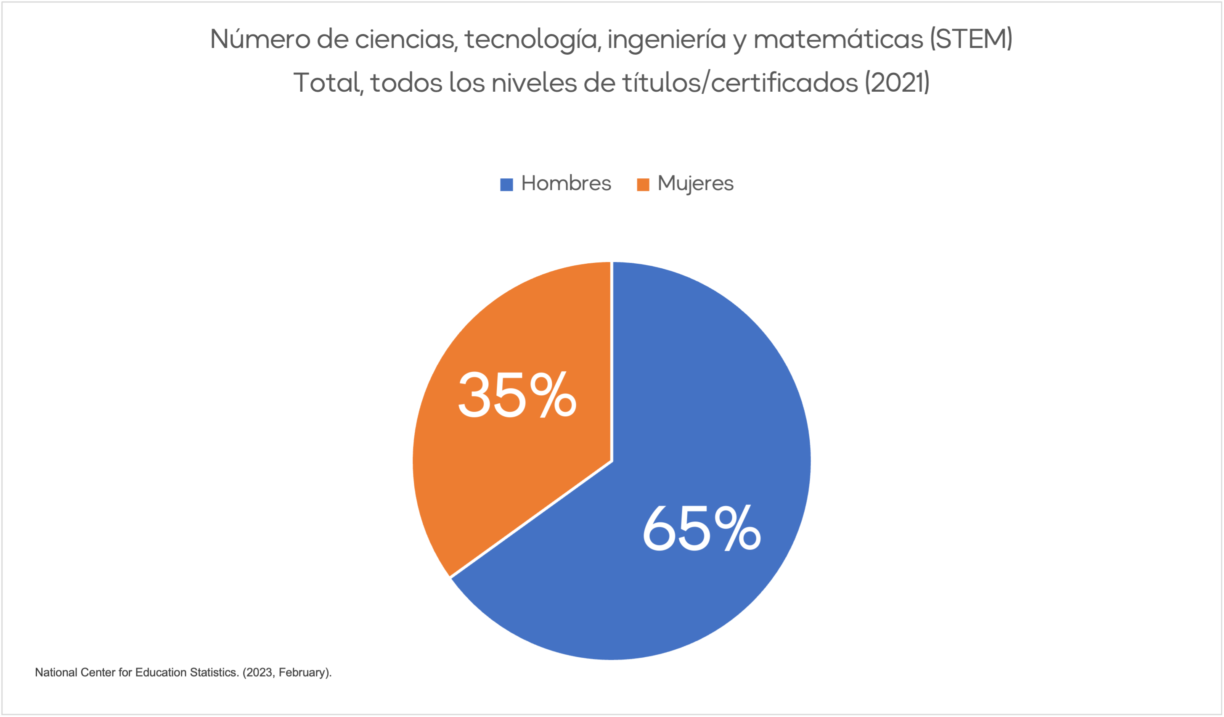
In the academic year that ended in 2021, more than 60 percent of all bachelor's, master's, and doctoral degrees at postsecondary education institutions in the United States were awarded to men. The distribution is even more skewed toward men for tertiary education below, or at, the associate degree level.
The former consist of certificates that do not necessarily lead to an undergraduate degree, while the latter are generally awarded after completing community college or similar institutions. Here, 71 percent of degree holders in the 2020-21 academic year were men.
Even so, associate degrees saw the most substantial shift toward a more equitable distribution over the last ten years, while the share of doctoral degrees in STEM fields awarded to women remained practically the same.
Overall, around 800.000 STEM degrees were awarded in the 2020-21 academic year, an increase of 42 percent compared with the previous ten years. In terms of total associate, bachelor's, master's, and doctoral degrees awarded in the United States in 2021, STEM degrees account for about 20 percent.
Analyzing the issue, we found several reasons that could explain this persistent disparity:
- Socialization and Stereotypes: From an early age, children are often socialized in ways that reinforce traditional gender roles. Stereotypes about who is «suited» for science or engineering can discourage young women from exploring these fields.
- Access to Resources and Opportunities: Differences in access to advanced science courses, extracurricular programs, and mentors in STEM can affect the interest and ability of girls and women to enter these fields.
- Institutional Climate: Academic and business institutions can, in some cases, be unwelcoming to women. This can show up in various ways, from the lack of role models to sexual harassment and discrimination.
- Imbalance Between Workload and Family Life: In many cultures, women take on a disproportionate share of family responsibilities, which can make it harder for them to commit to careers that demand a great deal of time and energy, as many in STEM do.
- Confidence Gap: Studies have shown that women, even when equally competent, tend to underestimate their abilities compared with men, which could make them less likely to pursue careers in STEM. It is essential to address these factors if greater gender parity in STEM fields is to be achieved. Beyond being a matter of social justice, making use of diverse talent is crucial for innovation and development in these critical areas.
When we wrote the Women in Tech report for Tabuga Intelligence, we found it hard to believe, given the roles women hold in technology today, that the first computer programmer was a woman. Ada Lovelace, an English mathematician and writer who lived in the Victorian era, designed and published the first algorithm.
Although it only became known much later, the first modern programmers were also women. During World War II, a team of women programmed and operated ENIAC (Electronic Numerical Integrator And Computer), the world's first general-purpose programmable computer, to perform calculations. The two male engineers who designed ENIAC received due recognition for their contribution, but the pioneering programmers were forgotten for a long time.
In the immediate postwar period, computing was considered women's work, since it was believed to resemble meticulous activities such as knitting and sewing, which require patience and care, and women were believed to be a perfect fit.
Stereotypes worked in women's favor this time, and the pioneering American computer scientist Grace Hopper deliberately invoked those stereotypes to encourage women to enter the field of computer programming. The most important technology jobs at the time were tied to hardware, such as electronic and mechanical engineers, and were held mostly by men.
It is true that the history of technology and computing offers several notable examples of women who pioneered the field, but now it is essential to address the factors mentioned above if greater gender parity in STEM fields is to be achieved.
Beyond being a matter of social justice, making use of diverse talent is crucial for the innovation and development of our country.
Published in El Nuevo Diario (digital), October 17 2023
Printed in El Nuevo Diario, October 18 2023