The Micrometeorite Dilemma
Space, for all its vastness, has become an increasingly crowded environment. Advances in space technology have made it possible to launch numerous satellites, space stations and other missions, but this progress has come with a significant increase in debris orbiting the Earth. Among this debris, micrometeorites…
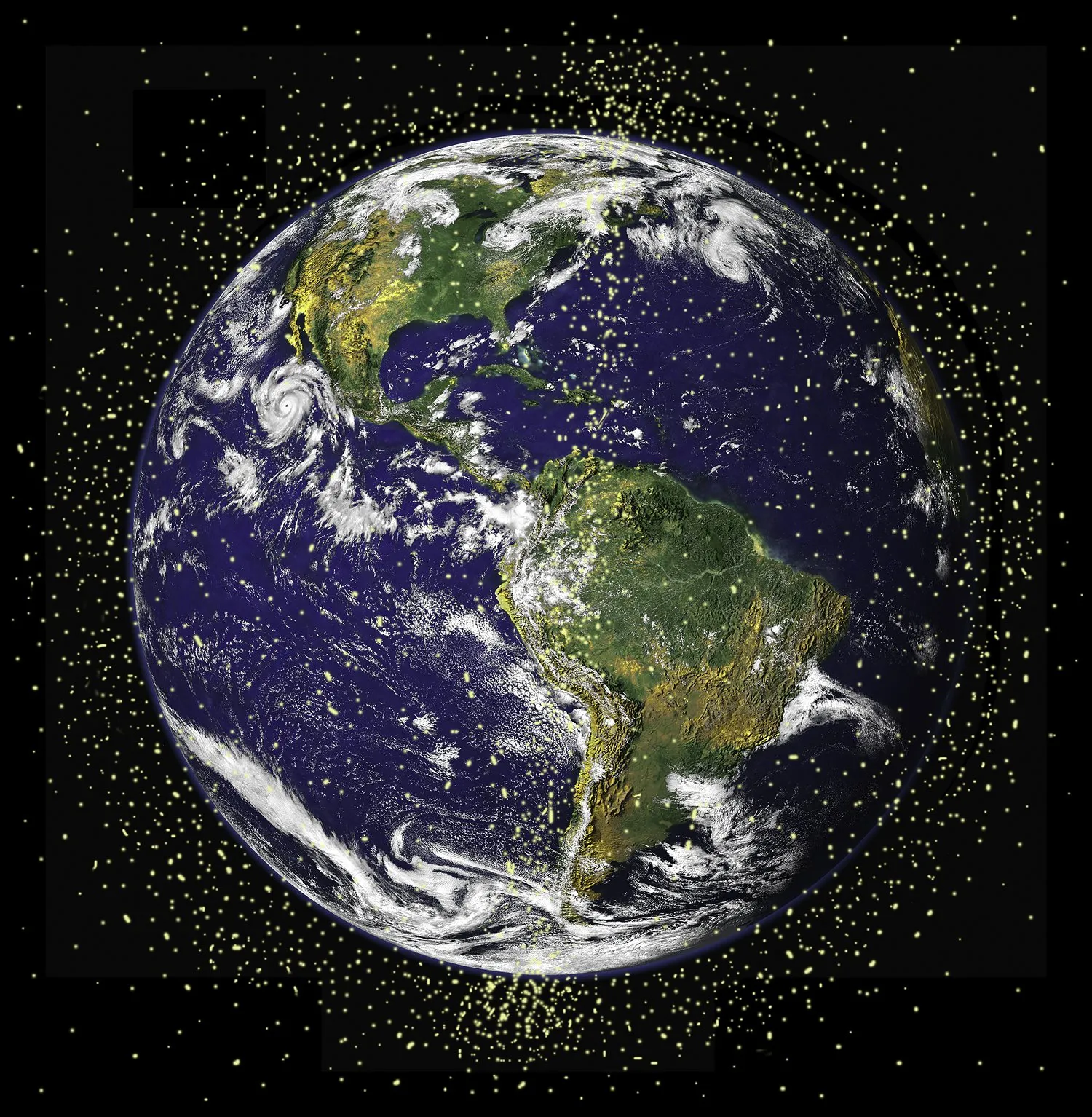
Space, despite its vastness, has become an increasingly crowded environment. Advances in space technology have enabled the launch of numerous satellites, space stations and other missions, but this progress has come with a significant increase in debris orbiting the Earth. Among this debris, micrometeoroids and fragments of space junk pose a considerable risk both to space missions and to life on Earth.
According to the National Aeronautics and Space Administration (NASA), micrometeoroids are tiny fragments of material that travel through space at extremely high speeds. These fragments can be natural in origin, such as cosmic dust particles, or human-made, such as debris left over from earlier space missions. These small objects can travel at average speeds of 10 km/s (22,000 mph), which makes them highly dangerous projectiles.
Space junk, for its part, consists of larger fragments of equipment and spacecraft that are no longer in use. This debris, like micrometeoroids, can cause serious damage when it collides with active satellites, spacecraft and stations such as the International Space Station (ISS). The risk is so high that even a paint fleck 1 centimeter across can inflict damage comparable to that of a 250 kg object traveling at 100 km/h on Earth.
The problem of space junk was recently illustrated by an incident in Florida, where an American family is claiming more than 80,000 dollars from NASA after a piece of space debris went through the roof of their house. This incident, which involved a 700-gram object from a used battery cargo pallet jettisoned from the ISS in 2021, highlights how serious the problem is. Fortunately, no one was hurt, but the incident underscores the potential danger this debris poses to life on Earth.
Although space junk incidents that reach the Earth's surface are relatively rare, micrometeoroids are a constant challenge in space. These tiny fragments can cause significant damage to spacecraft and pose a threat to astronauts. To mitigate these risks, advanced materials and protective configurations have been developed for the vital components of spacecraft.
Micrometeoroids and space junk can be classified by origin, size and the risk they pose. Below, we share each of these classifications according to the European Space Agency (ESA):
By Origin
- Natural micrometeoroids
Origin – Cosmic dust particles and small fragments of asteroids and comets. Examples – Interplanetary dust, meteoroid fragments. - Human-made space junk
Origin – Remains of space missions, decommissioned satellites, and rocket fragments. Examples – Rocket stages, obsolete satellites, fragments from explosions.
By Size
- Micrometeoroids and fragments smaller than 1 centimeter
Characteristics – They are often imperceptible, but can cause erosion and minor damage to spacecraft and satellites. Estimated quantity: millions of particles in Earth orbit. - Fragments of 1 to 10 centimeters
Characteristics – They can cause serious damage to satellites and other spacecraft because of their high speeds. Estimated quantity – Approximately 750,000 objects of this size orbit the Earth. Potential impact – A fragment of this size can completely destroy a satellite, as it has the power of a hand grenade. - Fragments larger than 10 centimeters
Characteristics – They pose a significant risk of catastrophic collisions. Estimated quantity – Approximately 29,000 pieces of this size are in orbit. Potential impact – An object of 10 cm can cause the catastrophic fragmentation of a typical satellite.
By the Risk They Pose
- Low risk
Examples: particles smaller than 1 cm. Potential damage – Minor erosion and surface damage to spacecraft components. - Moderate risk
Examples – Fragments of 1 to 10 cm. Potential damage – Serious damage to satellites
A decade ago, there were approximately 29,000 pieces of human-made space debris larger than 10 centimeters floating in Earth orbit. According to the European Space Agency, a collision with an object of 10 cm could cause the catastrophic fragmentation of a typical satellite. This statistic underscores the gravity of the problem and the need for effective measures to manage and reduce the amount of space junk in orbit.
At 2017, the largest space debris conference, held in Darmstadt, Germany, brought together scientists and decision-makers from the nations involved in space exploration. It was the seventh meeting of its kind organized by ESA. The event concluded that space debris is a serious and dangerous problem, as Holger Krag, then head of ESA's Space Debris Office, explained.
According to Krag, a bullet-sized fragment of debris orbiting the Earth at roughly 25,000 mph has a devastating effect. «If it hits a satellite, it [the satellite] will be completely destroyed, because the particle carries the power of a hand grenade», he said. An estimated 750,000 objects between 1 and 10 centimeters in size orbit the Earth. Most space debris is less than one centimeter in diameter and orbits our planet at an altitude of 800 to 900 kilometers (500 to 550 miles).
The phenomenon known as Kessler Syndrome describes a situation in which the amount of debris in orbit reaches a critical mass, triggering a chain reaction of collisions that generates even more debris. This cascade effect was predicted by Donald Kessler in the 1970 and is a growing concern today, as the amount of debris in orbit keeps increasing.
The dilemma of micrometeorites and space debris is a concern not only for space agencies but also for safety on Earth. The growing amount of debris in orbit demands continuous attention and innovative solutions to protect both space missions and life on our planet.
Incidents like the one in Florida serve as reminders of the urgent need to address this problem with effective, preventive measures. Universities, observatories and national research centers should put this imminent issue on their agendas. It is one of the dilemmas that come with humanity's new step toward the stars.