Digital wallets: how is their adoption going in the country?
It is estimated that more than 176,810 establishments in the country, physical and online, can accept payments with digital wallets, according to the ABA.
Arturo López Valerio, founder of the consulting firm Tabuga, was consulted by Forbes República Dominicana for this article by Lilian Tejeda on the adoption of digital wallets in the country.
The financial industry is constantly innovating, always looking for solutions that fit users' preferences, who, when it comes to payment options, prefer the simplest and safest ones. One of the novelties that has quickly gained acceptance in the sector is digital wallets, a solution that lets users store their debit and credit card data to pay through mobile phones, watches or other smart devices.
In the country, this technology has been present since before 2020, but its adoption has begun to accelerate over the last two years. The Association of Multiple Banks of the Dominican Republic (ABA) estimates that around 53% of multiple banks offer this service.
However, consumer use is still timid. In 2023 only 6 % of users of the financial system used international wallets, such as Apple Pay, Samsung Pay and Garmin Pay, and 10 % used local wallets (TPago, Moni, TAPP), according to the ABA.
This means that, although this technology is growing rapidly worldwide, the Dominican Republic still has a way to go before it is implemented at scale.
“The future of digital wallets in the country is promising, but it requires a balance between convenience and security. Both users and businesses must put adequate security precautions in place to enable high mobile payment penetration”, says technology entrepreneur Arturo López Valerio, founder of the consulting firm Tabuga.
According to the firm's projections, by 2029 approximately 26% of the population would be able to use this technology, which is largely related to the banking penetration rate, which last year stood at 55%, according to the National Survey on Financial Inclusion and Education (ENIEF) 2023 of the Central Bank of the Dominican Republic (BCRD).
Implementation
As more people gain access to formal financial services, the adoption of digital wallets will expand, gradually transforming the country's payments landscape, says López Valerio.
To move in that direction, he says, three fundamental steps are needed. The first is the availability of the service on mobile devices, a barrier that began to fall with the arrival of Apple Pay (built for iPhone), Google Pay (available to Android users) and other wallets.
Although these wallets are available for the phone brands with the largest presence in the Dominican market, where Apple has a share of 35.07% and Samsung 26.51%, according to estimates from Tabuga Intelligence, this does not mean that every user can access the service, because that depends on the type of device they own.
Another relevant aspect in achieving mass adoption of this technology in the country is its acceptance by businesses, which, in López Valerio's view, is one of the biggest challenges because it is tied to the formalization of companies, which remains low.
This is evident in the results of the Economic and Financial Survey of Micro, Small and Medium-Sized Enterprises (Enmipymes) 2022-2023 carried out by the BCRD, in which, of 470,527 establishments surveyed, only 14.8 % were formal.
The last step required for mass adoption of electronic wallets, according to López Valerio, is to keep promoting banking penetration. In this regard, the country has the National Financial Inclusion Strategy (ENIF) 2022-2030, which aims to raise the uptake of financial products to 65 % of the 2030.
Impact
The adoption of digital wallets has a positive effect on businesses, since the more options a merchant offers, the more attractive it is to customers, especially younger generations, who prefer seamless payment experiences.
Visa's report Gen Z Consumer Trends (2022) notes that during the 2021 more than 6 out of every 10 Gen Z people chose mobile devices as the most popular method for making digital purchases. The outlook is that this generation will keep driving the adoption of these new technologies as its purchasing power grows.
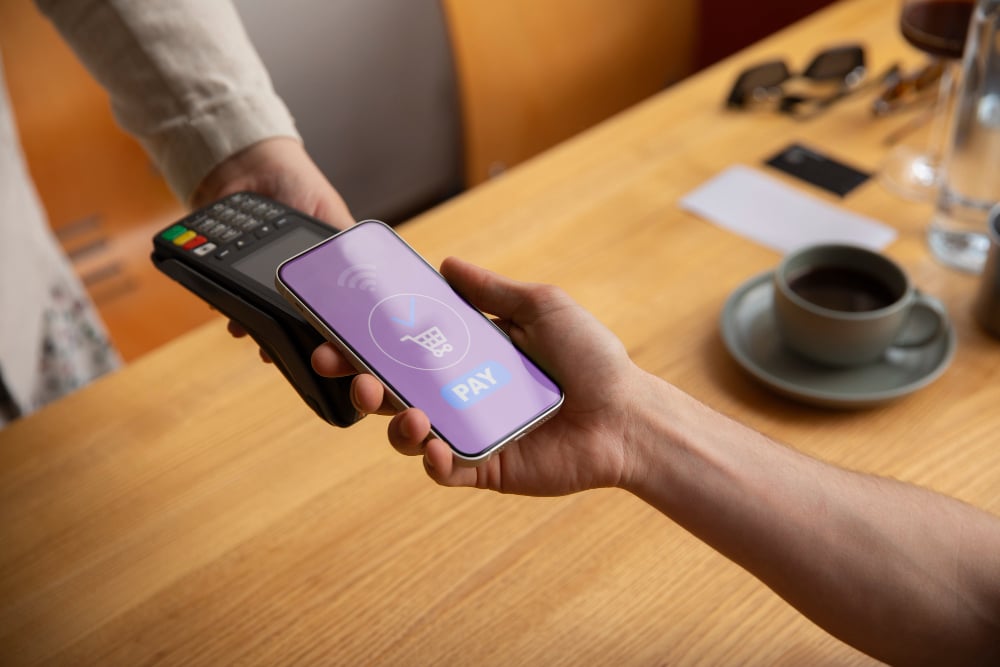
“I'm an Apple Pay user, and I use its Wallet app. To pay I just double-press the screen unlock button and my cards appear, I pick the one I want to use and simply hold the phone over the contactless payment terminal, but only after the phone has verified my face as a security measure”, explains Yadimir Crespo, a young user of the service.
To adopt this system, businesses don't have to make major changes, since if they have a point-of-sale terminal or verifone they can accept a digital wallet.
“Businesses themselves don't have to do anything, because the (verifone) payment points already have the technology to receive payments with digital wallets. The infrastructure is already deployed because contactless payments have been used with credit and debit cards for years”, explains technology content creator Hipólito Delgado.
López Valerio notes that in some cases the systems only need certain updates or adaptations to support the new payment methods.
Although there is no precise number, data provided by the ABA indicate that as of April this year more than 176,810 establishments in the country, both physical and online, were able to accept payments with digital wallets.
Global outlook
Payments with electronic wallets, or wallets, are expected to grow at an average rate of 26,78% over the period 2024-2029, according to projections by the market research firm Mordor Intelligence in its analysis Digital Wallets Market 2023 – 2028.
The study reports that last year around 4.400 million users worldwide used this method for their purchases, which represents roughly 52% of e-commerce payments.
In Latin America, digital wallets are estimated to have had a penetration of 21 % in 2023, and by 2028 they are expected to reach 28 %, according to Worldpay's Global Payments Report 2024.
Driving its growth
One of the factors driving the adoption of virtual payment technologies, such as electronic wallets, is the new functionality built into smart mobile devices, where companies such as Apple, Google and Samsung stand out as the main providers.
“Over the years, the smartphone industry has seen rapid technological advances in the features it offers, such as NFC (Near Field Communication), 5G adoption, biometrics, encryption and artificial intelligence, among others, which show in the greater penetration of smartphones in users' daily activities”, notes the Mordor Intelligence report.
Advantages of digital wallets
One of the main advantages of this technology, from the users' point of view, is that, since they don't have to give their personal data to a third party, they have more control over their accounts, which gives them a certain sense of security.
“Most digital wallets use multifactor authentication, which adds an extra layer of security with biometric authentication, strong passwords, digital tokens or a combination of these options. The data is encrypted and mechanisms are in place to prevent fraudulent transactions, using user behavior to detect possible unauthorized transactions”, the ABA explains in this regard.
Delgado points out that with this technology transactions are safer because the possibility of stealing card data is reduced “practically to zero”.
“If everyone used digital wallets exclusively for payments in physical locations, it would be the beginning of the end for the chiperos (a term referring to card scammers in the country)”, says Delgado.
The ease of doing without cash and plastic cards is another of the conveniences cited by users.
“For me it's very practical because if I go out for a quick purchase I take my keys and my phone, with no need to carry a lot of other things. I've been using the wallet for over a year and a half and I've never needed to present the card”, says Crespo.
Águeda Solano also values this convenience and describes her experience with digital wallets as something that “makes life easier”.
However, this method is not free of risks. Like other digital technologies, it is susceptible to cyberattacks and personal data breaches, López Valerio points out.
Users also face the risk of losing their information if the device is lost and they have a technological dependence because they always need an internet connection to pay, the expert adds.
Businesses may face difficulties with compatibility between different payment systems, service interruptions or technical problems, among other difficulties. For this reason, López Valerio recommends that businesses get good guidance on the regulations and on the costs that adopting this technology can entail.
Originally published in Forbes República Dominicana on November 18, 2024, by Lilian Tejeda.