The Tax Modernization Law: the strategic pivot the Dominican Republic needs for the digital economy
The perfect moment for digitalization As the Dominican Republic moves toward mass implementation of electronic invoicing, a seemingly technical bill is laying the groundwork for something far more ambitious: turning the nation into the Caribbean's technology hub. The bill amending paragraph IV of article 56 of the…
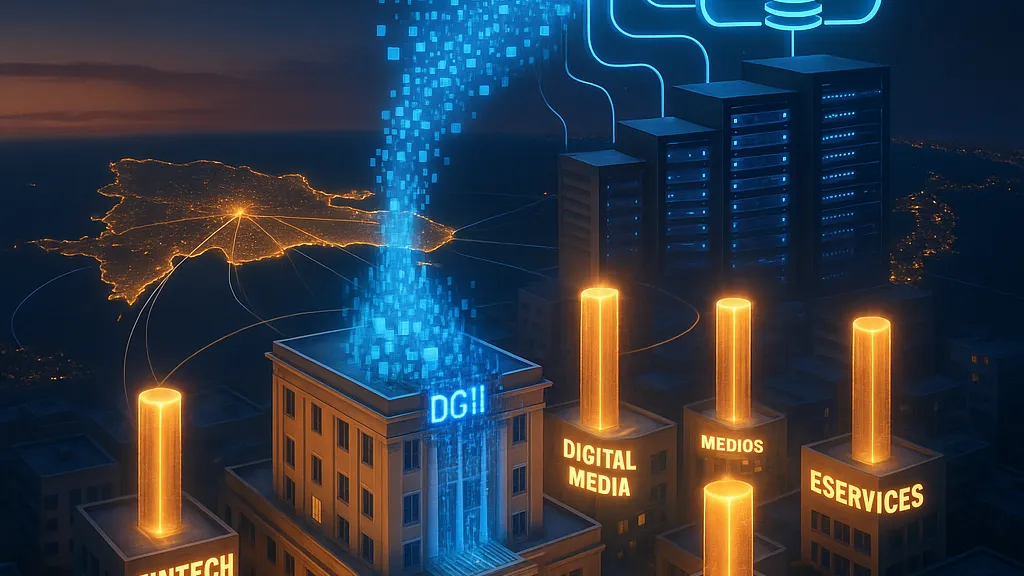
The Perfect Moment for Digitalization
As the Dominican Republic moves toward the large-scale rollout of electronic invoicing, an apparently technical bill is laying the groundwork for something far more ambitious: turning the nation into the Caribbean's technology hub. The bill amending paragraph IV of article 56 of the Tax Code is not just an administrative update; it is the strategic pivot the country needs to accelerate its digital economy.
The proposal, submitted to the National Congress by President Luis Abinader, allows the Dirección General de Impuestos Internos (DGII) to use cloud computing services and third-party data centers. This seemingly technical modernization hides transformative potential that could put the Dominican Republic at the forefront of the Latin American digital revolution.
The Digital Economy: A Growing US$5,404 Million Sector
In the book Digital Economy: Engine of Change for the Dominican Republic (Tabuga, 2 edition, April 2022), we set out with foresight how the country's digital economy could reach 5.85% of national GDP in 2022 –and it did, generating revenue of more than US$5,404 million. This amount was distributed across five key markets:
- Fintech: US$3,213 million
- E-commerce: US$1,563 million
- Digital advertising: US$251 million
- Digital media: US$232 million
- Electronic services: US$145 million
This figure places the country close to the global average estimated by UNCTAD (4.5%-15.5% of GDP), with a projected compound annual growth rate of 12.3% between 2020 and 2024. The tax reform is precisely that strategic opportunity to consolidate this growth.
The Immediate Problem
From 2019 to the beginning of 2025, the DGII has processed 715 million tax receipts. With the implementation of the Ley 32-23 on Electronic Invoicing, which makes electronic invoices mandatory throughout the national territory, this volume will multiply exponentially. The current infrastructure, designed in 2006, simply cannot handle this data load.
The legal restriction requiring data to be stored only in databases owned by the DGII has become a bottleneck that threatens the efficiency of the national tax system. The bill removes this limitation and allows the use of modern technologies such as cloud computing.
The Strategic Opportunity
But this modernization goes well beyond solving an operational problem. It enables a digital infrastructure that can serve as the backbone of the entire Dominican digital economy.
The new legal framework will allow data to be «received, processed and stored in proprietary data centers, third-party data centers or cloud computing services», with the DGII retaining ownership of and control over the information. This technological flexibility opens the door to adopting advanced technologies such as artificial intelligence, big data analytics and machine learning. It also provides efficient scalability, with the capacity to grow according to demand without massive infrastructure investments, and it enables collaborative innovation by making it possible to work with world-class technology providers.
The Digital Sovereignty Challenge
However, the bill has a significant strategic gap: it sets no geographic restrictions on third-party services. This means sensitive tax data could be stored on servers located outside the national territory, raising questions about digital sovereignty and national security.
This absence of territorial restrictions, while it allows access to the best global technologies, calls for a complementary framework that balances operational efficiency with digital sovereignty. Countries such as China and some members of the European Union have developed frameworks that allow technological innovation while protecting critical national data.
Toward the Caribbean Technology Hub
The Dominican Republic has exceptional conditions to become a regional technology center. Its high entrepreneurship rate of 17%, one of the highest in the region, stands out, along with a young population that is a key factor for technology adoption.
The country also has robust connectivity, reaching 75% internet penetration with 8.08 million users, and it maintains a favorable legal framework backed by multiple international trade agreements.
Digital Infrastructure as a Catalyst
Modernizing the tax system can serve as a catalyst for developing a comprehensive digital ecosystem. National data centers represent an immediate opportunity, since the demand generated by the public sector can justify private investment in world-class data infrastructure.
At the same time, the development of a Fintech ecosystem is favored by modern, efficient tax systems, attracting financial technology companies that require robust infrastructure and flexible regulation. Finally, the experience gained in handling large volumes of tax transactions can be applied directly to the development of e-commerce platforms.
The Danger of Short-Term Thinking
There is a risk that this modernization will be implemented with a purely operational vision and lose its transformative potential. If the project is executed only to solve the immediate problem of storage capacity, the Dominican Republic would waste a unique opportunity for strategic positioning.
The Window of Opportunity
The current context presents a window of opportunity that will not come again, combining several favorable factors. The post-pandemic era has accelerated digitalization globally, creating unprecedented demand for technology solutions.
The implementation of electronic invoicing creates an operational need that justifies significant investment in digital infrastructure. At the same time, the country has a government with a clear, pro-technology digital vision, while demand is growing in the region from other Caribbean countries seeking advanced technology solutions.
The Future Is at Stake
The modernization of the Tax Code is much more than an administrative update; it is a strategic decision that will define the technological future of the Dominican Republic. The country stands at a crossroads: it can seize this opportunity to make a quantum leap into the digital economy, or it can implement a limited solution that resolves only the immediate problem.
The difference between the two scenarios lies in vision and execution. If the Dominican Republic manages to articulate a comprehensive strategy that combines technological modernization, digital sovereignty, local talent development and regional positioning, it will be laying the foundations to become the Caribbean's technology hub.
The coming months will be crucial. How this law is implemented, and which complementary policies are developed, will determine whether the Dominican Republic is a spectator or a protagonist in the digital revolution that is transforming Latin America.
The Dominican digital economy, valued at more than US$5,404 million in 2022 and growing at 12.3% a year, has the potential to multiply exponentially with the right decisions. It is a key piece for growth toward 2036.
The tax bill is not the destination; it is the starting point toward a prosperous and sovereign digital future. The question is not whether the Dominican Republic will digitalize, but whether it will lead or follow in that digitalization. The answer lies in the decisions made today.
The digital economy does not wait. It is time to act with strategic vision and transformative ambition.