Reconfiguring Electric Mobility
Modularity as a paradigm of accessibility By Arturo López Valerio Technology Entrepreneur Founder of Tabuga The dominant narrative on electric vehicles often centers on range or sustainability as the transformative drivers. On a closer reading, proposals such as Slate Auto and Telo Trucks reveal a subtler emerging paradigm…
Modularity as a paradigm of accessibility
By Arturo López Valerio Technology Entrepreneur, Founder of Tabuga
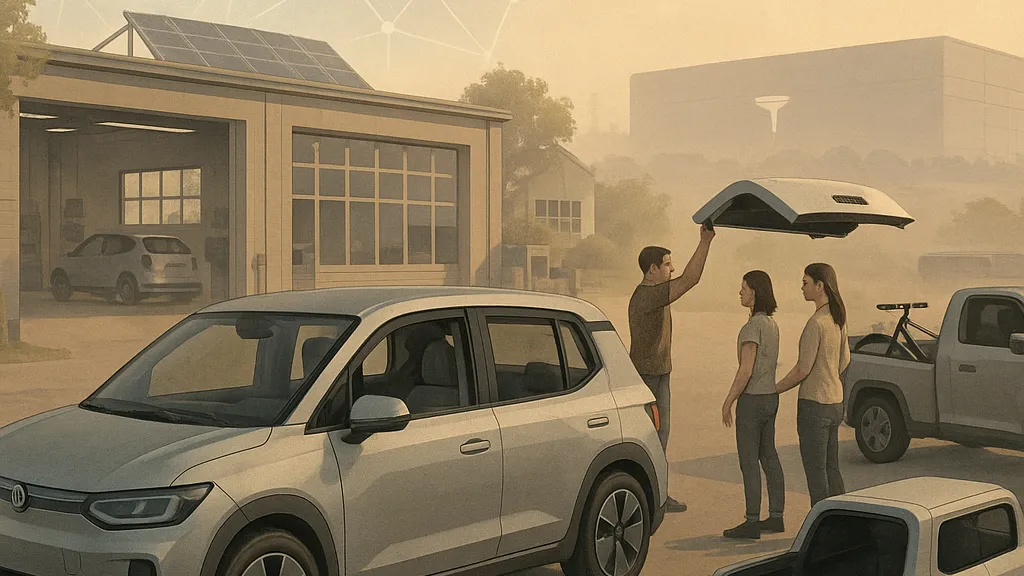
The dominant narrative on electric vehicles often centers on range or sustainability as the transformative drivers. On a closer reading, proposals such as Slate Auto and Telo Trucks reveal a subtler and potentially more revolutionary emerging paradigm: modular configurability as a response to the crisis of affordability and adaptability in personal transport.
This perspective refreshes our understanding of how innovation in mobility can democratize access while responding to the diversity of usage contexts.
Modularity as democratization: the Slate case
Slate Auto, headquartered in Troy, Michigan, with design operations in California, proposes something deeper than the simple electrification of transport. Its configurable assembly model represents a fundamental reimagining of vehicle ownership. Instead of buying a finished, immutable product, customers get a base platform that evolves with the user's needs. This approach challenges the traditional paradigm of planned obsolescence that has dominated the auto industry for decades.
The strength of this approach lies in its recognition of a basic truth: mobility needs are not static. A young urban professional may initially need a minimalist vehicle for daily commuting, but those needs may shift toward greater cargo capacity when starting a family or a business. Slate's modular model allows this evolution without having to replace the vehicle entirely, democratizing access through a lower initial investment and incremental upgrades.
This philosophy resonates with principles of circular economy and environmental justice. By allowing components to be upgraded, repaired or reconfigured individually, Slate not only reduces environmental impact but also creates an ecosystem in which vehicle ownership becomes more accessible to segments traditionally excluded from the new-car market.
Functional honesty: Telo's proposal
Telo Trucks, for its part, articulates a different but complementary form of affordability: the radical honesty of vehicle features. In a market where pickups have grown to almost absurd proportions —justified by capabilities that are rarely used— Telo proposes a return to functional essentials. Its Mini Cooper-sized pickup, with cargo capacity comparable to much larger vehicles, is an implicit critique of contemporary excess.
This dimensional honesty has deep implications for urban accessibility. In cities where space is an increasingly scarce and costly resource, a vehicle that offers real utility without taking up excessive space becomes a tool of urban equity. Telo recognizes that true innovation does not always mean adding features, but intelligently optimizing existing ones for real contexts of use.
The ease of conversion that Telo promises —transforming the vehicle according to the desired context— reflects a sophisticated understanding of how contemporary users move among multiple identities and needs. The same vehicle that carries tools during the week can become a recreational vehicle on the weekend, without compromising efficiency in either role.
Socioeconomic implications of configurability
Both approaches converge on a critical point: reimagining mobility as an adaptable service rather than a fixed product. This convergence has deep implications for the socioeconomic structure of transport:
- Slate's modularity could catalyze the emergence of new local economic ecosystems. Workshops specializing in upgrades, secondary markets for components and customization services could flourish, creating jobs and business opportunities distributed across geographies.
- Telo's approach, while less radical in appearance, could have equally transformative effects on consumption patterns. By showing that utility does not require excess, Telo challenges deeply rooted cultural narratives about status and capacity.
Both visions offer an alternative to the current concentration of the automotive model and open the door to more distributed, flexible and sustainable mobility.
The Anti-Giga Factory: Bezos's bet on productive decentralization
Jeff Bezos's investment in Slate Auto is more than a financial move in the electric vehicle sector; it is a philosophical statement about the future of automotive manufacturing. While Tesla consolidated the Giga Factory paradigm —massive facilities that concentrate vertical production to maximize economies of scale—, Slate proposes a radically opposite model: productive atomization through modularity.
This «Anti-Giga Factory» vision does not seek to compete on raw volume, but to reimagine the automotive value chain as a distributed network of local innovators. Where Musk bet on total control of the production process, Bezos backs an ecosystem in which small specialized manufacturers can contribute interchangeable components, democratizing not only access to the final vehicle but also participation in its creation.
This contrast reveals a fundamental tension in contemporary technology capitalism: is it more transformative to concentrate resources to achieve maximum efficiency, or to distribute them to maximize innovation and resilience?
Bezos's bet suggests that the future of mobility may lie not in monumental factories but in agile production networks that reflect the decentralized architecture of the internet itself —an ironic but coherent turn for someone who built his empire on the distributed infrastructure of Amazon Web Services (AWS).
Challenges and opportunities in implementation
Realizing these visions faces significant technical, regulatory and cultural challenges. The standardization needed for true modularity requires unprecedented levels of industrial cooperation. Moreover, current regulatory frameworks —designed for static vehicles— will have to evolve to accommodate dynamic, configurable platforms.
Culturally, both models require a change in how we conceptualize vehicle ownership and value. Moving from seeing vehicles as status symbols to understanding them as adaptable tools is a considerable narrative challenge, and it means rethinking the emotional and functional role of the car.
Toward a transformative synthesis
The real promise of these approaches lies not in implementing them in isolation, but in how they could catalyze a broader reimagining of urban mobility. A future where Slate's modularity and Telo's functional honesty coexist could offer a range of solutions that genuinely address the diversity of human needs.
This vision demands more than technical innovation: it calls for a transformation in public policy, urban planning and cultural narratives. Local governments could encourage configurable vehicles with tax benefits. Urban planners could prioritize infrastructure that values space efficiency over sheer size.
Twenty-first-century mobility will not be merely electric. It will be modular, honest and deeply human.