Deepfakes in the Dominican Republic
A thorough analysis of the Dominican legal framework in the face of the challenges posed by generative artificial intelligence. The Dominican Republic finds itself at an unprecedented technological and legal crossroads. While the country positions itself as a regional leader in artificial intelligence strategies, ranking seventh among 33 Latin American nations in government readiness for AI,…
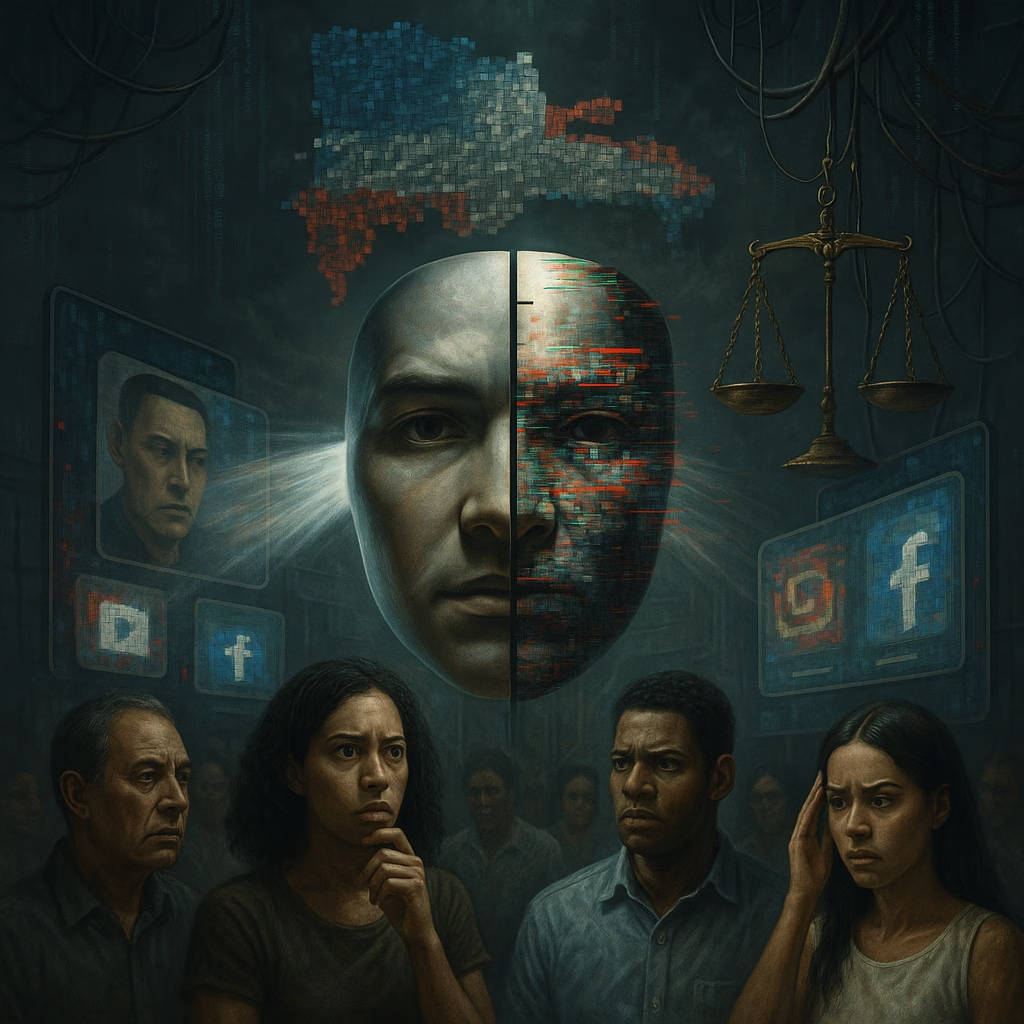
A thorough analysis of the Dominican legal framework in the face of the challenges of generative artificial intelligence.
The Dominican Republic is at an unprecedented technological and legal crossroads. While the country positions itself as a regional leader in artificial intelligence strategies, ranking seventh among 33 Latin American nations in government readiness for AI, it faces an emerging challenge that tests its legal framework: Deepfakes.
This audiovisual manipulation technology, capable of creating realistic but completely false content, has begun to appear in Dominican territory, with cases ranging from the impersonation of the Governor of the Central Bank to fake audio attributed to the President of the Republic. However, the legal response has been limited, revealing a regulatory gap that requires urgent attention.
A pioneering country in AI with no specific protection against its risks
The Dominican paradox is plain: it was the first Caribbean country to implement a National Artificial Intelligence Strategy (ENIA) in October 2023, yet it lacks specific legislation to combat malicious uses of that same technology.
The ENIA, led by the Government Office of Information and Communication Technologies (OGTIC), establishes four foundational pillars, including Smart Government and a Talent and Innovation Hub, but it does not specifically address the regulation of malicious synthetic content.
This contrast reflects a critical gap between accelerated technological development and the legal protection of citizens. While the country advances toward government digitalization and the adoption of AI, citizens remain vulnerable to technologies that can damage their reputation, privacy and personal safety.
The existing legal framework: an incomplete safety net
The Ley 53-07: the main shield against technological crimes
The main legal tool available is the Ley 53-07 on Crimes and Misdemeanors in the Field of High Technology, enacted in 2007, long before Deepfakes became an accessible technological reality. However, this law contains provisions that can be interpreted broadly to cover malicious Deepfakes.
Article 18, which punishes the forgery of digital documents with prison sentences of 1-3 years and fines of 50-200 minimum salaries, is the most directly applicable provision. Deepfakes can legally be interpreted as forged digital documents, especially when used to create audiovisual content that purports to represent authentic statements or documents.
In addition, Articles 21-22 on electronic defamation and slander establish penalties of 3 months to 1 year of prison for defamatory content distributed by electronic means, directly applicable to Deepfakes made for defamatory purposes.
Article 338: an extraordinarily relevant provision
The Dominican Penal Code contains a provision that seems to have been drafted in anticipation of the Deepfake era. Article 338 establishes penalties of 1-2 years of prison and fines of 50,000-100,000 pesos for «publishing a montage made with a person's words or image without their knowledge, if it is not evident that it is a montage».
This provision is extraordinarily relevant because it:
- Specifically punishes montages made without consent
- Covers both images and words (applicable to video and audio Deepfakes)
- Sets the requirement of clear evidence of manipulation
- Provides penalties proportionate to the potential harm
Complementary protection laws
The Ley 172-13 on Personal Data Protection adds another layer of protection. Its Principle of Loyalty explicitly prohibits «the collection of data by fraudulent, unfair or unlawful means», which applies directly to the creation of Deepfakes without consent. Penalties include prison terms of 6 months to 2 years and fines of 100-150 minimum salaries.
The Ley 24-97 on Violence against Women is also applicable in cases of non-consensual pornographic Deepfakes when there is a family or intimate-partner relationship, although its coverage is limited.
The reality of the cases: reactive responses without criminal consequences
The cases documented in 2024 reveal a worrying pattern of mostly reactive, media-driven responses with no effective criminal prosecution. The most notable case involved the Governor of the Central Bank, Héctor Valdez Albizu, who was the victim of a Deepfake promoting pyramid schemes. The response was limited to public denials by the Central Bank, with no documented criminal investigation.
Similarly, when a fake audio attributed to President Luis Abinader on migration policy circulated, the presidential campaign dismissed it as a «dirty offensive using artificial intelligence», but no judicial proceedings were documented in that case either.
This absence of prosecuted cases reflects both the emerging nature of the technology and the lack of specific procedural frameworks for investigating and prosecuting it.
Specialized institutions such as DICAT (Dirección de Investigación de Crímenes y Delitos de Alta Tecnología (High-Tech Crimes and Offenses Investigation Directorate)) and PEDATEC (Procuraduría Especializada contra Crímenes y Delitos de Alta Tecnología (Specialized Prosecutor's Office against High-Tech Crimes and Offenses)) receive between 40-50 cybercrime complaints per day, but they lack specific protocols and specialized technology for the detection and forensic analysis of Deepfakes.
The regional context: the Dominican Republic in comparative perspective
Latin America lacks coordinated, specific legal frameworks to address Deepfakes, but the Dominican Republic is favorably positioned compared with neighboring countries. Mexico applies the Ley Olimpia in 28 federal entities, but it has specific gaps regarding AI-generated Deepfakes. Colombia faces «deep legislative gaps» according to experts, with only Bill Ley 225/2024 under consideration. Argentina has several pending bills, but no specific legislation in force.
The Dominican Republic's comparative advantages include:
- A National AI Strategy that is already in place
- An existing technology legal framework with broader applicability
- Article 338 of the Penal Code as a specific provision on manipulated montages
- Specialized institutions with established technical capabilities
Legislative projects under way: signs of modernization
The legislative landscape shows encouraging signs of modernization. Senator Franklin Rodríguez Garabitos introduced a comprehensive artificial intelligence bill in December 2023, currently under review in the Senate Technology Committee. This initiative, inspired by regulatory frameworks from more than 30 countries, seeks to establish guidelines for the development and regulation of AI.
At the same time, President Luis Abinader introduced in 2022 a cybercrime bill that would fully repeal the current Ley 53-07, including a comprehensive classification of cybercrimes that could specifically cover Deepfakes under the category of «cybercrimes against persons».
Types of malicious use: a broad spectrum of vulnerabilities
Under the current legal framework, different types of malicious Deepfakes can be punished with varying penalties:
Defamatory Deepfakes: Punishable under multiple provisions with penalties of 3 months to 3 years depending on severity and target.
Impersonation Deepfakes: Covered under identity theft and non-consensual montage frameworks, with penalties of 1-3 years plus significant fines.
Pornographic Deepfakes: Punishable specifically under Article 338 of the Penal Code, with penalties of 1-2 years plus fines.
Fraudulent Deepfakes: Covered under electronic fraud and digital document forgery frameworks, with penalties of 1-3 years.
Deepfakes involving minors: The most severely punished under child pornography frameworks, with sentences of 2-4 years and fines of 10-500 minimum salaries.
Significant gaps persist, however, for non-malicious but non-consensual Deepfakes, commercial use without authorization, and politically disinformative content.
The invisible problem: the data crisis and social awareness
The legal framework, however robust it may be, faces a fundamental weakness: the lack of quantitative data on the true prevalence of Deepfakes in the Dominican Republic.
While DICAT and PEDATEC receive between 40-50 reports of cybercrime a day, there is no classification system that makes it possible to identify how many of them involve Deepfakes. This lack of specific statistical data severely limits the perception of the real magnitude of the problem, for authorities and citizens alike.
The underreporting paradox
International experience suggests that Deepfakes are among the digital crimes with the highest underreporting. Victims often do not report out of ignorance of their rights, shame (especially in cases of pornographic Deepfakes), or distrust of the judicial system's capacity to deal with complex technologies. In the Dominican Republic, this reality is made worse by the absence of:
- Public awareness campaigns on what a Deepfake is and how to identify it
- Specific reporting channels for cases of audiovisual manipulation
- Protection protocols for victims that encourage reporting
- Public statistics that show how seriously the problem is being taken
The invisible social impact
Beyond the legal framework, Deepfakes are quietly eroding public trust in audiovisual information. In a country where social media is the primary source of news for millions of citizens, uncertainty about the authenticity of content can:
- Accelerate political polarization by allowing each group to dismiss inconvenient information as «Deepfakes»
- Weaken institutional trust when citizens doubt the authenticity of official statements
- Silence legitimate voices for fear of becoming victims of Deepfakes in retaliation
- Creating information paralysis where citizens do not know what to trust
Technological challenges: beyond good intentions
The cost of detection
The proposal to «invest in Deepfake detection technology» sounds reasonable, but it hides significant complexities. The most effective commercial detection systems can cost between $100,000-$500,000 per year in enterprise licenses, not including specialized training.
For a country like the Dominican Republic, this represents a considerable budgetary challenge, especially when multiplied across the many institutions that would need this technology.
The digital arms race
Deepfake detection faces a unique technical challenge: it is a constant arms race. Every advance in detection is quickly followed by improvements in generation that render earlier systems obsolete. Dominican institutions would need not only an initial investment, but a commitment to continuous technological updating and specialized staff able to adapt to emerging technologies.
Global lessons left unapplied
While legislation in the Dominican Republic may compare with that of other Latin American countries, it may overlook successful global models that could inspire more effective solutions:
European Union model: The AI Regulation (AI Act) classifies Deepfakes as «high risk» and requires mandatory labeling, algorithmic transparency, and human oversight. Its preventive approach could be adapted to the Dominican context.
Singapore model: It combines specific legislation (POFMA – Protection from Online Falsehoods and Manipulation Act) with massive investment in citizen digital literacy, achieving one of the lowest rates of effective disinformation.
Estonia model: A pioneer in secure digital identity, it has developed authentication systems that make digital impersonation extremely difficult, offering a preventive rather than reactive approach.
The critical role of citizens: beyond reporting
The need for urgent digital literacy
Dominican citizens need immediate tools to:
- Identify basic Deepfakes through common visual and audio cues
- Verify suspicious content using available free tools
- Report effectively with the information needed for successful investigations
- Protect yourself preventively by limiting the availability of material that can be manipulated
A robust citizen reporting system
Legal effectiveness depends crucially on a system that:
- Simplifies the reporting process with specific forms for Deepfakes
- Protects the identity of whistleblowers especially in sensitive cases
- Provides transparent follow-up on the status of investigations
- Offers immediate precautionary measures to remove content while an investigation is under way
- Educates throughout the process about available rights and remedies
The paradox of legislative dependence
The proposed solutions depend dangerously on legislative bills whose approval and implementation are not guaranteed. The Ley 02197-2023 AI Bill has been under review for more than a year, while malicious Deepfakes keep proliferating. This reliance on «future solutions» leaves citizens vulnerable today.
The way forward: an immediate, comprehensive approach
Actions that do not require new legislation
Immediate creation of a National Deepfake Observatory to:
- Collect specific statistics on prevalence
- Monitor trends and patterns of malicious use
- Publish quarterly transparency reports
- Coordinate inter-institutional responses
National digital literacy program Implementable in 6 months together with the private sector:
- Mass training for educators on detecting Deepfakes
- Advertising campaigns during prime time
- Community workshops in coordination with municipal governments
- Free, accessible online resources
Rapid response system Operational in 30 days:
- 24/7 hotline for reporting Deepfakes
- Expedited takedown protocol in coordination with platforms
- Automatic precautionary measures for high-risk cases
A regulatory graduation model
Instead of waiting for perfect legislation, implement a phased model:
Phase 1 (0-6 months): Make the most of existing legal tools
Phase 2 (6-18 months): Administrative reforms and specific protocols
Phase 3 (18-36 months): Comprehensive legislation based on data and accumulated experience
From theoretical urgency to practical action
The Dominican Republic faces a silent crisis that goes beyond legal gaps: a crisis of data, awareness and immediate action. The country has legal tools it can use today, but it lacks the measurement systems, civic education and institutional response needed to implement them effectively.
The hidden triple crisis
Data crisis: Without specific statistics on Deepfakes, the authorities are navigating blind, unable to size the problem or allocate resources adequately.
Awareness crisis: Citizens remain largely unaware of both the threat and their rights, perpetuating underreporting and vulnerability.
Action crisis: Excessive reliance on future legislative solutions paralyzes immediate responses while the problem worsens daily.
An immediate, transformative opportunity
The Dominican Republic's regional leadership in AI strategies gives it a unique window to implement a comprehensive model without waiting for perfect legislation. The country can become a regional pioneer not only in AI adoption, but also in protecting citizens against its risks.
The response cannot wait for future laws. Every day of inaction means more potential victims, greater erosion of public trust, and the loss of the competitive advantage of setting responsible regional precedents.
The citizen imperative
Deepfakes are a challenge that no government can face alone. They require citizens who are informed, vigilant and active in reporting. But those citizens have to be cultivated through mass education, accessible reporting systems, and institutional responses that show digital protection is a national priority.
The ultimate question is not whether the Dominican Republic can regulate Deepfakes, but whether it will have the political will to act with the urgency the problem demands. Technology will not wait for the law to catch up; therefore, solutions must be as agile and innovative as the challenges they address.
The future of Dominican digital trust is decided today, not tomorrow. And that future depends as much on solid legal frameworks as on citizens empowered to protect themselves and report effectively. Only then can the Dominican Republic keep its regional technological leadership while protecting the integrity and safety of all its citizens.