Latam GPT: Artificial Intelligence with a Latin American Accent
Most of the artificial intelligence tools we use today —from conversational assistants to machine translators— are designed in technology hubs far removed from our realities. Although they handle multiple languages, most of these global models lack an essential element: cultural understanding. That is where Latam GPT comes in, the first model of…
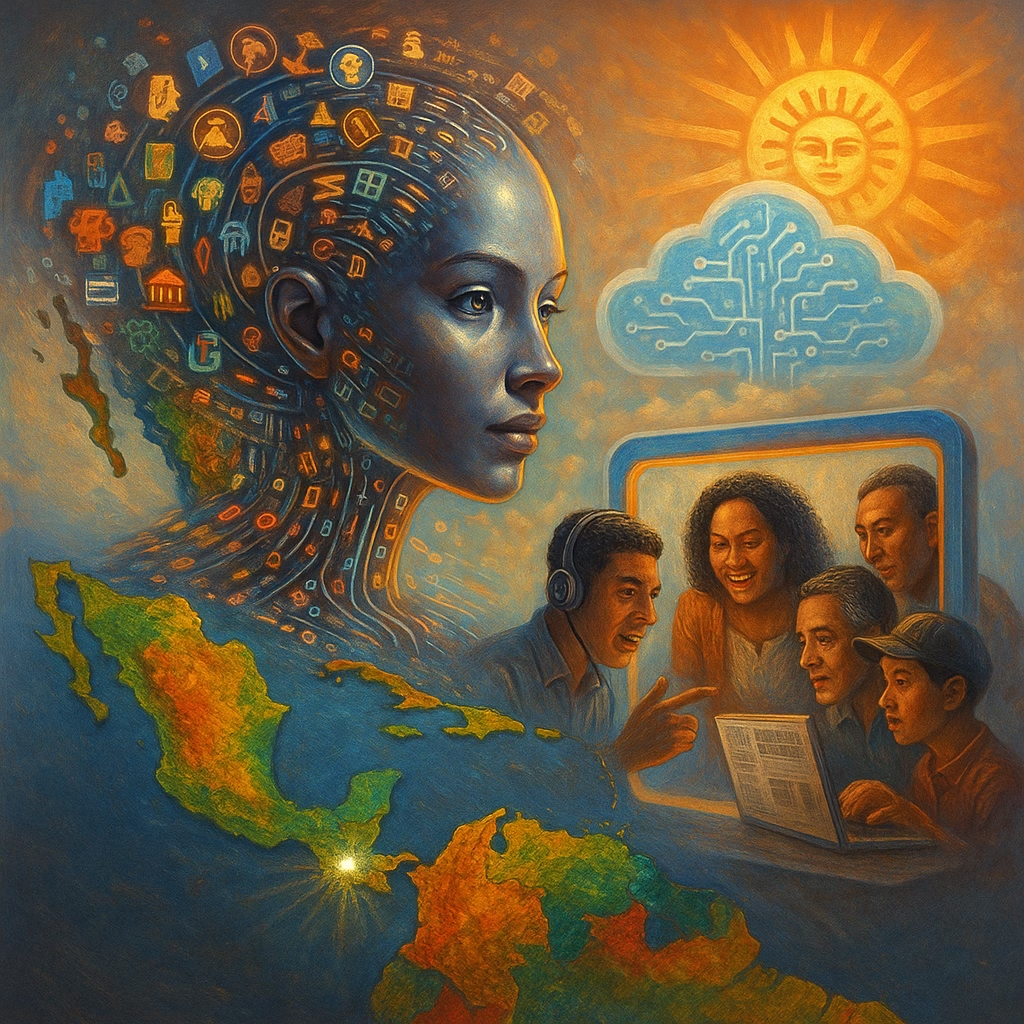
Most of the artificial intelligence tools we use today —from conversational assistants to machine translators— are designed in technology hubs far removed from our realities. Although they master multiple languages, most of these global models lack an essential element: cultural understanding. And that is where Latam GPT comes in, the first AI language model created in Latin America for Latin America.
This project is neither an adaptation nor a tropicalized version of a foreign model. It is an independent, ethical and deeply collaborative initiative that seeks to represent our voices, our stories and our ways of seeing the world.
A model with its own identity
Latam GPT is coordinated by Chile's National Center for Artificial Intelligence (CENIA), with the participation of more than 30 academic, social and technical institutions from across the region. It is being trained on more than 8 terabytes of carefully curated data, drawn from press archives, cultural documents, educational databases and regional literature, with the aim of reflecting not only the languages spoken, but also local nuances, rhythms and meanings.
Unlike other models, Latam GPT is defined by three key principles: • Transparency: Anyone can audit its development, review the source data and suggest improvements. • Open collaboration: It is designed so that citizens, universities, companies and governments can contribute to it and reuse it. • Data ethics: The model is trained on information collected with consent, without extractive practices or opacity.
This AI does not aim to compete with the technology giants. Its goal is clear: to be useful to the people of the region, from educational settings to social or institutional applications.
Copuchat: AI that learns from real speech
One of the project's most innovative elements is the Copuchat platform, an open interface where citizens can converse with the model and help train it with real language: everyday expressions, popular turns of phrase, local ways of speaking. This is not academic language, but the living language of the street, of the neighborhoods, of the towns. Copuchat turns the ordinary user into an AI trainer, thereby democratizing the construction of automated knowledge.
This does not only improve the model's accuracy. It also vindicates linguistic expressions that have often been sidelined or devalued, restoring dignity to the diversity of Latin American speech.
A historic milestone: the Dominican Republic enters the AI map
In July 2025, the Dominican Republic marked a before and after by becoming the first country in the Caribbean to contribute private-sector data to a massive AI model. The alliance between CDN Canal 37, Tabuga SRL and CENIA allowed more than 42,000 journalistic records from CDN's historical archive to be integrated into the training of Latam GPT.
This step, besides being a pioneering one, is deeply symbolic. For the first time, an artificial intelligence will incorporate data originating in the country —news, opinions, interviews, analysis— that reflect the living memory of a nation.
As Alba Nely Familia, director of CDN, put it:
“Today we mark a milestone that transcends borders and technologies. With this signing, CDN joins the visionary effort to create an artificial intelligence that understands our voices, our stories and our challenges”.
Since Tabuga, this effort has been complemented by training programs such as “AI for Everyone”, which seek to train local professionals in the foundations of ethical, contextualized artificial intelligence. It is not just about sharing data, but about building capabilities.
Challenges to overcome and paths to open
Like any ambitious project, Latam GPT faces real challenges. Among them: the legal complexity of copyright in Latin America, the need for continuous funding and, perhaps the deepest one, breaking the narrative that technology is only imported, not built.
But this model is also a platform for reversing that logic. It offers students, researchers, programmers, journalists and artists the chance to take an active part in creating an AI that represents them.
The AI of the future will be culturally aware… or it will be irrelevant
Latam GPT is not just a technical tool. It is a political and cultural bet. It is a way of contesting the global digital narrative, of ensuring that our stories are not simplified, misinterpreted or erased by algorithms trained on other realities. As we like to say at Martes Tecnológico, “the future is not awaited, it is trained”. And Latam GPT is a technology born in the South, with a regional soul, with dignity and with purpose.
Now all that is missing is for more people —like you reading this— to decide to be part of this story. Because shared knowledge builds sovereignty. And a truly Latin American artificial intelligence will only be possible if it is fed with our voices, our ideas and our dreams.