Artificial Intelligence for Climate Change Adaptation and Disaster Resilience in the Dominican Republic and the Caribbean
The Dominican Republic and the Caribbean face an existential threat from climate change. Hurricanes, floods and water scarcity increasingly disrupt the region's lives, economies and ecosystems. The World Economic Forum's Global Risks Report 2025 ranks climate change and its consequences—extreme weather, resource scarcity and failures in the…
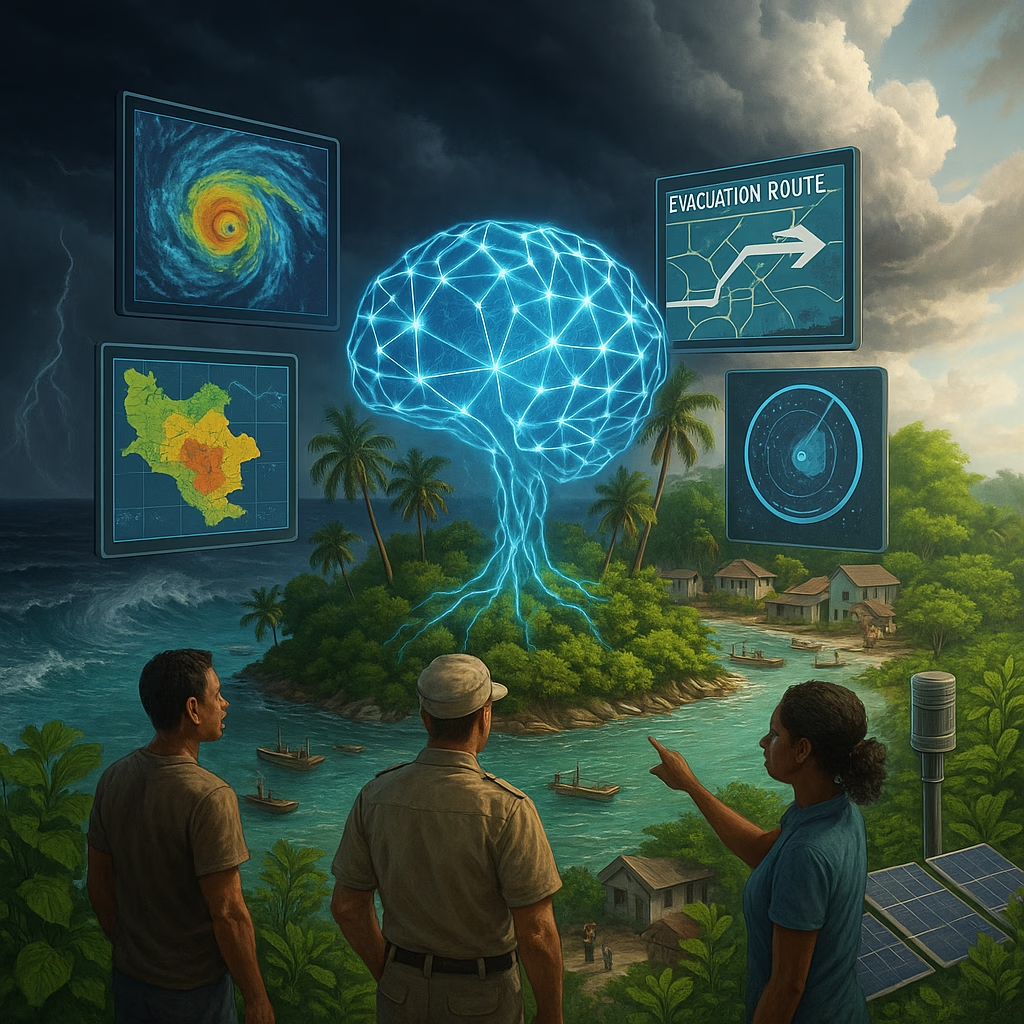
The Dominican Republic and the Caribbean face an existential threat from climate change. Hurricanes, floods, and water scarcity increasingly disrupt regional lives, economies, and ecosystems. The World Economic Forum's Global Risks Report 2025 ranks climate change and its consequences—extreme weather, resource scarcity, and failures in adaptation—as the top global risks for the coming decade.
In 2022, Hurricane Fiona caused damages exceeding $1,000 million in the Dominican Republic alone, displacing thousands of people and exposing systemic gaps in our preparedness. These challenges demand innovative solutions that go beyond traditional approaches.
Artificial Intelligence (AI) offers a transformative opportunity to bridge the gap between data deficiencies and actionable resilience, enabling predictive, adaptive, and equitable responses to climate risks. This analysis explores how AI can revolutionize climate change adaptation and disaster resilience in the Dominican Republic and the Caribbean, grounded in the critical need for accessible data and strategic innovation.
The current landscape: climate risks and data gaps
The Caribbean's geographic vulnerability amplifies climate impacts exponentially. The Dominican Republic faces annual hurricane seasons, with events such as Maria (2017) and Fiona (2022) causing widespread flooding and massive infrastructure damage. Sea level rise threatens coastal communities, while water scarcity affects agriculture and urban centers.
Inadequate data infrastructure
Despite these risks, the region struggles with inadequate data infrastructure. Public data on weather patterns, flood risks, or infrastructure vulnerabilities are often outdated, fragmented, or inaccessible. During Fiona, the absence of real-time hyper-local data hampered evacuation and resource allocation efforts.
This reflects a broader regional challenge: without up-to-date, consumable data, governments and communities cannot prepare effectively. Open data initiatives, though promising, remain underused, limiting citizen participation and innovation in disaster management.
AI as a transformative tool for climate adaptation
Artificial Intelligence can address these challenges by turning raw data into actionable insights. Several applications stand out for their transformative potential:
Predictive modeling and advanced forecasting
AI-powered machine learning models can analyze historical and real-time data to predict weather events with unprecedented accuracy. Deep learning algorithms can process satellite imagery, ocean temperature data, and topographic information to forecast hurricane trajectories or flood risks at a hyper-local level.
In the Dominican Republic, where urban areas such as Santo Domingo are prone to flash floods, such models could provide hours—or even days—of advance warning, enabling timely evacuations and infrastructure adjustments.
Strategic resource optimization
Water, a critical resource, is increasingly strained by climate variability. AI can optimize water management by predicting demand, detecting leaks, and prioritizing distribution during crises. Reinforcement learning algorithms could dynamically allocate water supplies in drought-prone areas such as the northwest, ensuring equitable access.
Similarly, AI can streamline the distribution of energy or food supplies after a disaster, minimizing waste and delays.
Intelligent early warning systems
AI-driven early warning systems can deliver accurate, timely alerts to vulnerable communities. By integrating data from weather stations, social media, and IoT sensors, these systems can identify risks and disseminate alerts via mobile apps or SMS.
In rural Caribbean areas with limited internet access, AI can optimize low-bandwidth communication channels to ensure inclusiveness. Costa Rica's use of AI for biodiversity monitoring offers a model whose predictive analytics could be adapted for disaster alerts.
Post-disaster response and recovery
AI can improve logistics during and after disasters. Algorithms can optimize routes for emergency vehicles, avoiding flooded or damaged roads, as seen in pilot projects in Chile for earthquake response.
AI can also prioritize aid delivery based on real-time assessments of need, reducing inequities in resource distribution. Machine learning models could analyze drone imagery to identify the most heavily damaged areas, directing resources efficiently.
Infrastructure resilience
AI can inform the design of climate-resilient infrastructure. By simulating extreme weather scenarios, AI tools can recommend materials, designs, or locations for bridges, roads, and buildings that withstand hurricanes or floods.
In the Dominican Republic, where coastal erosion threatens tourism infrastructure, such applications could safeguard critical economic assets.
Evaluation framework for AI effectiveness
To ensure that AI delivers measurable benefits, a robust evaluation framework is essential:
- Precision and accuracy: Models must be validated using historical data and real-time testing. A flood prediction model for Santo Domingo should reduce false positives by at least 20% compared with traditional methods, as has been demonstrated in similar pilots in Southeast Asia.
- Scalability and accessibility: AI systems must integrate with existing infrastructure, such as the Dominican Republic's National Meteorological Office, and be deployable in low-resource environments. Cloud-based AI platforms can reduce costs, making the solutions viable for smaller Caribbean nations.
Measuring strategic impact
Success should be quantified by reduced response times (cutting evacuation delays by 30%), lives saved, or economic losses mitigated (saving $100 million annually in disaster costs). Qualitative metrics, such as community trust, are equally vital.
Implementation challenges: High-quality data, computing power and technical expertise are prerequisites. Public-private partnerships can address these needs, as seen in Chile's collaborations with technology companies for seismic monitoring.
A hypothetical pilot in Santo Domingo could test AI-driven flood prediction, measuring reduced response times and community feedback. Scaling such pilots regionally would require standardized data protocols and cross-border cooperation.
Ethical implications and technology governance
AI's potential comes with significant ethical challenges:
- Bias and fairness: AI models trained on biased data can underrepresent rural or low-income communities, exacerbating inequities. Regular audits and diverse datasets are critical to ensure equitable outcomes.
- Privacy and transparency: Early warning systems that collect location data must prioritize privacy. Open-source AI frameworks and explainable models can build public trust.
- Accountability: Clear governance is needed to address AI failures, such as inaccurate predictions that lead to ill-informed evacuations. A national AI ethics council could oversee standards.
Evolution of public policy
Policies must evolve to support ethical AI. The Dominican Republic's nascent AI strategy should prioritize climate applications, with regulations that ensure transparency and fairness.
Public-private partnerships, such as those championed in regional innovation hubs, can fund AI deployment. Addressing the «brain drain» is also critical—STEM education and incentives for AI specialists can build local capacity, drawing lessons from Costa Rica's technology workforce initiatives.
National roadmap for climate AI
A national AI-for-climate roadmap is urgent. The key steps include:
- Data infrastructure: Invest in open data platforms that provide real-time, hyper-local data as a foundation for AI applications.
- Stakeholder collaboration: Governments, private technology companies, NGOs and international organizations such as the Inter-American Development Bank should co-finance AI pilots, such as regional early warning systems.
- Talent development: Expand STEM programs aimed at AI and environmental sciences, offering scholarships and repatriation incentives for Dominican professionals abroad.
- Regional learning: Adopt best practices from Latin American leaders such as Chile, which uses AI for seismic resilience, and foster Caribbean AI initiatives.
Strategic immediate actions
Immediate actions could include a pilot AI flood-prediction system in Santo Domingo, backed by public-private financing, or a Caribbean AI consortium for shared tools and expertise.
A resilient future
Artificial Intelligence offers a path to move the Dominican Republic and the Caribbean from climate vulnerability toward strategic resilience. By leveraging predictive modeling, resource optimization and ethical governance, AI can turn data into sustainable solutions that save lives.
This aligns with the region's need for innovation and data-driven decision-making, addressing global risks with local impact. The time to act is now—through policy reforms, strategic alliances and investment in talent, the Caribbean can lead in AI-driven climate adaptation.
Let this be a call to action for stakeholders to collaborate, innovate and build a future where technology empowers communities to thrive in the face of climate challenges. The digital transformation of our climate resilience is not just an opportunity—it is a strategic imperative for national survival and prosperity.