When the future meets reality
Mite and the silent AI revolution in the Dominican Republic. Second part of a conversation that goes beyond traditional formats. In an age when information is consumed in fragments of seconds and complex ideas are reduced to headlines, the programs "T al Cubo" and "Martes Tecnológico" have decided to bet on something revolutionary: the…
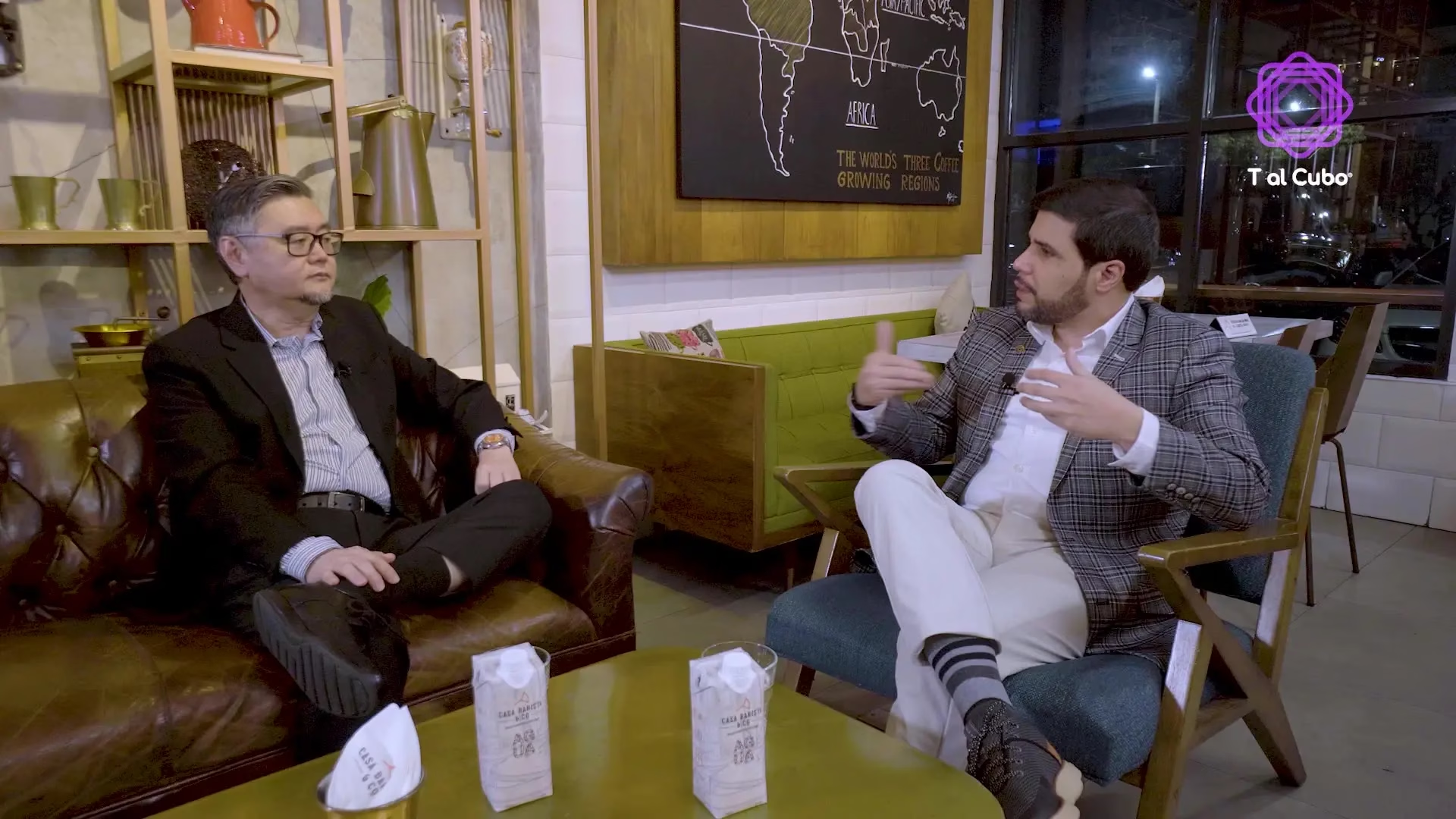
Mite and the silent AI revolution in the Dominican Republic. Second part of a conversation that goes beyond traditional formats
At a time when information is consumed in fragments of seconds and complex ideas are reduced to headlines, the programs «T al Cubo» and «Martes Tecnológico» have decided to bet on something revolutionary: depth.
The continuation of the interview with Mitsuteru “Mite” Nishio, which began last Sunday and continued this Tuesday, is more than a simple conversation about technology; it is a manifesto on how to approach the transformations that are redefining our society.
The talent paradox in the age of AI
Mite Nishio, a prominent digital transformation and innovation consultant in the country, raises a question that should concern educators, parents, and policymakers: «I wonder whether it is still worth having a kid spend 15 years in primary and secondary school, ten years in university to become productive, when you give him an artificial intelligence agent software and he can be productive right away.»
This is not an empty provocation. The Dominican expert observes how tools such as GitHub Copilot, ChatGPT, and Gemini are generating complete code, financial analyses, and medical diagnoses with an efficiency that challenges decades of traditional training. The question is not whether these tools work —they already do— but what this means for a generation that is investing years in acquiring skills that could become obsolete.
Adoption without shame
One of the most lucid contributions of this second conversation is the historical analogy Mite draws about technology adoption. «People aren't ashamed of not typing on a typewriter, aren't ashamed of using a calculator, aren't ashamed of using a smartphone with all its functions. But at some point they were ashamed to say they relied on that tool.»
This reflection goes beyond the anecdotal. In the Dominican Republic, as in many Latin American countries, there is institutional resistance to the use of AI tools that is not based on solid technical or ethical arguments, but on an educational conservatism that could be widening the digital divide precisely when we most need to close it.
The new business ecosystem
The conversation reveals a fascinating paradox: while large companies struggle with legacy systems that limit their capacity to innovate, Dominican SMEs may have an unexpected competitive advantage. Without the burden of obsolete technology infrastructure, these small companies can directly adopt the most advanced tools.
Mite envisions a future where «there could be unicorns, which are companies valued at more than 1.000 million dollars, that are run by a single person.» This is not science fiction; it is the logical projection of what we are already seeing with platforms like Cursor, which allow individual developers to build complete applications in days, not months.
WhatsApp as the Latin American SuperApp
Identifying WhatsApp as the dominant conversational platform in Latin America is no accident. Mite points out that «it has become something like the WeChat of China» and that «Meta already has artificial intelligence inside WhatsApp.» This convergence could be the tipping point for the mass digitalization of Dominican SMEs.
The brilliance of this observation lies in recognizing that innovation does not always come from where we expect it. While experts debate sophisticated platforms, the digital revolution may be happening in the app that 90% of the Dominican population already uses.
Humanism vs. Technology
Perhaps the most revealing moment of the interview comes when Mite questions the very foundations of the current education system. His proposal to focus on «soft skills such as emotional intelligence, mental balance, adapting to the world» instead of technical knowledge that AI can provide, echoes the recommendations the interviewer gave his own children about studying the humanities.
This convergence of perspectives suggests we are facing a paradigm shift that requires equally paradigmatic responses. The education of the future may need less memorization and more capacity for questioning, less technical specialization and more cognitive versatility.
Historical memory as a competitive advantage
One of Mite's most innovative proposals is the creation of an AI trained specifically on Dominican data: «bring together all the knowledge that has been generated in the Dominican Republic and make it available in a kind of artificial intelligence that you can shape to Dominican thinking.»
This vision goes beyond technology adoption; it speaks of digital sovereignty and of the importance of countries developing their own capabilities instead of being mere consumers of foreign solutions.
The act of resistance of depth
What makes this conversation special is not only its content but its format. In a media industry that privileges the immediate over the important, deciding to continue an interview on a second program, letting ideas breathe and develop, is in itself an act of resistance.
We resist the tendency to break complex ideas into thirty-second pills. This resistance is especially relevant when discussing technologies that are reconfiguring society.
The implications of AI cannot be understood in soundbites; they require the kind of deep exploration that is only possible when understanding is privileged over entertainment.
The future is now, but it requires wisdom
The second part of the conversation with Mite leaves more questions than answers, and that is precisely its value. Instead of offering simplistic solutions to complex problems, it raises the right questions: How should we educate a generation that will have access to AI from childhood? What does it mean to be productive in an economy where machines can perform most cognitive tasks? How can a small country like the Dominican Republic maintain its technological sovereignty in a world dominated by large corporations?
These are the questions that will define our future, and only through deep, sustained, unhurried conversations can we begin to find answers. In that, the programs «T al Cubo» and «Martes Tecnológico» are doing more than innovating in format; they are preserving the very possibility that we can think collectively about the most important challenges of our time.
The Artificial Intelligence revolution has already begun. Rather than asking ourselves whether we are prepared, we should now look at whether we have the wisdom to navigate it. And that wisdom is built only with the kind of depth these conversations represent.