How Dominican organizations sabotage their own future
The Dominican Republic's fall from 90 to 97 in the Global Innovation Index between 2020 and 2024, its worst drop in more than a decade, is more than a discouraging statistic. It is the quantifiable expression of a much deeper, systemic phenomenon: our organizations have developed, inadvertently but effectively, architectures…
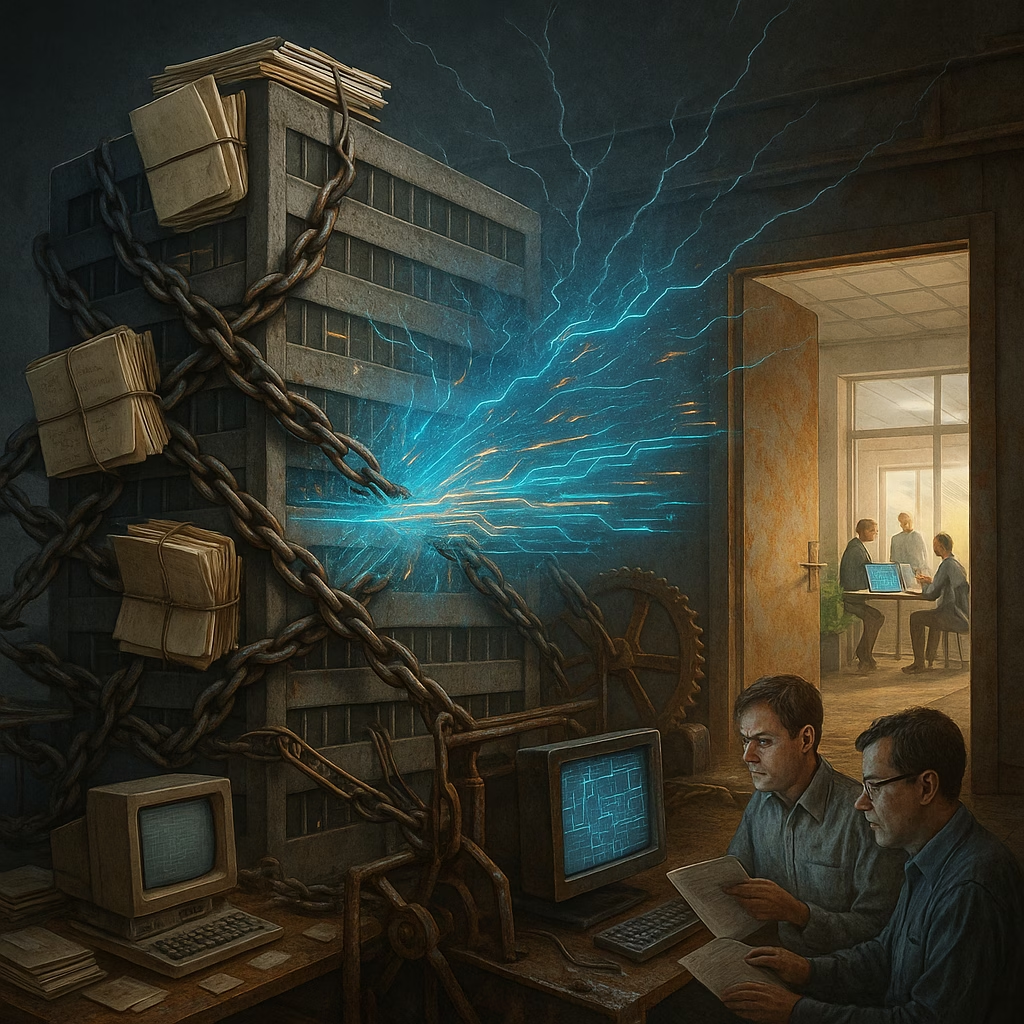
The Dominican Republic's drop from 90 to 97 in the Global Innovation Index between 2020 and 2024, its worst in more than a decade, is more than a discouraging statistic. It is the measurable expression of a much deeper, systemic phenomenon: our organizations have developed, inadvertently but effectively, cultural architectures designed to resist the very change they claim to want.
To reinforce the picture, the 2025 results of the same index show the country stalled on innovation. This is while the world keeps turning and moving toward geopolitical fragmentation and the acceleration of digitalization driven by business adoption of generative artificial intelligence and cognitive automation capabilities.
This contradiction is not unique to our national context, but it takes on particular characteristics when examined through three cases that reveal the specific mechanisms by which organizations halt their own evolution: institutionalized process obsolescence, the prison of established formats, and technology governance as an instrument of organizational fragmentation.
Dimension 1: The archaeology of technological obsolescence
The first mechanism of organizational resistance operates through what we might call «process inertia». It shows up when organizations keep operational, administrative or technological processes for periods of more than a decade without significant changes, creating a growing gap with emerging technologies that results in a loss of systemic competitiveness.
What matters about this phenomenon is not the age of the systems per se, but the incentive architecture that perpetuates their use. Consider the case of a Dominican manufacturing company that kept operating with inventory management systems developed in 1998. This obsolete technology persisted not because of ignorance about available alternatives, but because the entire organizational ecosystem—from training processes to performance evaluation systems—had been built around that technology platform.
The fundamental problem becomes clear when we recognize that three generations of employees had defined their professional competence through mastery of a system the market had already declared obsolete. In this context, technological migration is not simply a technical challenge, but an existential threat to the professional relevance of much of the workforce.
Intervention methodology: technological archaeology and intelligent coexistence
The effective approach to this challenge requires what we call «Technological Archaeology»—a systematic process of excavating the layers of decisions that led to the current situation. This analysis must answer fundamental questions: What problems did the technology originally solve? What organizational incentives have perpetuated its use? What professional skills have been built on mastering it?
The solution is not to abruptly eliminate the obsolete system—a strategy that invariably generates massive resistance—but to implement «Intelligent Coexistence»: technology architectures that allow old and new systems to operate side by side during carefully designed transition periods. This approach reduces the anxiety of change while allowing people to build competence on new platforms before leaving the old ones behind.
Crucially, this process must include redefining organizational metrics. Instead of measuring only operational efficiency, organizations must start measuring «speed of adaptation»—the capacity to incorporate new tools as they emerge in the market. This shift in metrics represents a paradigm change, from optimizing what exists to building the capacity for continuous evolution.
Dimension 2: The tyranny of established formats
The second mechanism of resistance operates through rigid adherence to established formats that limit creative innovation. This phenomenon is particularly visible in audiovisual content production, where creative frames of reference become institutionalized until they work as cognitive constraints that prevent the exploration of new narratives, formats and user experiences.
Lateral thinking—a concept developed by Edward de Bono—refers to the ability to generate ideas outside traditional logical patterns. In audiovisual contexts, this means questioning conventions about duration, narrative structure, interactivity and distribution. Yet the contemporary media industry operates under crystallized assumptions that are presented as «best practices» with no empirical evidence to back them up: «the audience has no time», «everything must be 15 minutes at most», «you need hooks every thirty seconds».
These are not observations based on real audience behavior, but conventions that have acquired the status of dogma, with their validity never questioned, in contexts where audiences show a hunger for substantial content and a capacity for deep engagement.
Controlled rupture methodology
Effective intervention requires what we call «Controlled Rupture Methodology»—the systematic identification of conventions that limit innovation and the creation of safe spaces for experimenting with alternatives.
Consider the case of a corporate events company that had produced the same format for fifteen years: thirty-minute PowerPoint presentations, networking over coffee, a Q&A session at the end. Clients attended, but satisfaction surveys revealed that they saw the events as «necessary but boring».
Applying lateral thinking requires questioning every element of the format: Why thirty minutes? Why PowerPoint? Why networking during the coffee break? Why questions only at the end? This systematic questioning shows that many conventions persist not because they are optimal, but because they are familiar.
The «Modular Experimentation» strategy makes it possible to change specific elements without affecting the overall structure, starting with micro-innovations: five-minute presentations followed by ten-minute discussions, real-time interactive tools, themed networking instead of general conversation.
The results are revealing: when these changes are implemented, satisfaction doesn't just improve—engagement triples. More important, audiences start demanding even more experimental formats. The problem was never the audience's capabilities, but organizations that design content based on obsolete assumptions about what people can or want to consume.
Dimension 3: The technological tower of Babel
The third and most complex mechanism of resistance arises when rigid technology governance structures create organizational silos that prevent acceleration in different business areas. The central problem is the absence of translation between technical language and business needs.
Technology teams speak in terms of architecture, security and scalability. Marketing, sales or human resources teams speak in terms of business goals, customer experience and measurable results. This linguistic disconnect creates a recurring pattern: innovative initiatives die not for lack of merit, but because different organizational areas are unable to co-create solutions.
The paradigmatic case: when innovation dies
Let's illustrate with a specific case: an internet company where marketing identified an opportunity to fully personalize customers' digital experience using artificial intelligence. They had the data, they understood the potential impact on conversion and retention, and they had calculated a projected ROI of 340% in eighteen months.
When the proposal reached technology, the response was a 47-page document explaining why implementation would take two years, require a complete restructuring of the data architecture, and pose «unacceptable» security risks. When marketing took this to the board of directors, the proposal died before it left the room.
The problem was not that technology was wrong—its concerns about security and scalability were valid. The problem was the absence of an organizational mechanism to translate between «business needs» and «technical possibilities» in a way that would allow innovative solutions to be found.
Systemic translation architecture
The solution does not lie in simply translating technical terms into business language, but in creating systematic processes where different organizational disciplines can co-create solutions instead of handing over requirements in one direction.
This architecture includes four main components:
Ontology Mapping: Work with each department to understand not only what they want to achieve, but how they define success, which metrics they use, under which constraints they operate, and what assumptions they hold about the rest of the organization. This makes it possible to identify differences not only in language, but in fundamental mental models.
Multilingual Co-design Sessions: Instead of each department presenting requirements separately, facilitate sessions where technology, marketing, finance and operations work together, using methodologies that force each group to express its needs in terms the others can understand and contribute to.
Organizational Prototyping: Before implementing complex technology solutions, create simplified versions that let stakeholders experiment with the proposed innovation, eliminating the resistance that arises from uncertainty about how it works in practice.
Cognitive Hybrid Facilitation: Develop the capacity to take part simultaneously in complex technical conversations and strategic business conversations, not only translating between them, but synthesizing new possibilities that no group had considered separately.
The result in the internet company's case was revealing: instead of the full AI system marketing proposed, a hybrid solution was co-designed, using simple algorithms to generate immediate insights while gradually building infrastructure for advanced capabilities. Marketing obtained measurable results in six weeks, technology kept control over the data architecture, and finance saw ROI from the first quarter.
Strategic synthesis: Culture as organizational destiny
The three cases analyzed reveal a common pattern: organizations with access to budget, technology and talent that fail to innovate because their cultures are fundamentally designed to resist change.
Peter Drucker left us a crucial observation: «Culture eats strategy for breakfast»—culture has strategy for breakfast. In the case of obsolete processes, it is not that organizations don't know better technologies exist—it is that their culture values stability over adaptation. In repetitive audiovisual formats, it is not that they don't understand that audiences have evolved—it is that their culture prioritizes predictability over experimentation. In restrictive technology governance, it is not that they don't recognize the value of innovation—it is that their culture favors control over collaboration.
These are not problems that get solved with better strategic planning or greater technology investment. They require systematic cultural transformation. And this is where most organizations fail: they try to change behaviors without transforming the underlying beliefs and values that generate those behaviors.
Implications for the Dominican national context
At the national level, this phenomenon shows up starkly. We have well-designed innovation strategies, progressive regulatory frameworks, and available resources. But we have an organizational culture—in both the public and private sectors—that favors centralization over distribution, exclusivity over inclusion, the tangible over the intangible.
The result is that our most brilliant strategies crash against cultural patterns we have not identified, let alone transformed. We keep falling in the global innovation ranking not because we don't know what to do, but because we cannot execute what we know works.
The fundamental question is not «what strategy do we need?» but «what culture do we need for our strategies to be executable?»
Strategic recommendations for cultural transformation
Building cultural immunization capabilities
Organizations must create systematic processes to develop antibodies against future obsolescence. This includes quarterly technology reviews, innovation committees with real budget authority, and reward systems that value experimentation as much as stability.
Institutionalizing coexistence architectures
We must recognize that effective transitions require periods in which old and new systems coexist, allowing human capabilities to evolve without generating the existential anxiety that paralyzes change.
Redefining organizational metrics
Expand performance evaluation beyond operational efficiency to include speed of adaptation, interdepartmental translation capacity, and the generation of cognitive hybrids that synthesize possibilities across different domains.
Creating Spaces for Protected Experimentation
Establish organizational zones where it is safe to question conventions, experiment with alternative formats, and explore solutions that challenge established assumptions, without risk of penalty for «failures» that generate learning.
Developing Technology Translation Skills
Invest in capabilities that allow simultaneous participation in multiple cognitive domains—not just translating between them, but synthesizing the possibilities that emerge from their intersection.
Toward a culture of continuous adaptation
Organizational innovation in the Dominican Republic does not fail because of technical limitations or a lack of resources. It fails because our organizational cultures remain anchored in paradigms that prioritize stability over evolution, control over collaboration, and predictability over experimentation.
Transformation requires recognizing that these are not bugs in our organizational systems—they are features, designed intentionally, if unconsciously, to resist precisely the kind of change we claim to want.
The challenge is not technical. It is cultural. And until we have that conversation with the seriousness and depth it deserves, we will keep implementing brilliant strategies that die on contact with organizational realities we have not transformed.
A nation's capacity for innovation is not measured by the quality of its documented strategies, but by our ability to carry out the cultural transformations that make those strategies executable. That is the conversation we, as a country, are still not having seriously.
And that conversation starts now.
Content taken from the program “T al Cubo”, episode “La innovación en Jaque”, published last Sunday, 28 September 2025.
Arturo López Valerio is a digital transformation consultant and founder of Tabuga, a firm specialized in the digitalization of businesses in the Caribbean and Central America. He published a book on Digital Economy, available on Amazon, and produces the show T al Cubo where he addresses the effects of technological transversality in the Dominican Republic.