Launch of LatamGPT
Just a few months ago, in October 2024, during ENEXPRO TECH in Santiago, I had the privilege of sitting down with Rodrigo Durán, manager at CENIA, to talk about how to apply artificial intelligence strategically in emerging markets like ours. I remember Durán told me something that stuck with me: "The key to…
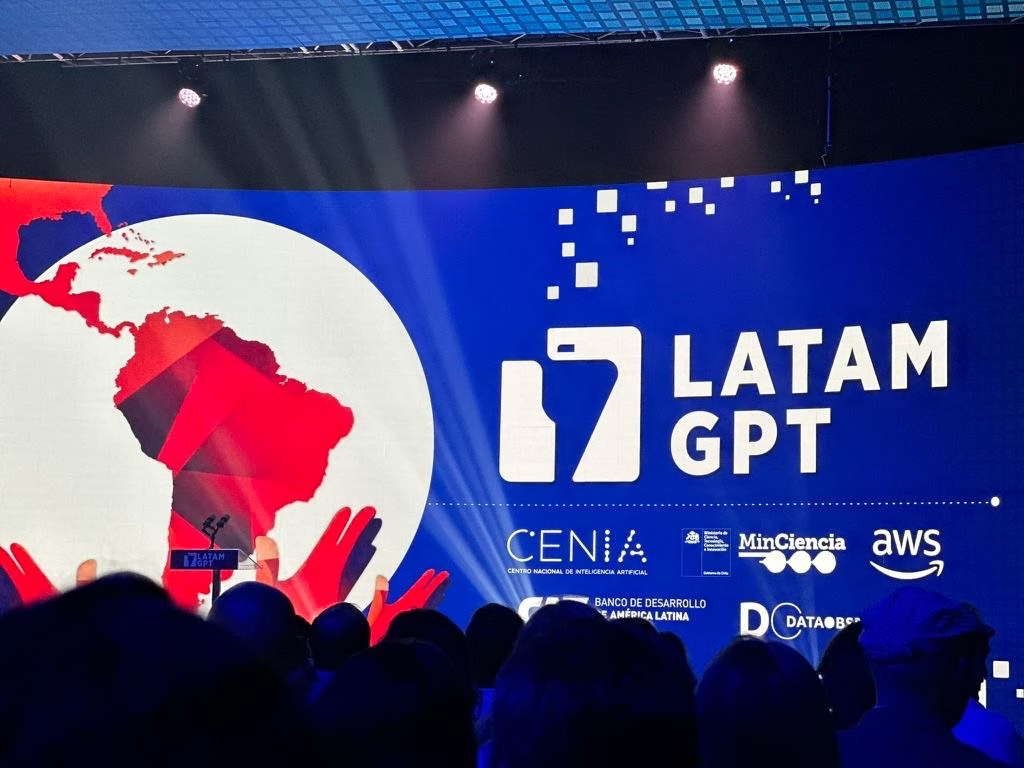
Just a few months ago, in October 2024, at ENEXPRO TECH in Santiago, I had the privilege of sitting down with Rodrigo Durán, manager of CENIA, to talk about how to apply artificial intelligence strategically in emerging markets like ours. I remember Durán told me something that stuck with me: «The key to success in implementing AI is to focus on solutions that address specific challenges in our region.» That sentence, which was then a statement of principle, is now taking shape in LatamGPT.
I want to sincerely thank CENIA, Álvaro Soto and the entire technical and executive team for the invitation to this launch, but above all for believing that a small Caribbean company could sit at that table. Because President Boric said it with perfect clarity during the event: «If we are not at the table, we are on the menu.» And for far too long, the Dominican Republic has been on the menu.
What happened with LatamGPT validates something we have been pointing out insistently in these columns: collaboration is not an option but an imperative need for our digital future. When I wrote about the 25 years of Wi-Fi technology, I recalled that what began as a collaborative effort to create a wireless standard became a unifying force that today transcends borders and cultures.
LatamGPT is exactly that: fifteen countries, more than sixty-five institutions, more than one hundred professionals, collectively building what none of them could do alone. A Latin American path for artificial intelligence based on three principles that resonate deeply with our vision since Tabuga: sovereignty, collaboration and openness.
For the Dominican Republic, this launch has a meaning that goes beyond the symbolic. Through the alliance between CDN Canal 37, Tabuga and CENIA, our country became the first in the Caribbean to contribute private-sector data to a massive artificial intelligence model. More than 42,000 journalistic records from CDN's historical archive are now part of this model's «intelligence», ensuring that the Dominican variety of Spanish, our historical memory and our cultural nuances are not invisible in the algorithmic era.
This is what I call cognitive sovereignty: that when someone asks an AI about the Caribbean, the answer does not come filtered exclusively through the gaze of the global north.
But let's be honest with ourselves. The ILIA 2024 placed us as «adopters», with a score of 47.43 in enabling factors, almost 30 points below Chile. We have fallen in the innovation indices while others advance. As I noted in the analysis of the ILIA, the absence of a coordinated approach and a decentralized multisector vision to foster innovation condemns us to be mere consumers, not creators, in the AI revolution. The scant output of scientific publications, the almost nonexistent creation of technology patents, and the low participation of the private sector in applied research are symptoms of a structural problem that is not solved with decrees or announcements.
What LatamGPT shows is that an alternative route exists. We do not need to build everything alone. The model was trained on more than 8 terabytes of curated data on AWS infrastructure, coordinated from Chile but fed by the entire region. That is Open Innovation in its purest form: accessing supercomputing capacity through collaboration networks, not through isolated checks. When Marcelo Facchina of CAF spoke about the need to accelerate investment in strategic digital infrastructure, he was describing exactly the gap we have documented: the Dominican Republic has no high-performance data centers or advanced computing capacity to train its own models. But it does have data, talent and the will to integrate.
This event also puts on the table something I have worked on extensively under the concept of digital co-responsibility. LatamGPT is an open, auditable public good. The Copuchat platform allows citizens to contribute to and validate the model. This sets a standard of Algor-ethics that contrasts painfully with our local regulatory situation, where we still lack specific legislation to combat deepfakes and where the protection of biometric data remains precarious.
The «IA para Todos» program that accompanies this participation is no minor add-on. It is the difference between transferring data and building real capabilities. As I have insisted since we visited CENIA: the key is to adapt the best practices we observed to our local context, explore possibilities for regional collaboration on AI projects in the Caribbean, and foster a more robust innovation ecosystem inspired by models that work.
The Dominican Republic has already taken the first step from the private sector. The challenge now is to scale. Let Dominican universities join the network of more than thirty institutions that collaborate with CENIA. Let more national archives, libraries and media outlets contribute structured data. Let us set aside the symbolic industrialization of hollow announcements and commit to building measurable capabilities: patents generated, STEM talent retained, technological dependence reduced.
During his presentation, Álvaro Soto showed a map in which Latin America appeared blank while AI development was concentrated in blue dots in the global north and Asia. That map is our current picture. But LatamGPT is evidence that the blank can be painted blue when the region acts together. From Tabuga, we will keep connecting markets, sharing knowledge and applying technological solutions that generate impact. Because the future of AI in our region will not be led by isolated actors, but by collaboration networks that understand that knowledge, like Wi-Fi, only reaches its true potential when it is shared.
Thank you, CENIA, for the invitation to witness this milestone. Thank you, Chile, for investing in Latin America. The Dominican Republic is no longer invisible.