The Past That Trains the Machines
At the beginning of 2024, an artificial intelligence company began buying printed books by the millions. The paper ended up discarded after going through the guillotine and the scanner, and many of those copies were secondhand, according to the ruling in Bartz v. Anthropic, from June 2025. The unsealed case file, more than 4,000 pages that the Washington Post made public in January 2026, names the operation Project Panama and sets it a goal: to destructively scan every book in the world.
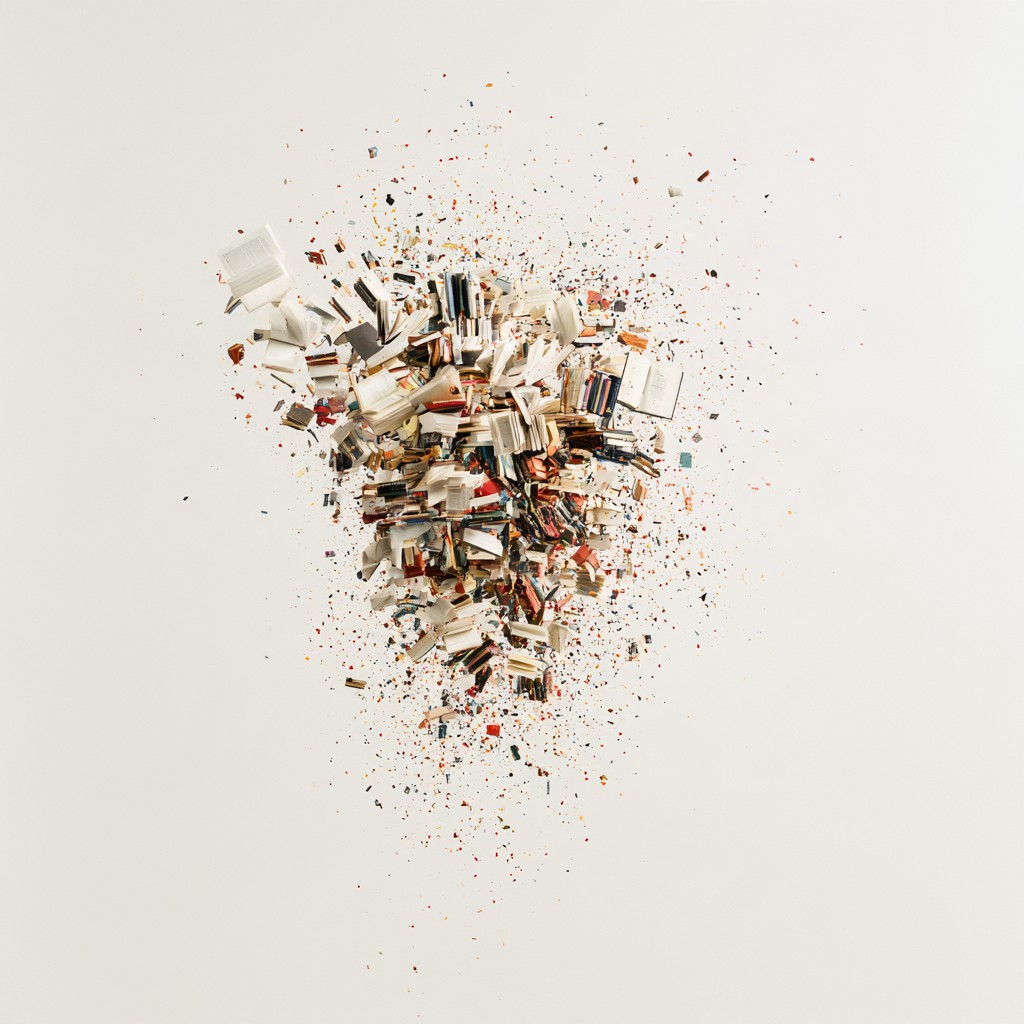
At the beginning of 2024, an artificial intelligence company began buying printed books by the millions. The paper ended up discarded after going through the guillotine and the scanner, and many of those copies were secondhand, according to the ruling in Bartz v. Anthropic, from June 2025. The unsealed case file, more than 4,000 pages that the Washington Post made public in January 2026, names the operation Project Panama and sets it a goal: to destructively scan every book in the world.
In the scanning process the paper publication disappeared and a single copy remained, the digital one. On that reasoning, Judge William Alsup declared the scanning fair use. The litigation closed with a $1.5 billion settlement over the pirated books the company had downloaded earlier, and the company's argument rests on the fact that the ruling still stands. Readers, libraries and authors have no access to that corpus, and out-of-print titles with few copies are at the greatest risk, according to booksellers and collectors.
Cervantes spoke in Don Quixote of «truth, whose mother is history». Three centuries later, Borges imagined Pierre Menard, who rewrites the sentence word for word and changes its meaning simply by changing the era. Read in the twentieth century, history works as the origin of reality, and historical truth amounts to what we judge happened. The machine that digests a library and returns answers is the Menard of this century.
That judgment is already part of the digital footprint of the twenty-first century. According to the Reuters Institute, half of those surveyed use generative artificial intelligence every week: one in ten people gets the news from a chatbot, while among young people aged 18 to 24 the share reaches 17%.
The archive these models learn from has a language, according to W3Techs, an organization that measures 49.5% of websites as English-language and 6.0% as Spanish-language. Chile's Cenia, the institution I represent in the Caribbean for Latam-GPT, estimates that the region contributes between 2% and 3% of the training data.
Three researchers from the University of Bucharest (Cocu, Cristia and Dumitran) posed the same controversial questions in 2025 to 13 models in Romanian, English, Hungarian and Russian. The answers varied by language, and the authors concluded that these systems operate as malleable narrative engines. In the case of Asia Minor in 1922, even the terms and the parties held responsible change with the language of the query, according to another study published in 2026 in the journal AI and Ethics.
Evidence of what happened is lost through old routes and new ones. In associations, chambers, companies and even governments, power that fears its own record starts by misplacing the minutes or the evidence. In 2025 I called that conduct «strategic forgetting», the kind that favors whoever can pay for silence. The courts are one such route: the appeal defeat on September 4, 2024 cost the Internet Archive more than 500,000 books from its digital lending. In the Panama case the route is industrial, because the machine digests the book and discards the paper. In the end the library that lent the books lost and the company that kept its copies in private won, even though in law the cases are not the same.
The custodians of the Internet Archive are already organizing, according to Wired, with more than 80 of its 124 eligible employees in the United States voting for a union, among them librarians, engineers and microfiche technicians who know where everything is and why it was kept. In 2018 I raised this in Forbes when describing Corporate Amnesia®, where I warned that «variable work, the kind that requires context, will be the work each organization must store and protect».
In 2009 I wrote that «our people are a people without memory» and that social networks made us live in a «continuous present». Seventeen years later, that continuous present has consequences on another scale. A country that documents little lets others document it, and what others judge happened to us will be «the truth» that a Dominican student reads when asking about Santana, Báez or Trujillo. In May 2025, when a foreign domain provider threatened to suspend a local newspaper, I warned that «when the custodian of a digital archive answers to another constitution, national history becomes subject to commercial clauses». I also wrote then that «forgetting may be an individual right, but remembering must be a collective right protected by the State».
Latam-GPT and its roughly 300 billion tokens of Latin American text have the reach that can encompass Dominican memory if someone wants to democratize it. I understand that institutions such as the Archivo General de la Nación, the Biblioteca Nacional, the universities and the newspapers with century-old archives must agree at some point on when they will integrate their archives into the region's open corpora. The history we hand to machines today will be the reality they return tomorrow, and that is, as Cervantes intended, the warning of what is to come.
Originally published in El Nuevo Diario on November 23, 2026.